Picquart’s four principles of investigation
An Officer and a SpyPicquart’s four principles of investigation are Georges Picquart’s rules for handling evidence under pressure: take matters one step at a time, approach them dispassionately, avoid a rush to judgment, and confide in nobody until there is hard evidence. They are both a practical safeguard against error and a measure of the distance between Picquart’s cautious inquiry and the French Army’s increasingly defensive treatment of the Dreyfus case.
Formulation and Purpose
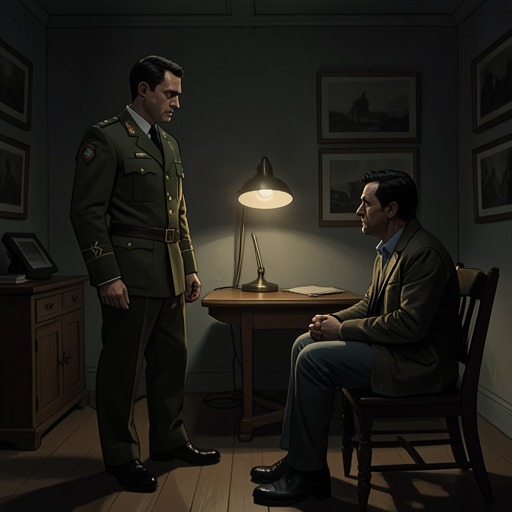
Picquart states the principles to himself after confirming that Major Charles Ferdinand Walsin Esterhazy is selling French military secrets. That conclusion, he thinks, is straightforward; the question of Alfred Dreyfus is altogether more difficult. Rather than allow the evidence against Esterhazy to settle the separate question of Dreyfus’s guilt, Picquart orders himself to proceed carefully and to keep the two problems distinct. His longing to discuss the matter with Louis Leblois makes the last rule especially concrete: even a trusted confidant must wait until the evidence is firm.
The principles combine pace, temperament, judgment, and information control. Step-by-step inquiry resists the temptation to leap from one discovery to a complete explanation. Dispassion is meant to keep the investigator from becoming attached to a preferred answer; caution about judgment preserves uncertainty where the evidence has not resolved it. The restriction on confiding in others is not simply secrecy for its own sake: Picquart treats it as a way to prevent an unverified suspicion from outrunning its proof.
Use in the Esterhazy Inquiry
When Picquart receives photographs of two letters by Esterhazy, he is struck not only by the handwriting but by their contents: the artillery references, the offer to have a manual copied, and the obsequious tone all seem to him characteristic of Esterhazy. He considers taking the evidence straight to the minister, but again decides that this would be folly. Instead, he takes the photographs to Captain Lauth and asks him to compare them with the bordereau.
The examination turns that restraint into a concrete procedure. Lauth studies the documents against a photograph of the bordereau, laying transparent squared sheets over the three samples and making notes under a lamp and magnifying glass. The method does not produce an instant pronouncement: Picquart watches, waits, and asks whether the handwriting is the same only after Lauth has examined the material. Here, the principles mean neither passivity nor disbelief. They require a claim to be tested before it is carried up the chain of command.
Evidence and Judgment at the Trial
The rules also give context to the competing claims of expertise at Alfred Dreyfus’s trial. Alphonse Bertillon arrives with charts and handwriting samples and presents a grid-based argument: repeated words in the bordereau, he says, begin in corresponding positions within five-millimetre squares. He assigns the pattern odds of one hundred million to one and concludes that the document could not have been written naturally. His presentation offers the judges a numerical appearance of certainty.
Picquart recognizes that the diagrams and statistic impress the soldier-judges, but he does not treat their reaction as proof that Bertillon’s reasoning is sound. He regards Bertillon as apparently unhinged and tells Armand du Paty de Clam that he is still unsure the evidence makes conviction more likely than not. The contrast is central to the principles: a confident expert conclusion, an arresting statistic, or an audience’s approval cannot substitute for a sound evidentiary basis. The book presents the rules as a discipline of judgment, not as a guarantee that every analysis will be correct.
Verification and the Cost of Certainty
The later discovery of the forgery in the Dreyfus file gives that discipline a broader significance. While Georges Picquart is imprisoned, he learns that Hubert-Joseph Henry was forced to admit that the supposed absolute-proof document was forged. By then the file contains three hundred and sixty items. A check ordered by the new Minister of War leads an aide to examine the document under a strong electric lamp; the heading and signature are on paper with bluish-grey lines, while the body is on paper with mauve lines. Those differences reveal that an earlier genuine letter had been taken apart and reassembled with a forged central passage.
This revelation echoes the principles’ insistence on testing what appears settled. The document had been treated as decisive, yet its physical construction had not received the scrutiny that could expose the fraud. Picquart’s rules do not themselves undo the wrongful case against Dreyfus, and the evidence does not make them a complete solution to institutional misconduct. Their force lies instead in the standard they set: conclusions must remain answerable to the material, and apparent certainty must not be allowed to replace examination.