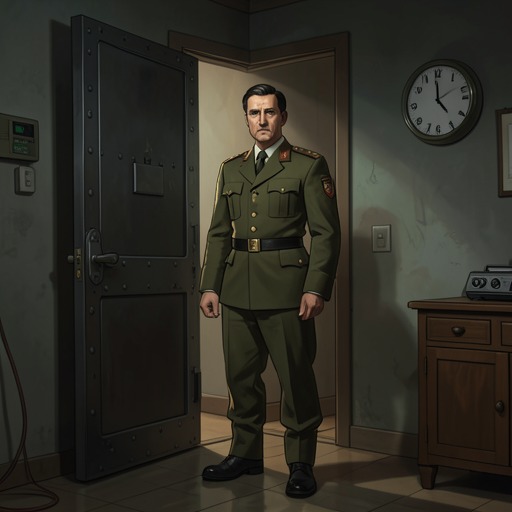
Professional paranoia
An Officer and a SpyProfessional paranoia describes the mistrust and self-reinforcing suspicion that intelligence work fosters in Georges Picquart. It appears not only in his doubts about colleagues but also in his adoption of covert procedures; crucially, he recognizes that the habits of espionage can distort judgment as well as serve it.
Suspicion within the office
For a time, Picquart and Hubert-Joseph Henry are at peace. Henry is friendly and agreeable to Picquart’s face, yet Picquart occasionally sees him conferring quietly with Captain Lauth and Junck. Their quick dispersal makes Picquart suspect they have been discussing him, though he cannot know that they have. He also hears Henry criticize someone for thinking himself cleverer than everyone else, but remains uncertain whether the remark is about him. Rather than treat suspicion as proof, Picquart dismisses the incident as a familiar feature of office life, especially where a chief is trying to impose discipline. The episode shows mistrust taking hold while leaving room for doubt.
That uneasy atmosphere reaches beyond the office. While gathering letters to pack into his briefcase, Picquart finds the surrounding talk oppressive and wants to leave. Before doing so, he asks about the Jews and raises General Boisdeffre’s concern that interest in the Dreyfus case might revive. The exchange connects Picquart’s professional unease to the continuing political sensitivity of the case, without establishing that every suspicion around him is justified.
Suspicion as investigative method
Henry’s criticism of Picquart’s pursuit of Esterhazy forces a more consequential reckoning. Picquart accepts that his imagination has enlarged Esterhazy into a traitor on the scale of Dreyfus, although the evidence, as Henry points out, indicates far less. He does not hand the operation over to Henry; instead, he decides to continue privately. He asks Felix Gribelin for the names, addresses, and brief service histories of the police agents recently used by the section. His response combines a real correction of judgment with an increasingly secretive way of proceeding.
Picquart then arranges to meet Desvernine away from the office, where Henry and Lauth might see him. The precautions are precise: the meeting is set for nine in the morning outside the Louvre, at the place du Carrousel; Picquart will wear civilian clothes, a frock coat, and a bowler hat, with a red carnation in his buttonhole and a copy of Le Figaro under his arm. The disguise makes the professional habit visible as performance: even a meeting must be staged to avoid observation by colleagues.
The cost of the professional habit
As he seals the message, Picquart notices how readily he is adopting the clichés of the spying world. He is alarmed by how little he trusts anyone and wonders whether he will come to resemble Jean Sandherr, whose suspicions focused on degenerates and foreigners. His reflection names professional paranoia as a deformation produced by the work itself. The danger is not merely that colleagues may conceal things from him; the habits required to investigate them may also make suspicion feel natural before the evidence warrants it.
The concept therefore holds two opposing possibilities together. Picquart’s secrecy helps him keep an investigation out of the view of people he distrusts, but his acknowledgment that he has overestimated Esterhazy exposes the risk of turning suspicion into a conclusion. His unease about the role does not resolve that tension: it shows that he can recognize the deforming pressure even as he continues to act within it.