Raoul le Mouton de Boisdeffre
An Officer and a SpyRaoul le Mouton de Boisdeffre is the Chief of the General Staff and one of the most senior officers in the Ministry of War (France). A specialist in Russian affairs and an architect of France’s growing alliance with the new tsar, he combines the appearance and authority of a traditional military elite with a distinctly political approach to the Dreyfus case. His role is consequential less through a single dramatic confrontation than through his influence over what the institution chooses to investigate, preserve, and contain.
Identity and Position
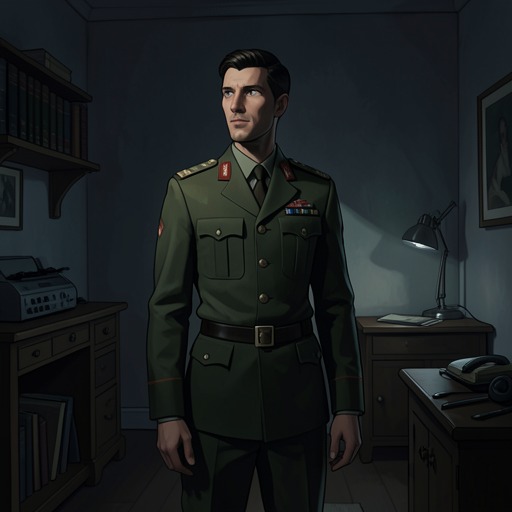
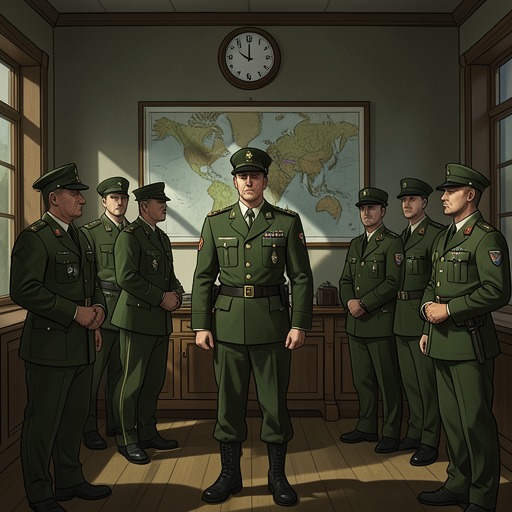
The novel introduces Boisdeffre in the Minister of War’s office, standing with the ministry’s senior officers beside an open fire. He is subordinate to the minister, General Auguste Mercier, and holds the office of Chief of the General Staff. The narrator describes him as an expert on Russian affairs who has spent so much time at the Imperial court that he has begun to resemble a stiff-whiskered Russian count. The portrait makes foreign policy part of his identity: he is not merely an administrator of military affairs but a principal architect of the alliance with the new tsar.
That strategic stature contrasts with the intimate mechanics of the case. Boisdeffre’s position places him high in the command structure, but his influence is exercised through briefings, instructions, and the management of information. The Dreyfus case reaches him as both a military question and a political danger, and he treats those dimensions as inseparable.
Political Calculation in the Dreyfus Case
In conversation with Picquart, Boisdeffre reasons that the continued imprisonment of Alfred Dreyfus will not quiet the Jewish community; he expects the case to remain an active grievance. From that prediction he draws an investigative instruction. Picquart is to examine the Dreyfus family for a possible motive for treason and to add material to the file, using the phrase “feed the file.” He asks for evidence that can be held in reserve, not simply for an impartial reassessment of the conviction.
The exchange reveals the bias in Boisdeffre’s political analysis. Rather than treating the absence of a demonstrated motive as a reason to question the case, he sees it as a vulnerability to be filled before it becomes politically damaging. His expectation that the family or wider community will act turns the prospect of renewed scrutiny into a reason to prepare additional allegations. The file thus becomes an instrument for managing a future controversy as much as a record of evidence.
Relationship with Picquart and Control of Information
Boisdeffre’s relationship with Picquart is that of a senior commander directing an intelligence officer whose findings may unsettle the army’s established position. When Picquart later presents Charles-Arthur Gonse with the petit bleu, surveillance photographs, and the secret file, he repeats the presentation he had already made to Boisdeffre. Picquart suspects that Boisdeffre warned Gonse beforehand. That is the narrator’s suspicion, not confirmation of a conversation between the two generals, but it places Boisdeffre within the chain through which the evidence is received and managed.
Picquart tells Gonse that the secret file contains nothing capable of establishing Alfred Dreyfus’s guilt beyond doubt. Gonse responds by instructing him to investigate Charles Ferdinand Walsin Esterhazy while keeping the bordereau out of that inquiry. The sequence makes the distinction between investigation and institutional permission visible: Picquart may pursue a new suspect, but the connection that could reopen the original case is treated as something to exclude. Boisdeffre is not present for Gonse’s instruction, so the decision should not be attributed directly to him; his earlier role, however, has already helped define the file as a place to accumulate politically useful material.
When the secret file is mentioned in the press for the first time, Picquart counts Boisdeffre among the people who know of it. The list grows to include officials, judges, and others as the information spreads. Picquart’s reflection that modern communications make secrets difficult to keep gives the episode a wider significance: command authority can control access for a time, but it cannot guarantee that a concealed dossier will remain contained. The evidence does not establish that Boisdeffre leaked the file.
The Command Structure and the Novel’s Portrait
Later, Gonse describes the chain of command to Picquart: the Minister of War gives orders to the Chief of Staff, the Chief of Staff to Gonse, and Gonse to Picquart. Boisdeffre occupies the central command position in that account, even when Gonse is the officer who confronts Picquart directly. The structure clarifies how an order to stop investigating can be transmitted downward while responsibility appears to rest with the immediate superior issuing it. When Gonse formally forbids Picquart from pursuing anything connected with the Dreyfus case, Boisdeffre is part of the hierarchy that gives the command its institutional force, though the scene does not show him issuing that particular order.
The novel presents Boisdeffre through the conjunction of strategic expertise and political caution: the Russian alliance marks his broad responsibilities, while his request to prepare a motive file shows how those responsibilities reach into the handling of evidence. This remains a portrait within historical fiction, not a claim that every private exchange occurred as narrated. The author’s note says that the book retells the true Dreyfus affair using the techniques of a novel, that almost all events happened in some form, and that the narrative also simplifies, dramatizes, and invents personal details. That distinction matters especially for the conversations through which Boisdeffre’s reasoning and influence are rendered.