Rennes trial of Alfred Dreyfus
An Officer and a SpyThe Rennes trial of Alfred Dreyfus was the second military court-martial in the case, bringing a long-buried prosecution back before judges, the press, and a worldwide audience. It put the army’s contested evidence under renewed scrutiny and brought Georges Picquart, whose investigation had identified the real author of the bordereau, into the courtroom as a witness. The proceedings made the conflict between public examination and military secrecy visible, but the trial’s verdict would itself later be overturned: Dreyfus was fully exonerated in 1906.
Causes and renewed scrutiny
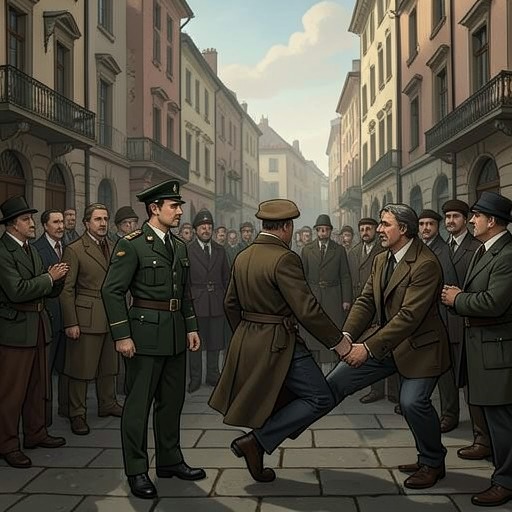
The trial followed years in which Dreyfus had been imprisoned on Devil’s Island while the evidence against him, and the army’s handling of it, became the focus of an increasingly public dispute. The scale of attention at Rennes showed that the case had outgrown the military institution that had first judged it. Three hundred journalists arrived from around the world. Authorities prepared special telegraph operators for an anticipated two-thirds of a million words of dispatches each day and equipped the Bourse de Commerce with 150 desks for reporters. Cinematographers set up outside the military prison, hoping to film the prisoner crossing its yard. Queen Victoria sent the Lord Chief Justice of England to observe the opening.
Before the trial, only four outsiders had been allowed to see Dreyfus since his return to France: Lucie Dreyfus, his brother Mathieu Dreyfus, and his lawyers Edgar Demange and Fernand Labori. The public appetite for news therefore gathered around both the case and the condition of a man kept from view. Picquart, who had not spoken with Dreyfus or his family, knew only what he had read in the press about Lucie’s visit to his cell.
The courtroom and the opening session
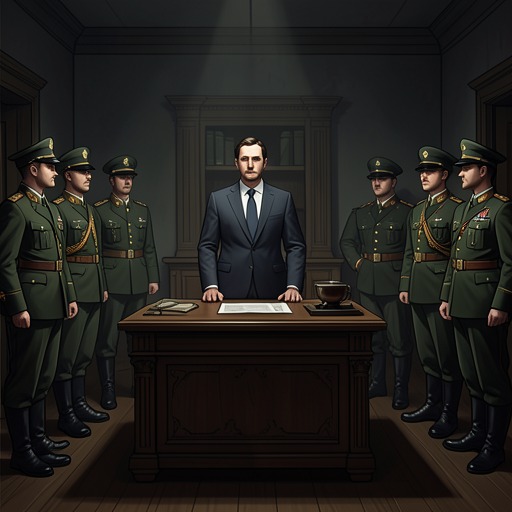
The court was assembled in a lycée classroom about twenty metres long and fifteen wide, with two tiers of windows admitting bright Breton daylight. Several hundred people filled the room. At one end, seven crimson-backed chairs stood on a raised platform beneath a plaster Christ on a black cross; prosecution and defence sat opposite each other, while crowded press benches ran along both sides. Infantry separated the public from the witnesses. The military witnesses, including Raoul le Mouton de Boisdeffre, Charles-Arthur Gonse, Jean-Baptiste Billot, Georges de Pellieux, Captain Lauth, and Gribelin, avoided one another’s gaze.
Picquart reached the courthouse with Edmond, passing mounted gendarmes, checked papers, infantry with fixed bayonets, and several doorways before entering. When Dreyfus appeared, the courtroom gasped. He looked old and diminished: his baggy tunic hung on a shrunken frame, his trousers flapped around his ankles, and he moved stiffly up the steps to his lawyers. The scene contrasted sharply with the international machinery waiting outside to report on him. Dreyfus stood before the judges and said he wanted to defend his honour and that of his children; he would not describe the tortures he had endured on Devil’s Island.
The opening sitting ended at eleven. Colonel Jouaust announced that the next four days would be held behind closed doors so the judges could be shown the secret files. The public and press were excluded, as was Picquart, and he was told he might wait at least a week before being called. Dreyfus was escorted away without looking toward him. Outside, journalists hurried to the telegraph operators, eager to send their accounts of the prisoner from Devil’s Island. The trial’s publicity and its central secrecy thus occupied the same day: the world could follow the spectacle, but not the evidence being placed before the judges.
Evidence, secrecy, and the army’s defence
When Picquart was finally called, his testimony occupied the whole of one day and most of the next. He presented the petit bleu, Esterhazy, the bordereau, and the surrounding letters, telegrams, personalities, forgeries, and falsehoods as a connected body of evidence. The officers questioning him challenged particular points; Picquart answered from detailed knowledge of the case. To him, the work resembled a lecture in a field he had spent years studying. At the end, Dreyfus appeared to give him a brief nod and half-smile.
The military case was represented most forcefully by Auguste Mercier, who spoke for three hours and produced documents from a black leather case. He again treated the lowlife D letter as evidence against Dreyfus and introduced fabricated Guénée reports about a spy in the intelligence department. Mercier alleged that thirty-five million francs had been raised in England and Germany to free Dreyfus, revived a supposed confession before the degradation, and claimed the affair had brought France within two finger-breadths of war with Germany. He also repeated an antisemitic claim about what Dreyfus had supposedly said of Alsace-Lorraine, although Dreyfus had always denied saying it. Jean Casimir-Perier rose to challenge Mercier’s account of a mobilisation crisis, but Jouaust would not let him intervene.
Mercier’s reliance on the secret dossier in open court created a point of vulnerability for the prosecution: material that had been withheld from the defence could now be tested in public. That issue echoed the earlier military trial, when Picquart had urged Auguste Mercier to show the dossier to the court. Later, when Picquart challenged the inquiry into his conduct, he asked whether he would be questioned about Esterhazy’s matching handwriting and the falsified material used to convict Dreyfus. He was told those matters lay outside its scope. At Rennes, the same underlying evidence returned, but this time Picquart had the opportunity to set out its connections before the judges.
Verdict, reversal, and significance
The Rennes proceeding did not bring the case to a clean or immediate close. The narrative of the affair stresses that the eventual victory came not in a public blaze of vindication, but after further years of review: Jean Jaurès presented the case in the Chamber of Deputies, General André agreed to reopen the evidence, and the Criminal Chamber referred the matter for review by the Supreme Court of Appeal. Political turmoil delayed the process, but on 12 July 1906 the Court of Cassation quashed the Rennes verdict and fully exonerated Dreyfus.
The following day, the Chamber of Deputies voted 432 to 32 to restore Dreyfus to the army as a major and award him the cross of the Legion of Honour. A separate motion restored Picquart at the rank he might have attained had he not been dishonourably discharged in 1898; it passed 449 to 26. Picquart later found himself back on the parade ground of the École Militaire in the uniform of a brigadier general for Dreyfus’s medal ceremony. The contrast with Dreyfus’s earlier degradation was stark: a public ritual once used to display the army’s conviction was followed by a ceremony of recognition after the courts had overturned that conviction. The Rennes trial matters both for the evidence it brought back into view and for the limits of its own verdict, which subsequent legal review finally displaced.