Secret evidence
An Officer and a SpySecret evidence is the information secretly submitted to the judges who convicted Alfred Dreyfus, without being shown to Dreyfus or his lawyer. In Georges Picquart’s account, it is at once a concealed instrument of the trial, a subject of official surveillance, and a political liability: military leaders treat its use as routine, while Picquart comes to recognize that a conviction resting on evidence unavailable to the defense could be widely judged unfair.
The secrecy and its justification
At dinner with fellow exiles from Alsace, Louis Leblois objects to secret trials in principle. He wonders whether a Christian officer would have been denied the normal judicial process and notes that Le Figaro has described the evidence against Dreyfus as thin. Picquart answers with institutional certainty: because the case concerns national security, its evidence could not have been aired in open court, regardless of the defendant. He also assures the table that there was plenty of evidence. Pauline’s frown and the sudden silence expose the strain beneath that confidence; Leblois says no more, and Pauline redirects the conversation.
The scene makes the justification for secrecy inseparable from the prejudice surrounding the accused. Before the trial, Picquart recalls Alfred Dreyfus as his student at the École Supérieure de Guerre: a solemn, myopic officer whose wealth, family circumstances, and Jewish identity shaped Picquart’s dislike of him. When Dreyfus challenges his low mark and asks whether his Jewishness explains it, Picquart denies allowing personal prejudice to affect his judgment. The recollection complicates his later assurances: the question is not only what information the judges saw, but how assumptions about Dreyfus’s character and loyalty affected the way evidence was received.
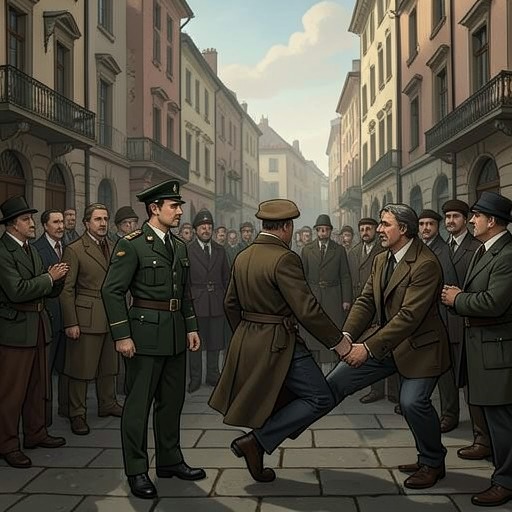
At the public degradation ceremony, an official watching through binoculars argues that an innocent man would resist humiliation, then speculates that Dreyfus’s submission reflects a Jewish trait. Jean Sandherr answers with an openly antisemitic indictment of Jews as lacking patriotism and honor. These remarks do not establish evidence of espionage; instead, they reveal how prejudice could supply a ready-made interpretation of conduct. Dreyfus’s composure becomes, to these observers, confirmation of guilt rather than a fact open to more than one reading.
What the judges were told
The hidden procedure becomes concrete when an informant’s report reaches Picquart. It records a conversation between President Fauré’s doctor and Mathieu Dreyfus at the hôtel de l’Athénée. According to the report, the doctor said that secret evidence given to the judges, rather than evidence presented in court, had secured the conviction, and repeated the point emphatically. Picquart asks Major Henry whether the judges were shown evidence kept from the public proceedings. Henry shrugs off the disclosure as something people were bound to talk about and calls it merely a legal procedure.
Picquart’s response marks a change in emphasis, not a change in his stated belief in Alfred Dreyfus’s guilt. He tells Henry that if it became widely known that Dreyfus had been convicted on the basis of evidence neither he nor his lawyer had seen, some people would argue that he had not received a fair trial. The distinction matters: in private, Picquart continues to defend the conviction’s substance, yet he recognizes that the procedure itself could undermine public confidence in it. The secret material therefore carries consequences beyond whatever it contained. Its concealment prevents the accused from answering it and gives opponents of the verdict a powerful argument about fairness.
A separate courtroom episode shows the force of an accusation when the speaker’s authority stands in for material that cannot be tested. During Dreyfus’s trial, Major Henry identifies him as the traitor, claiming that an unnamed honorable informant had reported a traitor on the General Staff and later specified the Second Department. Dreyfus rises angrily to demand the informant’s name, but the presiding officer orders him to sit. The scene does not identify this allegation as the secret dossier itself; it shows, rather, how an untested source and an officer’s assertion could shape proceedings while the accused had little opportunity to challenge them.
A secret becomes public
The dossier’s circulation extends well beyond the courtroom. When Picquart takes possession of it, he counts ten officials who know of it, including Auguste Mercier, Raoul le Mouton de Boisdeffre, Charles-Arthur Gonse, Jean Sandherr, Armand du Paty de Clam, Major Henry, Captain Lauth, Gribelin, Guénée, and Jean-Baptiste Billot. He adds the seven judges, President Fauré, the doctor, and Mathieu Dreyfus: twenty people, before accounting for anyone Mathieu may have told. The count gives secrecy a measurable limit. A file treated as confined to an inner circle has already passed from the military establishment to the president’s household and the accused man’s family.
Picquart’s reflection turns that tally into a warning about modern communications. Photography, telegraphy, railways, and newspaper presses make it impossible, in his view, to preserve a secret indefinitely. The point becomes immediate when an anonymous article in L’Éclair claims that a secret file proved Dreyfus’s guilt and urges the army to publish its contents. Picquart identifies this as the first press mention of the file. Because it appears just as he has taken possession of the dossier, he worries that someone has disclosed its existence. The leak, which might seem to support his position that secrecy cannot last, instead threatens to provoke Charles-Arthur Gonse and Raoul le Mouton de Boisdeffre into restricting the investigation.
Surveillance and censorship help explain how the secret was managed. Picquart learns that Mathieu’s household is watched through servants and a concierge, that Mathieu is followed, and that the family’s mail is diverted and copied. Major Henry also hands Picquart a file of Alfred Dreyfus’s correspondence, tied with black ribbon and bearing the official seal of the French Colonial Ministry. It contains both originals withheld by the censor and copies of letters cleared for delivery. This correspondence is not identified as the secret evidence shown to the judges; its presence in the same machinery of monitoring demonstrates how the case’s information was gathered and controlled, including the private communications of the imprisoned man and his family.
Claims of proof and the trial of disclosure
The secret dossier returns to public view at the trial of Émile Zola. Georges de Pellieux announces that in November 1896 the Ministry of War received what he calls absolute proof of Dreyfus’s guilt: a document supposedly originating from an unchallengeable source and referring to relations with a Jewish man. Picquart recognizes the allusion as the letter that appeared shortly before his removal from Paris, a document Jean-Baptiste Billot had read aloud but refused to show him. Picquart signals to Fernand Labori that Pellieux has made a blunder and should be pressed while the moment lasts. Charles-Arthur Gonse, recognizing the danger, hurries forward to seek the floor.
The episode exposes a tension at the heart of secret evidence. Officials present inaccessible material as conclusive precisely when its provenance and contents cannot be examined openly; yet each attempt to use it in public risks drawing attention to how little the defense, the court, or even Picquart himself was allowed to verify. Pellieux’s declaration does not settle the matter. It makes the contested claim of proof more visible, while Picquart’s recognition of the document reconnects the public performance to the concealed record he encountered earlier.
Significance
Secret evidence in the account is not simply a hidden bundle of papers. It names a procedure that separates what the judges are said to know from what the accused and his counsel are permitted to contest. Its defenders invoke national security, and Picquart initially insists that the underlying case remains strong. But the report of the president’s disclosure, the press leak, the surveillance surrounding the Dreyfus family, and Pellieux’s courtroom intervention show secrecy repeatedly crossing the boundary between private custody and public dispute.
That movement changes the meaning of the dossier. Concealment may protect information from public scrutiny, but it also deprives the defense of a chance to answer it and leaves the institution vulnerable when the secrecy breaks. The affair’s central irony is that officials treat the hidden material as decisive while treating disclosure of its existence as a danger to be contained. As Picquart’s changing concern makes clear, the question of fairness cannot be kept outside the case merely by keeping the evidence out of court.