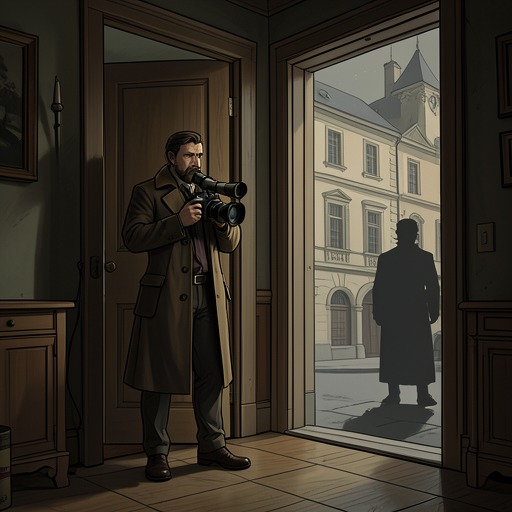
Speaking-tubes
An Officer and a SpySpeaking-tubes are concealed listening devices that Georges Picquart proposes installing through adjoining chimney flues to overhear conversations in the German officers’ apartment. The plan depends on a tentative architectural inference, requires painstaking work and an ingenious disguise, and ultimately offers only a partial kind of access: listeners can make out the sense of a conversation when a speaker is near a fireplace.
Design and Intended Use
The idea begins with the building rather than with a device already in hand. While considering how to hear what the Germans are saying, Picquart examines the plasterwork above his own chimney-piece and reasons that, if the apartments share the same layout, the flue from their fireplace should run alongside his. Desvernine confirms that this arrangement is plausible. Picquart’s proposal is to remove a few bricks and lower a speaking-tube through the flue. The tubes would exploit the proximity of the fireplaces to create a concealed listening route between the apartments.
The first proposal is for a single tube, but the plan expands to two. One is intended for the principal living area; the second is to be placed in the bedroom, where Schwartzkoppen and Panizzardi are considered more likely to discuss intimate matters. Their placement reflects a practical judgment about where conversations might occur, not an assurance that every conversation could be heard. The device is conceived as an instrument for gathering intelligence from ordinary speech at close range.
Installation and Risks
Putting the plan into practice demands far more than lowering a tube. Desvernine must smuggle in the equipment: the tubes themselves, a saw, cutters, a hammer and chisel, and sacks for rubble. Access to the flues is possible only when the ground-floor apartment is empty, usually at night. The work has to proceed at an agonizing pace because a single loud blow might alert the couple living upstairs, who have already begun asking Ducasse suspicious questions about the noises and his activities. A brick can take an entire night to loosen. There is also the danger that breaking into a flue will send soot down into the Germans’ fireplaces.
The project strains the people carrying it out as well as the building. The work is filthy, nerves become strained, and Desvernine reports that Ducasse has begun drinking heavily. These details make the tubes more than a clever technical notion: they are the result of a laborious operation in which noise, dust, timing, and the suspicions of nearby residents all threaten the concealment on which the device depends.
The question of entry into the German premises presents a separate risk. Desvernine initially suggests breaking in and shows Picquart a leather tool roll containing steel lock-picking instruments made for the Sûreté by a master locksmith. Its picks and rakes are designed for several types of locks, but the prospect of an agent being caught burglarizing a property rented by the Germans makes Picquart uneasy. The eventual method avoids that direct intrusion. It uses the appearance of legitimate chimney maintenance to reach the flues instead.
The Chimney-Sweep Disguise
Picquart identifies a seasonal opportunity: by mid-May, fires are no longer needed and chimneys are being swept. He suggests disguising men as chimney sweeps and having them offer to clean the Germans’ flues. Desvernine finds a suitable helper through a friend of his wife’s brother: a chimney sweep who is a patriot and had served in the same dragoon regiment as Desvernine when the latter was a sergeant. The sweep’s father was killed in 1870, and he agrees to help the Republic without asking questions.
The entry succeeds in the middle of May, while the Germans are drinking before lunch. The sweep knocks on the ground-floor apartment door and is admitted without question. Under the appearance of routine work, he moves between the ground floor and first floor, lowers both tubes, and secures them in place while pretending to clean the flues. When he leaves his card, one of the Germans even gives him a tip. The ordinary exchange completes the disguise: the visitor is accepted not as an intruder but as a tradesman whose presence has a plausible explanation.
What the Tubes Can Hear
After the installation, Picquart asks how much the listeners can hear. Desvernine reports that they can hear plenty, particularly when a speaker is sitting or standing near a fireplace, but describes the result cautiously: the tubes provide the sense of a conversation. They do not promise clear access to every word or discussion. Their usefulness is therefore real but conditional, shaped by where the speakers stand and by the acoustic limits implied in Desvernine’s assessment.
The tubes also mark a change in the nature of the investigation. A fireplace, normally part of domestic life, becomes an opening through which one apartment can be monitored from another. The operation depends on making that conversion invisible: bricks must be loosened slowly, access disguised as sweeping, and the equipment carried in without attracting attention. The method’s success is consequently measured not by any claim of perfect hearing, but by the ability to obtain an intelligible impression while remaining undetected.