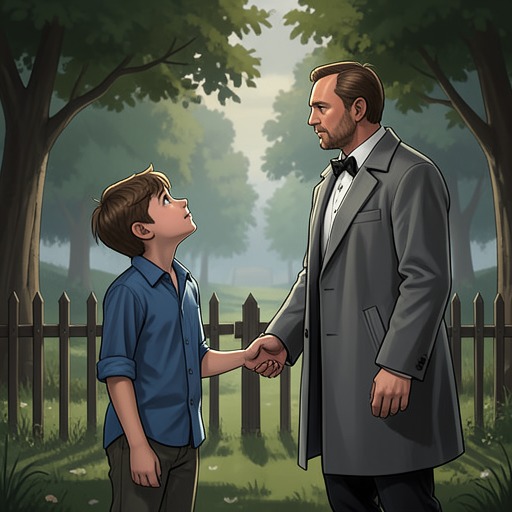
Anthony Casati Enlists in the Army
And Their Children After ThemAnthony Casati’s enlistment is both a practical decision and an act of escape. After considering the army at a career fair, he signs the papers in April and prepares to leave Heillange on July 15. The departure gives a date and destination to his desire to put distance between himself, his troubled adolescence, and his father, while exposing the uncertainty beneath the promise of a fresh start.
Recruitment and decision
In March, Anthony and his class visit a career fair in Metz, held in a freezing exposition hall. Schools and universities present a daunting range of options, including technical and engineering qualifications, but Anthony has little knowledge of what those possibilities might mean for him. The army offers a more immediate and vivid appeal. He takes a prospectus and speaks with a cheerful blonde recruiter in uniform, who gives him a CD and shows him images of a marine, a submariner, a helicopter pilot, and jungle-warfare training in Guyana.
Anthony signs the enlistment papers in April. He turns eighteen in May and passes the technological baccalauréat in June without needing to take the orals. These milestones might have opened further choices, but the narration stresses that he has no illusions about what comes next and that, by then, those choices no longer seem to matter. His enlistment is not presented as the result of a clearly defined military vocation. The prospectus and images make the army imaginable; the decision’s deeper force comes from what it allows him to leave behind.
Leaving home and adolescence
Anthony sees enlistment as a way to escape Heillange and put hundreds of miles between himself and his father, Patrick Casati. Their distance has a history. After his trial, Patrick moves into a small ground-floor studio in a converted barracks outside town. Anthony sometimes finds him asleep, fully dressed and unresponsive, and cleans the apartment, changes the sheets, or brings food cooked by his mother, Hélène Casati. These acts show an ongoing bond, but they also make Anthony a witness to his father’s decline. Wanting to leave does not erase his care for Patrick; the two impulses sit uneasily together.
The prospect of adulthood also changes the meaning of Anthony’s earlier behavior. As a minor, he had repeatedly sought trouble, become involved in drug deals, stolen scooters, skipped classes, and damaged public spaces. The narration frames the end of minor status as a threshold: protection falls away, consequences become unavoidable, and second chances can no longer be assumed. Anthony has dreaded this change without fully believing it would arrive. The army offers a shelter of sorts, with orders to follow, as well as the more decisive promise of distance. His departure is therefore not simply a career choice but an effort to move beyond a life whose consequences have begun to catch up with him.
The last day in Heillange
On July 14, the day before he is due to leave, Anthony runs ten miles in the morning. His route takes him through the Petit-Fougeray woods, around the lake, and along the departmental highway to the Relais des Chasseurs, where he retrieves his Opel Kadett. The routine carries him through a familiar landscape, but the day is marked by its place in the countdown: the following morning, the train is scheduled for 10:15.
He plans to take his 125 out one last time, attend a party, drink, and dance. The ordinary pleasures of a final night contrast with the fixed departure time waiting beyond them. That evening, the town gathers on the beach for its Bastille Day fireworks. A thousand faces turn upward as rockets and Roman candles light the lake; even Stéphanie and Clémence are absorbed by the display. The shared spectacle briefly gathers the valley into one audience. For Anthony, however, the celebration falls on the eve of separation: the crowd watches the sky together while he is preparing to leave the place that has organized his everyday world.
Departure and significance
The enlistment’s central consequence is immediate and concrete: Anthony has signed, and he is leaving Heillange the next day. His final ride and party are not presented as a conversion or a resolution of his past, but as the last hours before a break in his established routine. The army’s appeal lies partly in its structure—he can follow orders—and partly in the physical distance it promises from home. The decision joins an outward movement with an inward retreat: he can leave town without having to decide what, beyond departure, he wants his adult life to become.
The story later places Anthony and Hacine Bouali in the same bar during France’s World Cup semifinal against Croatia. They recognize one another amid the spectators’ celebration, and Anthony joins the collective excitement as France scores. By then, Heillange remains a place to which he can return, rather than a past cleanly erased by enlistment. The later scene does not undo the resolve of his departure; it makes its meaning more complicated. Leaving was a necessary attempt to escape, but it did not sever his ties to the town or determine what his life there might become.