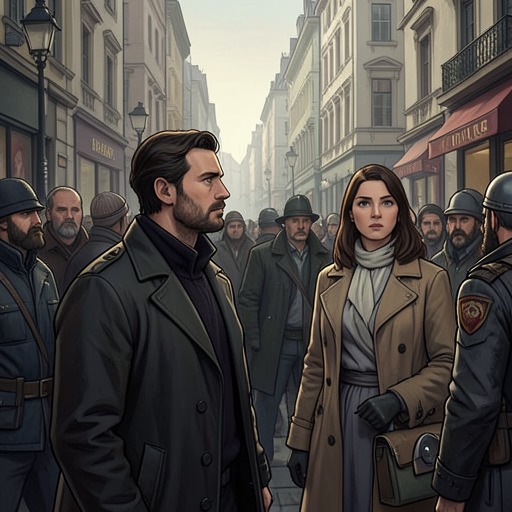
Anthony Meets Stéphanie at the Lookout
And Their Children After ThemAnthony Meets Stéphanie at the Lookout is a small but decisive scene in which a one-sided pursuit briefly becomes an invitation to intimacy. After following Stéphanie along the departmental highway toward Étange, Anthony is allowed to walk beside her and accompany her up to the Virgin Mary Statue Overlook. There, a bottle of vodka, the familiar landscape, and Anthony’s earnest request to go out together bring them close, while Stéphanie’s plan to leave Heillange for Paris places a limit on what that closeness might mean.
From pursuit to company
Stéphanie is weary and depressed, caught between two kinds of discomfort: she does not want to be seen in town with Anthony, whom she privately thinks of as a retard, but she does not want to be alone at home either. With evening falling, she feels vaguely anxious. She walks along the dry-grass shoulder of the departmental highway, while Anthony follows about thirty yards behind. The distance makes his persistence visible without making it a confrontation; once again, she lets him catch up.
When she asks how long he intends to follow her and whether he has nothing else to do, Anthony shrugs. Stéphanie is no longer speaking with animosity. Her questions have become teasing, a change in tone that permits the two of them to remain together without resolving the contempt and discomfort still present between them. The scene’s first turn is therefore modest: not a declaration of affection, but a shift from reluctant tolerance toward shared company.
The climb and the familiar landscape
Stéphanie proposes having a drink. They retrace their steps and take the steep, winding road uphill, passing trees and recently built houses belonging to people who work in Luxembourg. The climb makes their companionship physical and gradual: they walk side by side, occasionally bump elbows, grow tired, and fall silent. Anthony is happy because he has longed for something like this. His happiness belongs to the present moment, while the silence leaves the meaning of their walk unsettled.
At the summit stands the Virgin Mary statue, a thirty-foot monument paid for by the Wendel family. Its bent head and outstretched arms still seem to bless Heillange, the workers’ town below. Anthony mentions that a shell struck the statue during the war, and Stéphanie says she already knows. Their exchange establishes a shared local history rather than a new discovery: both recognize the landmark and the story attached to it. The statue’s imposing scale also sets their tentative personal moment against a much older, larger landscape of industry, war, and communal memory.
Stéphanie disappears behind the statue’s base and returns with a bottle of vodka. She explains that they had come up there drinking the other day and left it behind. The bottle connects this meeting to an earlier visit without requiring either of them to explain what that visit meant. It is at once a concrete remnant of past company and the means by which the present encounter loosens. Anthony studies the statue as she is away; when she returns, their shared drink becomes part of the scene’s movement from awkward proximity toward a more direct approach.
An invitation and an answer
With the Henne Valley visible in the distance, Anthony asks Stéphanie whether she would like to go out with him. His seriousness stops her from laughing. The narration lingers on the way she sees him: vodka has made him seem less small, and becoming accustomed to his face alters her impression of it. From the side, his features appear differently; his long brown eyelashes and tangled black hair draw her attention, and she forgets to keep her distance. When he turns toward her, his half-closed eye returns to view, and she smiles in embarrassment.
That change in perception is real but incomplete. Stéphanie asks what makes him ask, leaving the invitation open rather than accepting it outright. The scene does not turn a drink into a settled romance: attraction, embarrassment, and uncertainty coexist. Anthony has moved from following at a distance to stating his desire plainly; Stéphanie has moved from resisting his company to looking at him with fresh attention. Yet the exchange remains a beginning, not a promise.
Leaving Heillange
Asked where she is looking, Stéphanie gazes across the jumble of roofs and the lives interwoven below the bridge. She knows the panorama by heart and can immediately locate its landmarks, but familiarity does not make the place feel adequate. She says, “I’m getting out of this dump. As soon as I pass my bac, I’m gone.” When Anthony asks where she wants to go, she answers Paris.
Her declaration gives the encounter a second direction. The climb has brought them together at a place bound to local history, but Stéphanie’s immediate future points away from Heillange. Her wish to leave is not an abstract rejection of a place she barely knows: she has come to the overlook hundreds of times and can read the view in detail. The scene thus holds recognition and escape together. For Anthony, the evening offers the closeness he has wanted; for Stéphanie, it takes place under the sign of a departure she already intends to make. Their meeting matters precisely because it opens a possibility without removing the distance between their circumstances or their futures.