Anthony Threatens Hacine at Gunpoint
And Their Children After ThemAnthony Threatens Hacine at Gunpoint is a confrontation in which a plan for violence comes close to becoming irreversible, then breaks at an unexpectedly small interruption. Anthony Casati arrives armed with a MAC 50, points it at Hacine Bouali, and has an apparent opportunity to shoot. When the scooter stalls, he lowers the threat without resolving the hostility between them: instead, he spits at Hacine and flees. The scene makes the gap between intention and action decisive, while leaving both boys with an encounter neither can simply dismiss.
Preparation and departure
Anthony’s approach begins with practical knowledge rather than a sudden improvisation. He has a screwdriver taken from the Romand garage on rue Général-Leclerc, where he sometimes watched mechanics at work. The garage had also given him opportunities to ride motorcycles: Didier sometimes let him take one out, including a Honda CBR 1000. That familiarity supplies the skill he will need to start a scooter without a key. It also makes the coming theft feel like an extension of knowledge acquired in an ordinary setting, repurposed for escape.
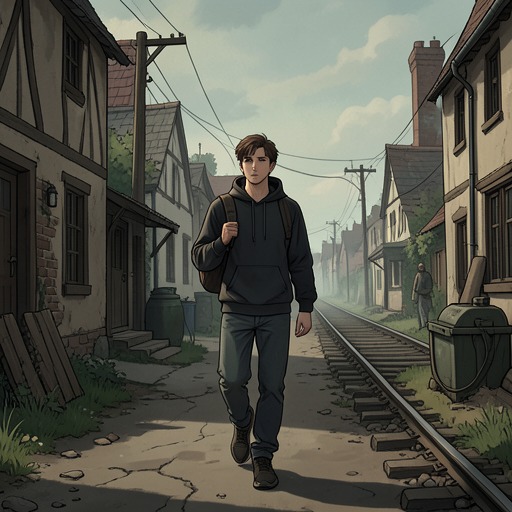
Before setting out, Anthony visits Manu, who appears willing to help him. Manu’s advice, as reported by the narration, is that people like Hacine must be dealt with in only one way. Anthony carries a backpack, with the MAC 50 inside, and walks downtown with a fixed purpose. The weapon is not discovered at the confrontation by chance: he has brought it with him as part of a deliberate plan. His sense that he owes his father something is later connected to his decision to go through with the threat, although the scene does not make that debt a justification or explain it further.
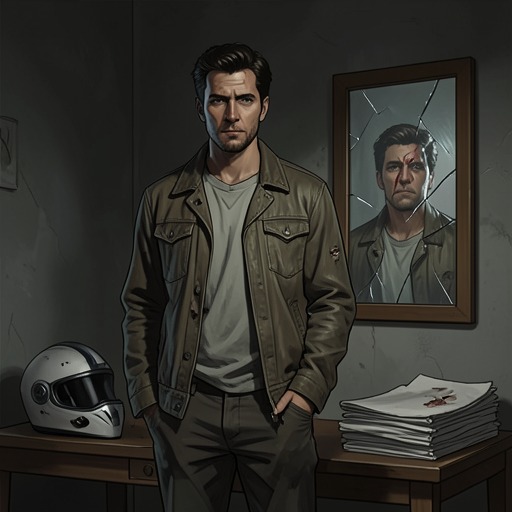
At the Metro Arcade, Anthony pauses before acting. He sees the parked two-wheelers outside, identifies which scooter is not secured by an antitheft lock, and spends some of his remaining money on pinball. In the arcade’s large mirror, he watches his own small figure against the pale glow of the game screens. He plays badly and briefly, distracted by what he intends to do. That pause sets the reflective image against the action to come: Anthony sees himself, then goes outside and commits himself to a course that has consequences beyond the theft itself.
The scooter and the threat
Anthony chooses a BMW scooter with a Pollini exhaust manifold. In the deserted street, he removes part of its fairing and uses the screwdriver to force the steering lock. The work is hurried, and the resistant screw makes the plastic yield. He then kick-starts the scooter. Its engine draws the owner out of the arcade, and other players follow, but Anthony accelerates away before they can stop him. On rue Michelet he rides fast, then slows for the turn toward the upper town. At a red light he waits rather than risk running it. The episode links his willingness to break a lock and steal a vehicle with a remaining capacity to judge immediate risk; his conduct is not simply uncontrolled at every moment.
He reaches Hacine and the group gathered at the shelter. Hacine walks directly toward him, while the boys begin shouting and some move out from under the shelter. Anthony opens his backpack and takes out the MAC 50. The others retreat; Eliott, who is in a wheelchair, is particularly exposed by his inability to move away as quickly. Anthony points the pistol toward Hacine with one eye closed. Hacine attempts to keep calm and remains facing him despite his fear. The scene makes the threat legible to both of them without requiring either to spell out what the weapon could do: Anthony has put Hacine’s life in immediate danger, and the group’s retreat registers the change in power.
Interruption and aftermath
Anthony cocks the pistol and believes he can shoot Hacine from where he is. The narrative briefly slows around that possibility, presenting the threat as a sequence of actions that could still be carried out. Anthony remains on the scooter, with its engine running, and thinks he is about to act because he owes his father at least that much. The confrontation has narrowed to a choice: fire, or stop. Yet the decisive interruption does not come from an intervention by the group or from a change of mind announced in advance. The scooter stalls.
The failure of the engine changes the force of the moment. Anthony’s arm relaxes, and he does not shoot. The scene does not treat the interruption as a reconciliation: Hacine is still standing in front of him, and Anthony cannot simply depart with the encounter unmarked. Instead, he spits in Hacine’s face. Hacine does not wipe it away while Anthony is still there. Anthony then has to use the screwdriver to get the scooter moving again, making his exit awkward, and finally escapes. The gun has not been fired, but the threat has ended in a deliberate insult rather than an apology or a settlement.
Significance
The encounter turns on a sharp reversal between apparent control and mechanical failure. Anthony has selected the vehicle, carried the weapon, reached Hacine, and taken aim; for a moment, the scene seems to have reduced the outcome to whether he will pull the trigger. The stalled scooter disrupts that apparent inevitability. It does not erase Anthony’s intention or the fear he has caused, but it prevents intention from becoming a killing. The scene therefore locates the boundary between threat and lethal action in a contingency that is small in practical terms and enormous in consequence.
The ending preserves the conflict rather than resolving it. Anthony’s escape leaves Hacine alive, but the spit makes clear that the encounter still carries humiliation and hostility. The scooter, which first enables Anthony to reach the shelter and flee, also fails at the instant when the threat is at its height; the screwdriver serves both as the tool of theft and as the means of departure. These linked objects bind preparation, confrontation, and escape into one sequence. Anthony does not emerge as having mastered the situation: he leaves it unfinished, with a failed vehicle and an act he cannot take back.