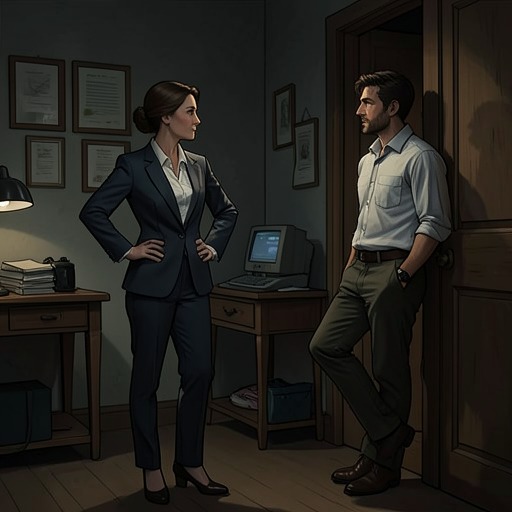
Anthony and Hélène: A Strained Mother-Son Bond
And Their Children After ThemAnthony and Hélène: A Strained Mother-Son Bond is defined by moments in which care becomes visible without making either character fully able to speak about what hurts. Hélène can recognize her son’s distress and reach for him, but anxiety over the family’s circumstances also erupts as anger. Anthony, in turn, withdraws into silence yet apologizes when he sees his mother shaken. Their relationship holds affection and strain together rather than resolving one into the other.
A Quiet Encounter in the Garage
As Anthony rolls the Yamaha through the darkness, careful not to hit Hélène’s Opel, Hélène is waiting outside the garage with a cigarette. Framed by the evening sky, she has a sweater over her shoulders and her arms crossed, staring into space. Anthony stands with his hands on the handlebars and says nothing. He is thinking about Stéphanie and feels close to tears, a private sadness that Hélène seems to approach without requiring him to explain it.
Hélène recalls that she was Anthony’s age when they lost her mother. The memory makes the exchange about more than his immediate embarrassment or trouble: she offers the fact of her own early loss as a way of speaking to him across a difference neither can undo. She puts her forearms on his shoulders and clasps her hands behind his neck, turning that recollection into physical reassurance. Her advice that life is not always fun is plain rather than consoling; it acknowledges pain instead of promising to make it disappear.
The tenderness is imperfect and bodily. After Anthony’s plea for her to stop, Hélène hesitates, kisses his cheek, and nearly falls. She catches herself against the wall, laughs briefly, and shows him the finger she has scraped on the cement. When she asks whether this is about a girl, Anthony does not answer. Her smile and his silence leave the cause of his distress understood but unspoken. She heads back to the patio; only when he is at a safe distance does he start the Yamaha and ride away, quickly losing himself in the motion. The scene brings them close, but it does not make Anthony ready to confide.
Care Under the Pressure of the Missing Motorcycle
The later confrontation begins in a different register. Hélène is sitting beneath the kitchen’s neon light, reading the television listings and smoking. The ashtray holds about twenty-five cigarette butts, and Anthony avoids looking at her. When she comes to his room, she speaks quietly and asks what happened, then asks what he did with the motorcycle. Her questions make the missing vehicle a family matter, not simply Anthony’s private problem.
Anthony refuses to explain, saying that the account would be too long and complicated and that he wants to sleep. Hélène responds by slapping him hard across the face. The violence is abrupt and frightening: the sound cracks through the small bedroom, and Anthony sits up and grabs her wrist to prevent another blow. The exchange shows how sharply the bond can turn when the stakes overwhelm their ability to talk. Her concern does not prevent her from hurting him; his attempt to stop her does not erase his dependence on her or his awareness of her distress.
Apology, Fear, and Family Obligation
After the slap, Anthony calls to Hélène again to bring her back to the moment. Her eyes are moist and lost, and her hands shake. Anthony apologizes. Hélène wipes her cheeks, sniffs, and pulls down the hem of her T-shirt before getting to her feet. These small gestures follow the violence without undoing it: both are left visibly unsettled, and neither offers a complete explanation of what has just happened.
When Anthony asks what they will do, Hélène says she does not know, but that they will find the motorcycle because they have no choice. Her final warning—that otherwise the family is done for—makes the pressure behind her reaction explicit. The missing motorcycle threatens more than an object or a rule: in Hélène’s account, it endangers the family itself. Her fear gives the confrontation its stakes, but does not excuse the slap; the scene keeps the practical crisis and the damage between mother and son in view at once.
The Bond’s Unresolved Shape
Across these encounters, Hélène’s care appears through attention to Anthony’s emotional state and through her insistence that the motorcycle must be found. In the garage, she approaches his unspoken sadness with a personal memory and a kiss. In his bedroom, she tries to make him face a crisis, but does so with a blow; afterward, his apology and her visible distress register their continuing attachment without settling the conflict.
Anthony’s silences are part of the relationship’s pattern. He does not tell Hélène what is troubling him about Stéphanie, and he resists explaining the motorcycle when she asks. Yet he remains affected by her gestures and responds when he sees her shaken. Hélène, meanwhile, can recognize that his distress concerns a girl, but the scene stops short of a fuller conversation. Their bond is therefore neither secure refuge nor simple antagonism: it is a closeness that surfaces in touch, apology, and shared family danger, while important feelings remain difficult to say.