Anthony’s confusion and sense of being trapped
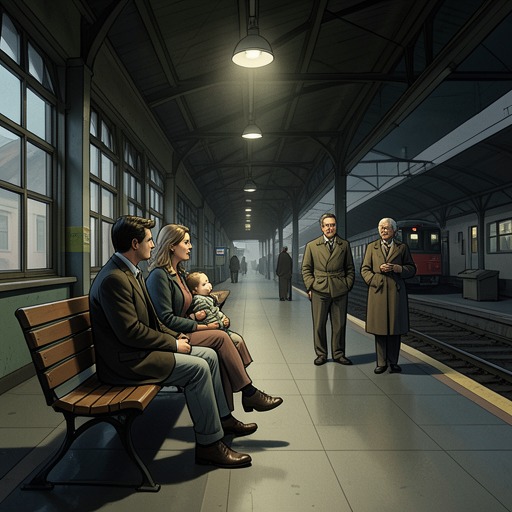
And Their Children After ThemAnthony’s confusion and sense of being trapped emerge from a widening gap between the future people say is open to him and the narrow choices he can actually see. Back in Heillange, he is told he is young and has his whole life ahead of him, yet he cannot explain what he wants or how to get there. Work gives him a measure of independence, but not security; the town offers familiar routes, not a way out. His frustration is less a single crisis than a daily condition, repeatedly interrupted by moments of belonging, desire, and possibility that do not resolve it.
Advice Without a Direction
After returning from the army, Anthony faces the expectation that he should get moving. People suggest Canada or some kind of training, and acquaintances ask about his mother, his plans, and whether he has found work. Their advice treats his future as a practical problem with ready-made answers. Anthony, however, does not have the words to explain why those answers fail to fit. When asked about work, he says he is looking; the response that he is young and has time does not give him a direction.
His first jobs bring effort without a dependable foothold. He cleans bathrooms at the Saint-Vincent clinic and at slaughterhouses, works as a school janitor, and joins the kitchen crew at the prefecture. The last job requires a long drive for four hours of work, leaving him with barely four thousand francs a month after the cost of getting there. His mother accepts hard work as a normal obligation, and Anthony begins to adopt that view too. Having a right to complain offers some dignity: he sees himself as useful and exploited, part of a broad majority with little power to change its circumstances. Yet that sense of solidarity does not make the work less exhausting or show him a different path.
Work, Companionship, and Repetition
Anthony moves through nursing homes, a warehouse, Liqui Moly, and the Merax print shop before finding a more or less permanent position at the Gordon metalworking factory. There he stacks metal sheets, rods, and grillwork into structures that are lifted into industrial ovens to make air conditioners. The work is exacting and repetitive, while supervisors watch workers and temporary staff who can be dismissed when business falters. The managers and engineers belong to a separate world, visible at the canteen but socially distant from the shop floor.
Friendship makes this routine more bearable without breaking its limits. Anthony looks forward to seeing Cyril, Krim, Dany, le Zouk, and Martinet; they eat together and secretly smoke during breaks in the courtyard behind workshop C. Their shared wages, pastimes, and anxiety about the future bind them together. They are reluctant to name the deeper fear beneath their daily routine: that they are staying in a backwater town they once wanted to leave and reproducing the lives of their fathers. Pride, especially the desire not to be seen as weak, keeps that unease largely unspoken. Companionship offers a small shelter, but the workday and its repetitions continue.
Independence on Credit
Once Anthony can afford a small one-bedroom apartment, he furnishes it and buys a new Clio Williams. The car gives him mobility, but it also consumes his army check and adds to his debts. His mother criticizes the spending; as long as he keeps working, she does not press the point. His earnings and purchases create the appearance of an adult life, while his finances remain precarious and his prospects with women fall short of his private ideal.
The gap becomes explicit in the factory’s arithmetic. Anthony earns seven thousand francs a month, and rent takes half. Car expenses, fuel, cigarettes, groceries, and credit payments leave him overdrawn by at least five hundred francs each month. After he discovers he is two hours short at work, the possible salary deduction and reprimand from human resources feel like threats to an already fragile balance. He pays down the overdraft on payday, promises himself to be careful, and soon falls back below zero. His bank’s forbearance protects him from charges, but his autonomy depends on it. The car, refrigerator, bed, leather sofa, and television are not signs of secure comfort so much as commitments that keep him returning to work.
The Town as a Route Back
Anthony’s most private routine leads north through Heillange. Late at night, after drinking, he gets into his car, listens to old songs on the radio, and drives through streets and landmarks that have followed him since childhood. The route passes the steel mill, bus shelters, his old school, the train station from which he left and to which he returned, and the bridges where he once passed time. It continues through commercial sites and familiar empty spaces toward the residential neighborhoods and Stéphanie’s home.
He does not announce this longing to anyone. Near the Chaussoys’ house, he looks toward its gate and wonders whether Stéphanie is there, then eventually drives home. The drive combines movement with stasis: he can cross the landscape, but the destination is a life and a relationship he cannot enter. Heillange is not simply the place he has failed to leave. Its repeated roads carry childhood memories, disappointment, and the persistent pull of home, making departure and return part of the same unresolved circuit.
A Temporary Opening
The World Cup brings an abrupt contrast to Anthony’s habitual uncertainty. During the semifinal, he recognizes Hacine at a bar. When France scores, the crowd’s celebration sweeps them into a shared burst of joy; Anthony embraces Hacine, and the hostility between them briefly recedes. As France secures its place in the final, spectators experience a fantasy of unity in which old divisions and grievances seem, for a moment, to disappear.
Heillange continues that celebration in the streets, with cars, flags, beer, and embraces. The town seems to rediscover its collective energy, and the language of victory gives people a common voice. Yet the celebration is temporary. Anthony’s return to work, debt, and constrained prospects shows that national excitement has not altered the conditions shaping his life. Later, after another long day and a bus ride through a quieter town, he walks home feeling unexpectedly well and phones his mother with an idea about the Déchetterie, the beach he used to visit with his cousin. The account opens onto that thought without yet establishing what it will become. Its significance lies in the small shift itself: amid a life repeatedly narrowed by routine, memory gives Anthony a place from which to imagine doing something different.