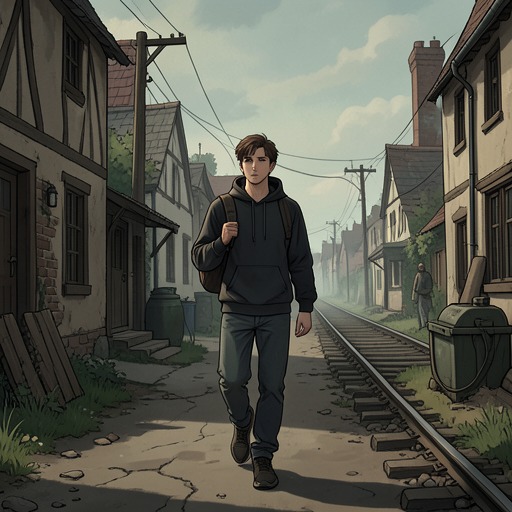
Anthony’s return to Heillange after military discharge
And Their Children After ThemAnthony’s return to Heillange after military discharge begins not with a decision to come home, but with an injury that makes continued service impossible. A damaged meniscus, weeks of treatment and rehabilitation, and the abrupt end of his army career leave him carrying a substantial payment and a duffel bag toward a destination he has not yet chosen. His detour through Paris exposes his unease outside familiar surroundings; his eventual arrival at his mother’s home restores, at least for a night, the ordinary shelter of family life.
Injury and Discharge
Anthony hurts his knee playing soccer after class in the army. At first, the injury does not seem serious: he spends a week in the infirmary with a bandaged knee, taking Doliprane and enduring constant pain and boredom. The episode turns more alarming when a nurse finds him unconscious and tangled in his sheets. Codeine allows him to read magazines without becoming nauseated, but the treatment does not return him to fitness.
When the chief doctor comes back from leave, he examines Anthony and orders him sent to France for immediate surgery at the Saint-Mandé military hospital. Six months of physical therapy follow. Anthony is then sent back to Germany, where a series of fitness tests determines that there is no point in trying to keep him in service. The decision is delivered in a small office by a civilian-clothed official: Anthony will receive two years of pay and can go home. At the time, the arrangement seems like a good deal. Its apparent simplicity conceals a disorienting change: military life ends through an administrative decision, and the next step is left to Anthony.
The Unchosen Route Through Paris
Anthony finds himself on a German train platform with nearly twenty thousand francs in his pocket and his possessions in a duffel bag. The destinations on the board—Dortmund, Munich, and Poland—hold no appeal. He knows he must pass through Paris on the way to Heillange, but postpones deciding whether to continue straight home or spend a day or two in the capital.
At the Gare de l’Est, the scale of Paris immediately unsettles him. He dislikes its size and crowds, and reads the city through a confused suspicion that everyone is ready to take advantage of him. He takes refuge in a bar on rue d’Alsace, where pinball, beer, ska, and the owner’s familiar-feeling manner give him a temporary foothold. Anthony buys several rounds and makes friends, but the bar closes at one in the morning. Outside, he asks the owner if he needs help; the owner declines, and Anthony is left drunk on the sidewalk without a plan.
The brief stop does not become an escape or a new beginning. Afraid of getting lost and of encountering dangerous people, Anthony retraces his steps and waits near the station. Homeless men ask him for a cigarette and give him a hard time when he has none. He considers using his physical strength to answer them, then decides to leave instead. Hotels intimidate him, and he does not want to spend a hundred francs merely to get through the night. He walks, sits, and waits for dawn, warming himself by blowing on his hands. In the first open brasseries, coffee at the counter and the sight of dump trucks and garbage workers provide the muted routine of a city waking up. As soon as he can, he buys a ticket to Heillange via Nancy.
Arrival at His Mother’s Home
Anthony reaches his mother’s place in the early afternoon. Her question about what he is doing there registers the abruptness of his return, but she does not seem especially surprised. His bed has been made. Leftover cauliflower au gratin and pasta are available, and she cooks him a cutlet in cream. Anthony eats ravenously, goes upstairs, and sleeps for twenty hours.
The details make the homecoming more than a change of location. After the army’s infirmary, surgery, physical tests, and formal release, his mother’s house receives him through small acts of preparation: a bed kept ready, food saved, and a hot meal made for his arrival. The long sleep is the clearest immediate consequence of the journey and the strain surrounding his discharge. He has come back without an itinerary for what follows, but he does not return to an empty house or an indifferent welcome.
Return and the Novel’s Wider Heillange
The return places Anthony back in the town from which he had left, but it does not imply that Heillange has become a place of renewed opportunity. Elsewhere in the novel, the ZUP’s young men endure long, stagnant afternoons and the absence of reliable work. Hacine, facing a shortage of hash and a collapse in customers, worries that he and his friends may lose everything; Eliott is among the companions sharing that precarious world. These circumstances form a social contrast to Anthony’s passage through the army: military service has offered him a structured route out, but injury closes it, while homecoming brings him back to an environment marked by limited prospects.
Hacine’s later development makes another contrast visible. In Morocco, he begins with a few dozen grams supplied by his cousin Driss, moves into larger purchases and shipments, and imagines organizing a business around supply, logistics, and labor. On returning to Heillange, he calculates how to build that operation with a kilo, an initial investment, and plans to delegate the risky driving. His entrepreneurial plans do not describe Anthony’s own aims; rather, they show a different response to constrained circumstances. Anthony’s discharge leaves him with money but no stated project, and the train journey records his hesitation before he resumes life at home.
The episode therefore makes return a limited, concrete event rather than a triumphant reintegration. Anthony reaches Heillange, eats, and sleeps, while the larger question of what he will do with his time and his discharge remains open. The episode’s movement—from the army’s medical and administrative decisions, through a night of anxious wandering in Paris, to his mother’s prepared room—ends in temporary care, not a settled future.