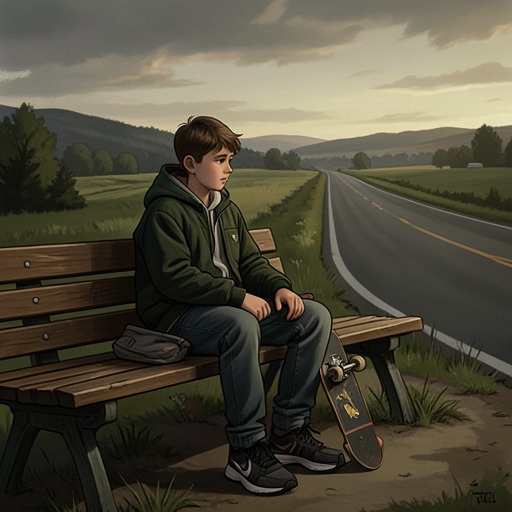
Anthony's Adolescent Alienation and Emotional Crisis
And Their Children After ThemAnthony's Adolescent Alienation and Emotional Crisis is a period of escalating estrangement in which ordinary teenage boredom turns into anger, exhaustion, and a sense of being trapped. Anthony's frustration is at once bodily and social: he resents the limits imposed by school and family, measures himself against other people, and cannot imagine a future that feels worth wanting. The episode is not simply a private mood; it unfolds amid a town and family marked by constricted prospects, while moments of collective celebration offer only temporary relief.
Restlessness and Self-Comparison
Anthony's dissatisfaction appears early in his awareness of his own body and status. At the beach, he compares his broad, heavy build with his cousin's lean, defined physique and wishes he could look more like him. Although Anthony exercises every night, he feels that his body remains stubbornly unlike the ideal he has set before himself. His cousin's apparent adulthood also opens doors—to bars, nightclubs, and girls—that Anthony cannot enter on equal terms. The comparison combines physical insecurity with envy of a freedom that seems to belong to someone else.
The boys' boredom gives that envy an immediate direction. Anthony has been pestering his cousin to go to the beach they call Bare-Ass Beach, investing the outing with the hope of seeing topless women. His fixation shows desire searching for an event large enough to break the sameness of the days. Yet even leisure is filtered through comparison: his cousin can lie at ease, while Anthony is urgently trying to make something happen.
Schoolroom Outburst and Its Aftermath
Anthony later recalls the onset of his crisis in biology class. The lesson's unfamiliar terminology, the classroom's surfaces and smells, his bitten nails, and the energy he feels burning inside him accumulate until the remaining half-hour seems impossibly long. He abruptly sends his school things and stool flying. The outburst is presented as the breaking point of an already overloaded student, not as an isolated act of defiance.
The visit to the principal's office brings punishment, but not a dramatic confrontation. Monsieur Villeminot treats Anthony's behavior as one more instance of the pressures bearing on students: confinement, hormones, and educational credentials that sort them into different routes. He imposes a three-day suspension because the incident follows earlier outbursts. The mechanical application of the rule offers no resolution to Anthony's distress; it marks his conduct as a disciplinary problem while leaving the conditions that feed his anger in place.
Afterward, daily life becomes harder to bear. Anthony wakes more tired despite sleeping later, which angers his mother. Friends provoke him into anger, and he begins punching and wanting to break or hurt things. He rides his bicycle with his Walkman, replaying the same sad song, and can be overcome by melancholy while watching Beverly Hills, 90210. The distant image of California becomes a measure of the life he thinks he lacks: somewhere people might be living worthwhile lives, while he remains stuck with pimples, worn sneakers, and a future he cannot accept.
Family, Violence, and the Fear of Inheritance
Anthony's resistance to parental authority coexists with a deeper sense of powerlessness. He evades his parents' orders, but that rebellion does not make a promising future seem any closer. His clearest model of the adulthood he fears is his father, Patrick Casati, whom he imagines drunk, shouting at the television news, and arguing with a wife who no longer cares. Patrick's drinking is not a distant abstraction in the family: it has included work failures, concealed bottles, domestic shouting, and Anthony witnessing the consequences. Anthony's refusal to become like his father gives his discontent a specific shape, but it does not give him an alternative life to pursue.
The crisis also finds expression in Anthony's attention to physical danger. While mowing the lawn beside his father, he imagines how an accident might happen and finds an unsettling cheer in the thought that blood could provide escape. The scene links his distress to the body and to work: he is sweaty, tired, and pushing a heavy mower, while the possibility of injury briefly appears to offer release from an otherwise inescapable routine. Later, when he confronts Hacine at gunpoint, Hacine's response is shaped by a belief that retreat would invite the status of a victim. The encounter shows how the boys' conflict is governed by a masculine code in which vulnerability can seem more dangerous than facing violence. Anthony's alienation thus exists in a world where aggression is available as an answer, even as it threatens to deepen the trap he already feels himself in.
Isolation and Temporary Belonging
Anthony's sense of being stuck reaches beyond the home and school. Walking to the edge of Heillange, he sees a bleak landscape of hills and yellow grass, with an abandoned shopping cart that offers him no romantic consolation. The setting gives physical form to his conviction that there is nowhere meaningful to go. When he sees Stéphanie, his heart leaps, a brief and immediate interruption to the anger and numbness that have carried him there; the moment does not, by itself, resolve the larger crisis.
Collective celebrations provide a striking counterpoint to that private estrangement. On Bastille Day, a thousand faces turn toward the fireworks above the lake, and the crowd is caught up in light, sound, and the same spectacle. Later, during the World Cup semifinal against Croatia, Anthony recognizes Hacine in a bar just as France scores. The goal draws the men into a sudden, shared eruption: Anthony grabs and shakes Hacine in celebration, and the crowd's excitement briefly overrides the history separating them. France's second goal intensifies the fantasy of a country joined as one, while the streets of Heillange fill with cars, flags, painted faces, firecrackers, and embraces. These scenes do not establish that Anthony's private problems have disappeared. They show instead that his isolation is not absolute: for a moment, a common spectacle can pull him into a fellowship he cannot manufacture alone.
Significance
Anthony's crisis develops through recurring contrasts: the body he wants and the one he inhabits, rebellion and powerlessness, the imagined elsewhere of California and the landscape around Heillange, and the future he rejects against the one he cannot yet see. School discipline records his outbursts without relieving their causes; fear of repeating Patrick's life sharpens his refusal of adulthood without giving that refusal direction. The temporary unity of the fireworks and football celebrations offers a different kind of possibility, but it remains episodic. The emotional force of the period lies in that unresolved tension between a desperate wish to escape and the brief experiences of connection that keep Anthony within the world he finds so difficult to bear.