Bastille Day Lakeside Brawl and the Colin Boy’s Disappearance
And Their Children After ThemThe Bastille Day Lakeside Brawl and the Colin Boy’s Disappearance is an unresolved episode in which a familiar holiday gathering at Lake near Heillange turns into a mass fight, and one young man is never found. Its significance lies not only in the disappearance but in the gap between what witnesses know and what the town believes: the search yields no body or confirmed explanation, while suspicion quickly settles on Arab residents. The event becomes a lasting absence around which rumor, grief, and racialized fear gather.
The Holiday Gathering and the Fight
On July 14, the area around the lake drew a crowd from nearby communities to watch fireworks. People made campfires and barbecues along the shore and in the woods. Violence was a recurring feature of the gathering: shortly after midnight, a fight broke out. Men on leave from the barracks went after Arabs from the housing projects, and other local groups joined in; eventually, ordinary campers were caught up in the melee as well. The clash did not remain a contained confrontation between two sides but spread through a mixed crowd that included young people and some fathers.
The Colin boy had come with friends who had recently passed their baccalauréat examination and did not even have driver’s licenses. They had gone to watch the fighting, not to take part, but were swept into it. Their testimony establishes that the Colin boy was at the lakeshore that evening; it does not establish what happened to him after the disorder. Witnesses later offered uncertain accounts of a boy who seemed to have been hurt. In the confusion, no one stepped forward to help. By morning, the Colin boy’s bed was empty.
The traces left at the scene gave the gathering a disordered aftermath but no answer. Greasy paper, broken bottles, and bloodied sticks were scattered around, and one of the Sailing Club’s Optimists had ended up in a tree. These remnants testified to the scale of the night’s disturbance, yet none identified the missing boy’s fate. The contrast between visible debris and the absent person at the center of the episode makes the disappearance harder, rather than easier, to explain.
Search, Rumor, and an Unresolved Absence
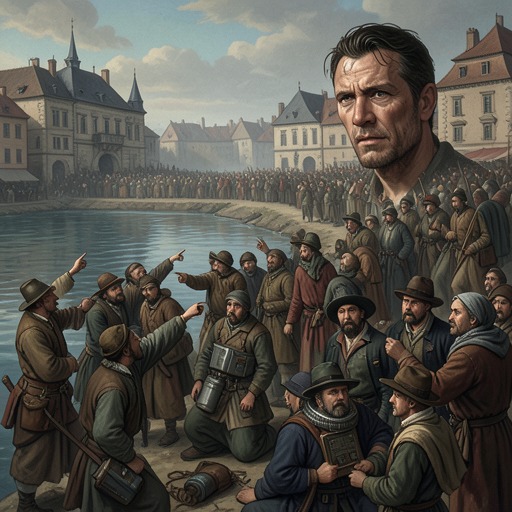
Over the following days, the regional prefect ordered searches of the neighboring woods, while divers searched the lake. Onlookers watched the firefighters’ orange Zodiac make repeated trips across the water. The process offered a public spectacle of waiting, but no discovery: the divers returned, and the crowd had to wait in silence for news. The search covered both the nearby land and the lake, yet the Colin boy’s body was never found.
As the search continued, accounts of the family circulated alongside accounts of the fight. There were rumors that the boy’s mother was hospitalized on sedatives, that she had hanged herself, or that she had been seen wandering the streets in her nightgown. The later account rejects the claim that she had hanged herself; it says only that she took pills. The contradictory stories show how little the town could verify, even as the missing boy’s fate became a subject of collective speculation.
The Colin boy’s father was a town police officer and a hunter. People assumed that Arabs had killed his son and seemed to expect him to respond or seek revenge. Instead, he remained aboard the firefighters’ boat in the blazing sun, watching the search with what observers perceived as unbearable calm. Their disgust at his stillness reveals another expectation layered onto the case: the crowd wanted not only an answer but a visible performance of anger. His composure, however, did not resolve the disappearance, and the book supplies no confirmation that the town’s accusation was true.
Public Memory and Racialized Suspicion
A newspaper photograph later made the missing boy more legible to the public as a victim. The article noted that he had passed his examination with top honors, an achievement presented as notable in light of his family. The image and the account of his academic success gave readers a portrait to attach to the disappearance, but they did not provide new evidence about the night or explain what had happened to him. Public recognition thus sharpened the emotional force of the loss without closing the factual gap.
The event also belongs to a wider pattern of suspicion toward residents of the ZUP Residential District. At a later gathering, discussion of the Furiani disaster slid into talk about Corsicans and Arabs, and neighbors imagined Arabs setting cars on fire, casting themselves as the last line of defense. Elsewhere, when Hacine Bouali and another young man appeared uninvited at a party, their presence prompted a hostile confrontation; Hacine muttered that the people confronting him were racists. These later scenes do not establish a connection to the Colin boy’s disappearance. They show how readily conflict involving Arab residents was folded into a pre-existing local story of threat.
That reflex appears again after a motorcycle is burned: a bystander immediately attributes the fire to young Arabs, before the scene supplies any proof of who was responsible. Read beside the lakeside case, such accusations reveal a recurring imbalance between evidence and certainty. The Colin boy’s disappearance remains genuinely unexplained, but the town’s readiness to assign blame gives uncertainty a racial target. In the end, the body is never found, the Colin boy’s father returns to work without public drama, and the narrative leaves the central question unanswered. The event’s lasting force comes from that unresolved ending—and from the certainty others claim in its place.