Colin boy
And Their Children After ThemThe Colin boy is a teenager whose disappearance after a crowded Bastille Day gathering becomes an unresolved local tragedy. The account gives him no first name and offers no explanation for what happened to him. Instead, it follows the gap between what witnesses can establish—that he was at the lakeshore before a fight—and what the search cannot answer: where he went afterward.
Identity and the Night of the Disappearance
A year before the scene in which his story is recalled, the Colin boy attended a Bastille Day celebration beside the lake. People from the surrounding area had gathered in the woods and along the shore for fireworks, with campfires and barbecues. A fight broke out shortly after midnight. Men on leave from the barracks fought with young men from the housing projects; people from Hennicourt and other campers were drawn in as well. The next morning, signs of the disorder remained around the site, but the Colin boy was missing.
His presence that evening was not merely a rumor. He had come with friends who later testified that they had been there. They were ordinary teenagers who had recently passed their baccalauréat and did not yet have driver’s licenses. They had expected to watch the fighting rather than become involved, but they were caught up in the melee. Their testimony confirmed the Colin boy’s arrival without resolving what happened once the crowd became confused.
Search and Unanswered Questions
Witness accounts offered fragments, not a clear sequence. Several people recalled seeing a boy who appeared to be hurt; others mentioned a bloodstained T-shirt and a cut to the throat. In the confusion, nobody came forward to help him. By morning, the Colin boy’s bed was empty. These accounts establish the fear and disorder surrounding his disappearance, but the narrative does not identify who, if anyone, caused his death or explain how he vanished from the lakeshore.
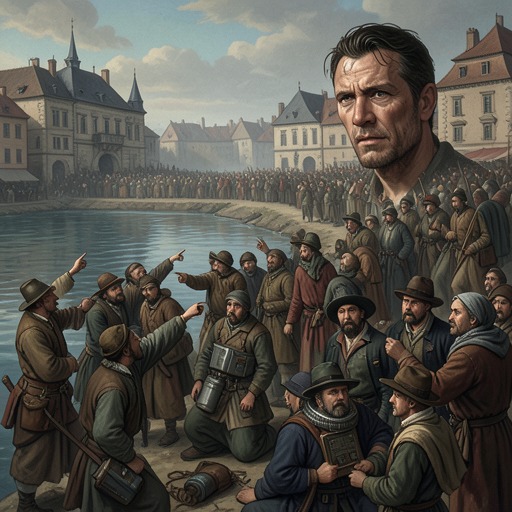
In the days that followed, the préfet ordered searches of nearby woods while divers examined the lake. Onlookers watched the firefighters’ boat make repeated trips, waiting for the divers to return with news. The searches produced no body. The Colin boy’s father, a town police officer and a hunter, remained aboard the boat under the sun while people watched from shore. The account records the crowd’s response to his stillness, but offers no evidence that his conduct or his occupation revealed what had happened to his son.
Family, Public Memory, and the Unresolved Disappearance
Rumors about the Colin boy’s mother circulated alongside the search. Some people said she was in hospital under sedation; others claimed she had hanged herself or had been seen wandering in her nightgown. The narrator corrects the most dramatic versions: she had not hanged herself; she had taken pills. Her distress becomes part of the public story of the disappearance, but does not bring the missing boy’s fate any closer to explanation.
A newspaper photograph later gave the Colin boy a more definite public image: a pale-faced teenager with curly hair, brown eyes, and a red T-shirt. The report noted that he had passed the baccalauréat with top honors, a distinction made striking by the account of his family. The photograph and achievement made him legible to the town as a particular young person, not just the absent figure at the center of a search. Yet they did nothing to settle the question of what had happened. His body was never found, and his father returned to work without making a public fuss. The disappearance therefore remains both a specific family loss and a blank at the center of the community’s recollection of the night.