Deindustrialization in the Heillange Valley
And Their Children After ThemDeindustrialization in the Heillange Valley is not simply the disappearance of factories; it is the reordering of work, politics, memory, and the town’s physical landscape. As industrial employment recedes, workers lose both livelihoods and electoral weight, while local leaders recast the valley as a place for tourism and leisure. The new vision promises prosperity, but the novel sets that promise beside decaying worker housing, insecure jobs, and informal economies that reproduce some of industry’s patterns without its collective identity.
Industrial legacy and social fracture
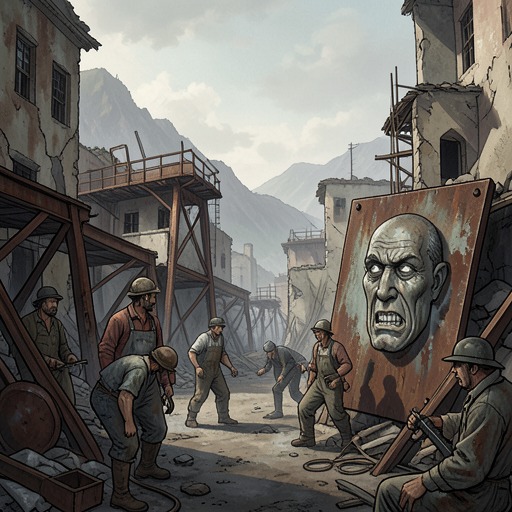
The valley’s steel industry once shaped its built environment and its political life. Metalor owned rows of modest workers’ houses as well as larger residences for engineers and managers. After the mills shut down, the properties were left so neglected that they began to fall apart. The holding company eventually accepted responsibility for the damage, but its response came only after a long delay: it hired Solodia to undertake the cleanup, creating at least three years of work demolishing and clearing the old buildings.
The industrial past also survives in the people who organized around it. At Luc Grandemange’s funeral, Muslim former coworkers and union veterans gathered alongside churchgoers and people who stayed outside the mass. Luc had paid his first union dues in 1963 and served in a succession of union roles, becoming a familiar figure during the major Metalor strikes. He was not distinguished as a theoretician or negotiator; his contribution was to keep people connected, steady wavering comrades, and ease tension among those in struggle. His death therefore marks the burial of more than an individual: a piece of the valley’s labor history is disappearing with him.
That history is politically unsettled. Over time, Luc came to explain workers’ difficulties through an anti-immigrant account, treating immigration as the cause of unemployment and advocating quotas and deportations. Others around him shared such views, but they remained largely unspoken in settings that demanded public respectability. The priest’s account of Luc’s life and his obituary did not mention them, and his wife played them down. The episode shows how deindustrialization leaves a contested political inheritance: solidarity built through work can coexist with attempts to define the community by excluding immigrant workers and their families.
Work after the mills
The abandoned housing stock makes the industrial collapse tangible in Hacine’s temporary job with Solodia. He and a small crew arrive with buckets, sledgehammers, and crowbars to smash plaster panels, brick walls, and old lead pipes. At first the work feels like a demolition game; soon the rooms are filled with dust, and the labor turns to hauling rubble, beams, and pipes to a dump truck. The sequence moves from the apparent pleasure of breaking things to repetitive, physical cleanup. Rather than restoring the industrial buildings to productive use, the workers are paid to dismantle what the old economy left behind.
Hacine initially attacks the job at a run, mistaking speed and aggression for strength. His foreman, Jacques, pulls him aside. That small correction places the work within a different discipline from the one Hacine chooses for himself: a low-paid, temporary routine with instructions and a pace set by someone else. The job gives him a legal foothold in the postindustrial economy, but it is not presented as a route to security or advancement.
The drug trade offers a sharply contrasting model. During a summer shortage of hash, Hacine worries that he has seen fewer than ten customers since morning and fears that he and his associates could lose everything. In the ZUP, a new supply of two 250-gram bars brings relief after weeks of scarcity, and a dozen young men smoke through the day. The stalled trade and the temporary abundance reveal how closely their routines depend on fragile supply, while boredom and the lack of conventional prospects frame the business as both livelihood and trap.
In Morocco, Hacine builds a more ambitious version of that livelihood with help from his cousin Driss. Starting with a few dozen grams for low-level sales to tourists, he buys a kilo and invests in shipments bound for France and Germany. He recognizes a resemblance between the traffic and heavy industry: both depend on supply, organized labor, and the support of families across Europe. But the comparison has limits. The new work promises flexible hours and a sense of independence, yet it replaces the factory worker with the street dealer and the labor collective with a business-minded hierarchy. Back in Heillange, Hacine calculates a plan to invest twenty thousand francs, expand distribution, and delegate the dangerous transport work. His ambition to get rich is bound up not just with comfort but with revenge, making illicit enterprise an answer to humiliation as well as unemployment.
A new urban future
With factories nearly gone and young people leaving for lack of jobs, the old industrial workforce has become the smallest part of the local electorate. Heillange’s center is being pulled between businesses moving to the outskirts and an expensive renovation of its historic core. City Hall, supported by regional and state councils, looks to tourism as a replacement engine of growth. The program includes improving the campground, expanding the sailing club and swimming pool, building miniature golf, adding pedestrian streets and bike paths, and announcing a new iron and steel museum for 2000. Hikers can be drawn by the surrounding hills and trails, and companies from the region, Germany, and Luxembourg have been approached about an amusement park.
This strategy is presented through an uncomplicated faith in investment: borrow, build, and expect prosperity. Pierre Chaussoy, now deputy mayor for culture, supports the project, while the municipal council insists that the benefits will come once the plans are underway. When challenged about the town’s economic condition, councillors blame the state or previous administrations. The promised revival remains prospective; the evidence shows a program and its political rhetoric, not that it will deliver full employment.
The renovation is visible in the new palette of light red, green, fuchsia, and baby blue, which reaches even the prefecture. Driving through town can feel like entering a Jacques Demy film, but the bright surfaces also cover over what remains of the old city: the steel mills, memories of war and the dead, Republican mottos, and Catholicism. The result gives inhabitants the strange impression of living in a theme park. In the name of progress, the town makes its industrial and political past harder to see even as it proposes a museum to preserve one part of it.
What deindustrialization leaves behind
The valley’s decline is registered not only in abandoned buildings and changing elections but in the narrowed horizons of everyday life. In the ZUP, a summer afternoon stretches into a greasy, almost motionless expanse: children and televisions fall silent, the towers seem to sway in the heat, and the occasional motorbike cuts across the stillness. Young men imagine a job in an air-conditioned office or a day by the sea, while the actual day repeats itself. At another point, Fred’s dependence on smoke, lack of work, and poverty at home are set against the doctors who accommodate his mother’s extensive medication. The image of the valley as being in palliative care extends economic decline into a broader atmosphere of lives managed rather than renewed.
Against that stagnation, the town’s redevelopment and Hacine’s business schemes offer different stories of escape. One relies on public debt, leisure infrastructure, and the promise that investment will revive the community; the other turns informal trade into a privately managed enterprise. Neither restores the old relation between employment, collective organization, and local identity. Deindustrialization in the Heillange Valley thus names an ongoing condition, not a completed transition: the mills have closed, but their physical remains, political divisions, and unmet promises continue to shape what work and belonging can mean.