Districan
And Their Children After ThemDistrican is a vending-machine service company whose ordinary operations make the novel’s changing labor conditions tangible. It assigns Patrick Casati a route of machines to collect and restock, and uses electronic records of his visits to organize services, prepare invoices, and measure work. The job offers a permanent contract and conventional benefits, yet its routines also bring the company’s expectations into Patrick’s movements, pace, and appearance. Through Districan, employment appears at once as a source of stability and as a system of minute, continuous oversight.
The Route and the Work
Patrick gets the job through Adecco, after which Districan’s boss signs him to an open-ended contract. His assignment takes him to thirteen checkpoints and almost thirty vending machines, including machines spread across a hospital. The route is sufficiently extensive to occupy his whole morning. At each machine he collects the money, wipes down the unit, and replenishes it with canned drinks, bottled water, chips, Papi Broussard cakes, and chocolate bars. The repeated tasks make the work physically straightforward, but the sheer number of stops gives the day its pace and structure.
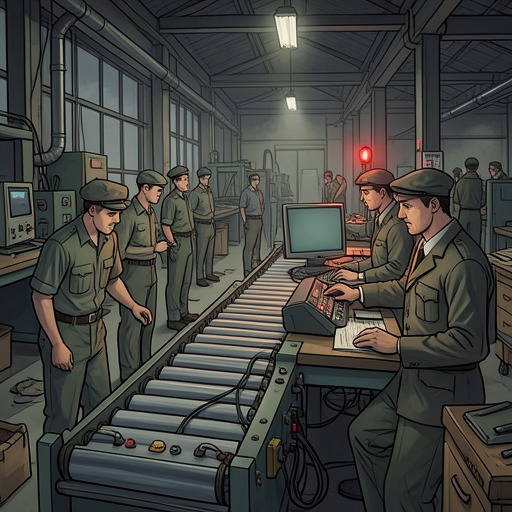
The route is also recorded electronically. Each machine has a magnetic badge, and Patrick registers his visit with a scanner carried on his belt. At home, he connects the device to a phone line so its information can be sent to Districan’s database. The company uses that information to coordinate its services and prepare invoices; it can also measure pace, identify downtime, optimize routes, rationalize charges, and identify workers it considers insufficiently productive. The scanner thus turns a sequence of separate service calls into data the employer can compare and use. What looks like a simple record of attendance also supports oversight of how work is done.
Patrick’s pay and benefits give the job a measure of security. He earns a little under seven thousand francs a month, receives a meal allowance, five weeks of paid vacation, and supplemental health coverage, and can take free Mars bars and Cokes. These provisions matter alongside the job’s repetitive tempo: Districan is not presented as offering no protections, but as making employment and monitoring coexist. For Patrick, whose life has become more restricted since his separation, the routine can seem tolerable—until the company’s rules make themselves conspicuous.
The Cap and Corporate Discipline
The clearest point of friction is Districan’s soft red cap. Patrick accepts the company T-shirt and jacket but refuses the hat, which he considers an unnecessary imposition. A quality-control supervisor has found him working bareheaded several times and insists that the cap is part of the company’s image. The dispute is small in material terms, but it gives visible form to the question of who controls a worker’s presentation. Patrick’s objection is practical as well as personal: he argues that wearing the cap will not help him meet his quota and that no one can see him. The supervisor, in turn, treats compliance as a rule the company cannot simply set aside.
The cap becomes a recurring test rather than a single reprimand. Patrick wears it, feels watched, stamps on it, forgets it in his van, and loses it; in different settings he keeps having to consider whether he is supposed to have it on. This repeated uncertainty extends corporate discipline beyond the machine and the assigned route. The requirement follows him into the ordinary transitions of his day, making a uniform item a reminder that the company’s standards concern not only completed tasks but also how its employee represents it.
The narrative places this conflict within Patrick’s broader account of postindustrial work. He contrasts the older image of dangerous, shared industrial labor with newer jobs marked by small demands, close surveillance, and weakened workplace ties. In this view, the threat is not only a supervisor’s intervention but the accumulation of modest controls: tracking, targets, prescribed appearance, and the expectation that workers adopt the company’s language and purposes. The cap matters because it condenses that larger shift into a concrete object Patrick can refuse, misplace, or be reminded to wear.
Benefits, Workarounds, and the Working Day
Patrick does not simply follow the system at every moment. With no supervisor expected in mid-July, he works bareheaded. The hospital route takes him through the morning, and he works through lunch because Anthony Casati is expected for dinner and he wants to get home early. After three o’clock, he chooses to scan some machines without restocking them. The episode shows a narrow space for individual maneuver inside a process designed to make activity legible: Patrick can record a visit while abbreviating the service itself. The text presents this as a temptation enabled by the system, not as a change in Districan’s stated procedure.
His small economies of effort coexist with careful, repetitive work. He moves quickly through the route, performs the same actions at each machine, and sometimes takes a free Coke. Since giving up liquor, he has made the soft drink a substitute indulgence, drinking several quarts a day. This detail connects the workday’s routine to Patrick’s private adjustment after separation and sobriety, without making Districan responsible for those changes. The company supplies the setting and the available treat; Patrick’s habits give those details their personal significance.
A Wider Labor Landscape
Districan’s service work belongs to a valley where the older industrial order has been disrupted rather than cleanly replaced. The account of Patrick’s cap and electronic scanner emphasizes individualized employment and measurement. Elsewhere, Hacine works for Solodia, a cleanup contractor that has won Metalor’s account to demolish and clear neglected worker housing left behind after the steel mills shut down. That work is also organized by a company and carried out on an industrial site, but it involves crews, shared physical tasks, and a different rhythm from Patrick’s circuit of vending machines. Set beside it, Districan represents one strand of the postindustrial economy: service work administered through route data and standards of corporate presentation.
At Gordon, Anthony Casati’s coworkers manage production through a tacit balance between maintaining a steady pace and avoiding targets that might be raised if they work too quickly. Foremen watch for downtime, while workers preserve small pauses and a degree of solidarity through a collectively understood restraint. The contrast clarifies Districan’s particular method of control. Its scanner makes visits individually traceable, and the cap makes the company’s image an explicit part of the job; Patrick’s occasional shortcuts and resistance are personal tactics within that framework. Districan is therefore significant not as a single emblem of all work in the novel, but as a precise example of how employment in the changing valley can offer a contract and benefits while measuring time, standardizing conduct, and narrowing workers’ control over the working day.