Drimblois
And Their Children After ThemDrimblois is the destination of Anthony Casati and his cousin’s illicit ride to a party, and the place where they discover that Anthony’s Yamaha YZ motorcycle has disappeared. The village’s modest, varied landscape gives way to a conspicuously grand house and pool; the journey’s anticipation ends at the woodpile where the boys had concealed the motorcycle, now gone. Drimblois thus holds both the promise of entry into a glamorous social world and the abrupt material consequence of taking a risk to reach it.
Village and Setting
Drimblois is described as a small model village: it has a church, a few farms along the departmental highway, newer houses, and an old dental-office building behind a wrought-iron grille. The compact catalogue gives the place a settled, legible character, while also showing different traces of building and use side by side. The road through it connects scattered farms and houses rather than a dense urban center.
The party is not in the village’s ordinary-looking center but at a handsome modern house. Its extensive glass, illuminated rooms, broad lawn, and bright turquoise swimming pool make it stand apart from the surrounding landscape. The contrast is especially sharp because the boys approach Drimblois after cycling through woods and rural roads: the party’s manicured lawn and glowing pool present a concentrated, almost staged image of leisure.
The Journey to the Party
The invitation comes from Alex the jock, whose friend is holding a party at his parents’ house. Anthony and his cousin are welcome if they bring dope. The promised attractions are liquor, girls, music, and a midnight swim. The boys agree, though appearing cool seems to demand deliberate effort. Their assent turns the journey into more than simple travel: it is an attempt to gain access to a social scene whose terms have already been set by others.
The distance makes the invitation difficult to accept by bicycle. Drimblois would mean a twenty-five-mile round trip, so the boys consider taking the Yamaha that had been under a tarp in their garage for years. Anthony knows that dealing with his father, Patrick Casati, would be no joke; his cousin argues that Patrick will not notice. The motorcycle makes the party reachable, but using it also brings the boys into conflict with the authority Anthony is reluctant to face.
They ride toward the village on highway D953, at speed and bareheaded. On the turns Anthony puts out a leg, then accelerates on the straights; the rush leaves their eyes watering and their chests full of pride. His cousin asks him to slow down once, a small interruption in their shared sense of invulnerability. Drimblois is only twenty minutes away by motorcycle, and the quick arrival confirms how completely the borrowed machine has changed the scale of the trip.
The House and Its Guests
After reaching Drimblois, the boys ride around until they identify the party house, a glassy modern building with lights in every room, a golf-course-like lawn, and a pool shining turquoise behind it. They pause before pulling up beside the other two-wheelers. Anthony’s brief hesitation marks the threshold between the road and the gathering: the invitation has brought them there, but arrival does not make them part of the crowd.
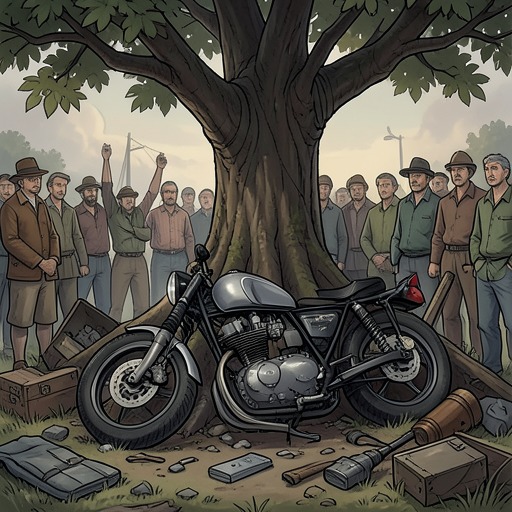
Before going in, the cousin points out a long farm building with its shutters closed. Beside it, cords of wood are stacked for winter. Anthony hides the Yamaha behind the wood and feels uneasy. They then share rum from a small bottle and beer from the cousin’s backpack, taking turns before throwing the empty can onto the freshly cut lawn. Their laughter accompanies this casual act of trespass into a space whose finish and abundance contrast with their concealed, borrowed transport.
On the patio, young people gather around a table laid with salad, chips, bread, and wine; more liquor sits in bottles on ice. Tall, sharply dressed men tend the barbecue while drinking Sol beer. Their swim-club tank tops, athletic shoulders, and self-satisfied manner identify them as the valley’s celebrated athletes and indoor surfers. They are described as getting the girls and being widely disliked. A whiny rock song that sounds like R.E.M. has replaced the reggae. These details make the party’s social hierarchy visible: its apparent ease and abundance coexist with the boys’ outsider status and effort to seem at home.
The Missing Motorcycle
A few hours later, Anthony has a headache, and a rooster crows as the boys reach the wood stacks where they left the motorcycle. The return is measured against the earlier arrival: the spot feels almost like another life, but the YZ is no longer there. Anthony drops to his knees. The disappearance transforms the motorcycle from a means of freedom into an immediate, undeniable loss, and the party’s excursion ends not with the anticipated midnight swim but with the discovery that the machine is gone.
Narrative Significance
Drimblois binds together the episode’s central contrasts without making the village itself the cause of the loss. The boys’ fast, bareheaded ride expresses youthful confidence; the cousin’s request to slow down briefly exposes its limits. At the destination, a vivid pool and well-stocked party embody the leisure they hoped to enter, while their hidden motorcycle and awkward position among the guests mark the distance between invitation and belonging.
The woodpile gives the episode its decisive reversal. It is first a practical hiding place, selected beside a shuttered farm building and winter stores; later, it is the exact point at which the boys confront the absence of their vehicle. Drimblois consequently remains in the narrative as more than a destination on the road: it is where the excitement of crossing a boundary—using Patrick’s motorcycle and entering the party—turns into the consequences of having crossed it.