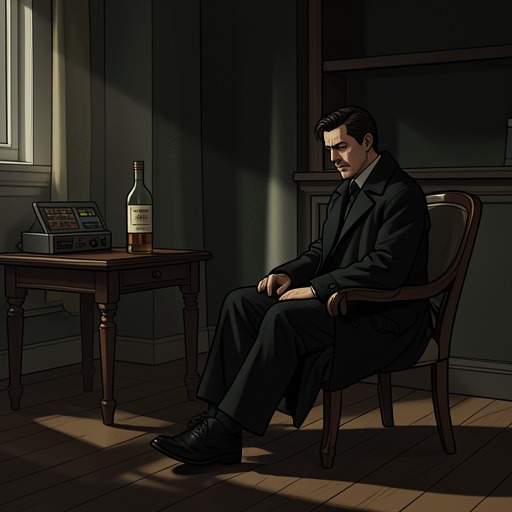
Drinking and Self-Destruction
And Their Children After ThemDrinking and Self-Destruction describes alcohol as both a recurring practice in Patrick Casati’s life and a force that steadily reduces his world. His drinking changes form across different periods, but repeatedly returns him to isolation, failed resolutions, and bodily exhaustion. In the aftermath of Metalor’s closure, with work and family structures diminished, drinking becomes less an occasional excess than the organizing rhythm of a life he can no longer readily put to use.
A Life Repeated Around Drinking
Patrick’s drinking has passed through several recognizable phases. Early on, it belonged to friends and parties: the next morning brought a patchy memory, two aspirins, and a Coke. Later came binges lasting several days, followed by self-pity and repentance. In those intervals he lectured his friends and considered returning to the church, as though resolve might be restored by declaring a new beginning.
Another phase combined continuous, moderate drunkenness with the effort to conceal it. Patrick hid bottles in the locker room and used chewing gum to disguise his breath. At work, his friends covered for the many mistakes that drinking produced. The pattern extended from laughter at the bistro to gloomy returns home, shouting matches, and nights spent on the living-room sofa. Anthony saw these domestic consequences while still a child, so the drinking was not confined to Patrick’s private life: it entered the household as noise, absence, and disrupted sleep.
After Metalor shut down, Patrick drank therapeutically, in the sense that alcohol offered relaxation, encouragement, or temporary forgetfulness amid unemployment. He could tell himself that even an unemployed man had a right to enjoy himself. But periods of quitting did not end the cycle. When he stopped, he withdrew from friends and dreaded occasions such as Christmas, while the daily approach of seven o’clock brought the familiar temptation to have a single drink. A small amount could lead back into a deeper binge, forcing him to start over. The cycle is marked less by a clean division between sobriety and drunkenness than by repetition: abstinence itself becomes a tense wait for relapse.
Work, Idleness, and the Narrowing of Daily Life
Patrick’s difficulty with idleness is rooted in the values he learned growing up. His father had left school at twelve, his mother not much later, and Patrick himself dropped out at fourteen. His parents taught him to distrust doing nothing and to respect practical competence. He learned to cut wood, build a fire, lay tiles, repair a faucet, patch a roof, tend a house and garden, and do basic carpentry. The family’s outdoor life included gathering mushrooms and picking blueberries and plums; even the steel mill could feel like an extension of the outdoors. Work with the hands gave Patrick a language for being useful.
That inheritance sharpens the contrast with his later life. He lives alone much of the time, passing gloomy evenings with Picon-bière and falling asleep in front of the television. He wakes suddenly at three in the morning with a cold ache across his lower back, struggles up the next day, works, and then comes home to repeat the evening. The promise that he will have only one glass gives way to finishing the cans one after another. His hands remain heavy and capable, but the life around them offers little purpose for their strength. He wishes he could wrap them around a tool and make something; instead, anxiety and feverishness can turn him toward violence.
The later details of his circumstances make this loss concrete. Patrick survives on welfare and a small, twelve-hour-a-week minimum-wage job doing housekeeping and maintenance at quiet residences: taking out garbage, mowing lawns when the weather allows, helping older residents, and making small repairs. He has large debts, a tiny income, and a housing subsidy. At first, encountering former acquaintances while mopping floors feels humiliating, but the occasional carpentry and repair jobs give him a practical role. The work is limited, yet it connects him to the competence he still values.
He also has permission to cultivate a plot behind the Renardière soccer stadium. He plants potatoes, onions, parsley, and strawberries, but brings a case of beer each time he goes. After his third can, he sets down the spade and sits smoking cheap tobacco in a camp chair, staring at the turned earth as the sun sets behind the bleachers. Empty cans gather around him; he can remain there for a long time, drinking and doing nothing. The harvest is poor, and he mainly eats canned food anyway. Gardening and fishing persist, but the alcohol repeatedly interrupts the activity they might have sustained. The result is a diminished, anesthetized life that Patrick accepts without asking many questions.
Relapse and Escalation
Patrick’s drinking history is not presented as a single uninterrupted decline. He has stopped before, sometimes avoiding even a weekend drink, and has experienced the fear and social withdrawal of sobriety. Yet the account insists on how easily a small return becomes a plunge. Alcohol’s appeal takes the form of a familiar argument that life is short and pleasure should not be denied; the next day, Patrick is once again damaged by the drink and required to begin again. The recurrence gives his attempts at control a bleak structure: each apparent break can become only another stage in the same circuit.
The present phase exceeds those earlier patterns. Patrick now drinks with the competitive intensity of an athlete chasing a personal best or a bodybuilder trying to lift a weight that will leave him spent. During this effort, he feels like a king: powerful, brutal, and frightening to those around him. The image of a thirst with no destination except the cemetery makes the self-destructive direction explicit, without suggesting that the earlier phases were harmless. What changes is the scale and intensity of the drinking, while the underlying cycle of temporary power followed by depletion remains.
Family, Pride, and the Final Scene
Alcohol has shaped Patrick’s relationship with Anthony through years of domestic conflict, but it does not erase his affection for his son. When Anthony is about to leave for military service in Germany, Patrick feels proud and tries to imagine the uniform through ideas of order, discipline, and steady employment rather than focusing on war. He thinks of Anthony as a boy who has had little luck, born when his parents were very young and raised amid problems at the mill, financial anxiety, and the persistent strain of drinking. This reflection links Patrick’s own habits to the insecure conditions of family life, even as his pride in Anthony survives them.
Before the visit, Patrick makes a visible effort to prepare. He clears five full bags of empty bottles from his studio apartment and leaves the place immaculate. The gesture does not establish that he has overcome drinking; rather, it shows him arranging a temporary space of care for his son. His life otherwise remains small and repetitive: he drinks wine, smokes, watches television, and waits. The room’s modest routines stand against the hopes he attaches to Anthony’s departure and the future that the young man may have beyond his father’s stalled existence.
At a dance, Patrick sees Anthony embracing a girl as they move slowly together. The song evokes for Patrick a vision of adult life worn down by divorce, death, labor, and loneliness, but that burden does not belong to Anthony in the same way. The boy is absorbed in the moment with his girlfriend; after the song ends, the pair disappear. Patrick stands panting, unable to move, and no longer thirsty. What remains is the knowledge that he does not want to go to sleep. The scene briefly interrupts alcohol’s hold: his attention is fixed on his son and on the distance between the young couple’s closeness and the diminished adult life he recognizes. It offers no resolution to his drinking, but gives the cycle a human measure, showing both what it has damaged and what Patrick still feels.