France's 14 July National Day
And Their Children After ThemFrance's 14 July National Day turns Heillange's lakeshore into a public stage where social divisions remain visible even as people gather for a common celebration. The holiday's fireworks briefly suspend ordinary detachment, bringing a diverse crowd together beneath the same sky; a later football celebration offers a striking, but distinct, parallel image of national unity.
A Holiday Crowd at the Lakeshore
The celebration draws people toward the lake in large numbers. They arrive on foot in groups after parking for miles along the departmental highway, in fields, and even in the forest. The crowd is deliberately broad: older residents, unemployed people, executives, workers, young people on motorbikes, families with prams, residents from the housing projects, and vendors stand alongside one another. The narration stresses that they are socially divided and difficult to reconcile, yet for the moment they move together and remain largely friendly.
The lake-bound gathering also frames Patrick's journey there. Before leaving his apartment, he takes beers for the road, gets into his 205 hatchback, and sets out to give his son a present, whether the son wants it or not. His private, strained intention sits beside the mass arrival of people coming to celebrate: the holiday is both a public occasion and the setting for family encounters that are not made simple by the festive mood.
Fireworks and Shared Attention
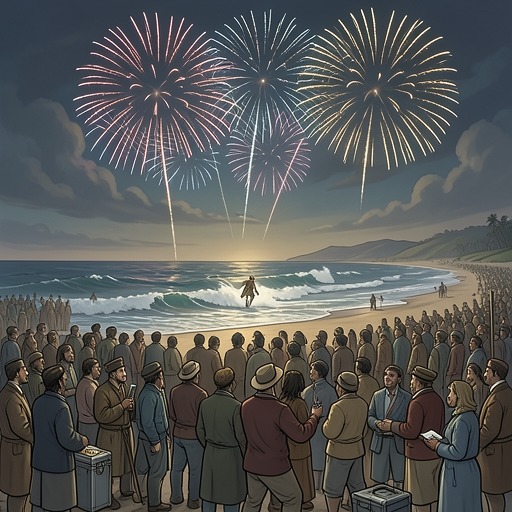
As darkness falls, the beach fills with spectators looking toward the sky. The display is unusually lavish, with Roman candles sending up color and noise; Heillange City Hall has made a conspicuous effort. The spectacle gives the crowd a shared focus, not by dissolving its differences but by briefly making those differences secondary to a common act of watching.
Stéphanie and Clémence, normally inclined to keep their distance from the crowd's sociability, are caught up in the show. Their attention shifts from mockery to absorption. Nearby, a father holds his daughter as she names the colors overhead, while even the police look up. The scene gathers children, friends, families, and officers into the same moment of attention, and explicitly identifies the occasion as July 14, Bastille Day.
The display ends, the spectators whistle and applaud, and the crowd immediately disperses toward drinks. The transition is practical and unceremonious: the audience is thirsty, and dancing is about to begin. The holiday's communal feeling is real, but it unfolds through a sequence of ordinary pleasures rather than as a permanent change in the town's social life.
A Later Image of National Unity
The book later sets the fireworks' shared gaze beside a separate public spectacle: France's 1998 World Cup semifinal victory over Croatia. In a bar, Anthony and Hacine recognize one another just as Lilian Thuram scores. The equalizer turns the room from stunned silence to a shared uproar; after Thuram's second goal, the narration presents the crowd as temporarily fused, with no space for outsiders or exceptions. That unity is described as a fantasy in which history, the dead, and old debts seem momentarily erased.
The celebration spills into Heillange's streets. Cars jam the roads, flags appear at windows, faces are painted in the national colors, and strangers toast and embrace. The police watch with indulgence as people stop to hug and kiss them. At City Hall, champagne is opened, while a local reporter gathers reactions for the next day's newspaper. A few Algerian flags also appear. These details make the scene more complicated than a simple portrait of consensus: the shared national pronoun is emphatic, but the crowd remains visibly varied, and the text frames its unity as an intense, temporary experience rather than the resolution of the town's divisions.
Narrative Significance
Across the lakeside holiday and the later football victory, public celebration makes belonging tangible through shared space, spectacle, and collective attention. The Bastille Day fireworks bring Heillange's disparate residents side by side without pretending their differences have vanished. The football scenes intensify that image into a national fantasy, then place it against the town's long history of hardship. Together, the occasions show how a ritual or sporting triumph can create a powerful sense of togetherness while leaving the conditions of ordinary life unresolved.