Gordon factory
And Their Children After ThemThe Gordon factory is where Anthony Casati moves from a succession of short-term jobs into a more or less permanent position, stacking metal components in a workshop that produces air conditioners. It is both a place of companionship and a tightly managed workplace: the workers share meals, jokes, and a guarded solidarity, while production targets, supervision, and low pay keep their futures precarious. The factory’s routines make Heillange’s economic limits tangible, even during the brief collective euphoria of the 1998 World Cup semifinal.
Anthony’s Route into the Factory
Before arriving at Gordon, Anthony cycles through temporary work in nursing homes, where he does laundry and cleaning, and at the Vivarte warehouse, Liqui Moly, and the Merax print shop. Gordon is a change in duration rather than a secure escape from that pattern: he finds a job in a workshop that is more or less permanent, but the factory’s reliance on temporary workers and its exposure to economic downturns remain part of the workplace around him.
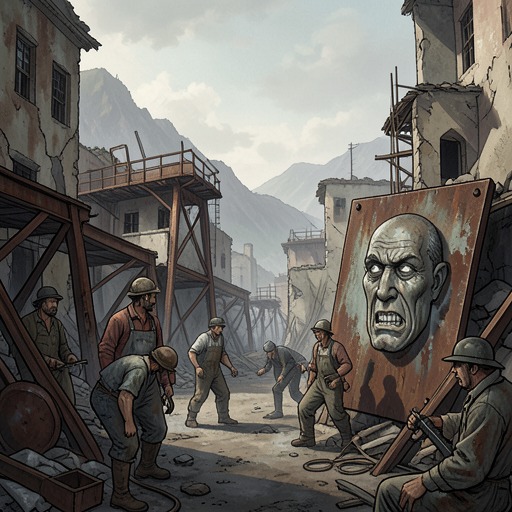
Anthony’s work is physically precise and repetitive. He stacks sheets of metal, rods, and pieces of grillwork in a set arrangement, building a cubic stainless-steel casing. Forklifts lift the heavy assemblies into ovens heated to more than two thousand degrees; the process makes the air conditioners Gordon sells across Europe. The scale of the machinery contrasts with the narrowness of Anthony’s task: he arranges components according to a pattern, while the larger production process moves around him.
The company faces increasing difficulty selling its products. Supervisors watch workers closely, including a continually changing stream of temporary staff who may be dismissed as soon as business falters. Above the workshop floor stand bosses, engineers, and executives, whom Anthony sees in the canteen as representatives of another world. The separation is social as well as organizational: workers and management share a workplace, but not an equal position within it.
Workmates and Everyday Solidarity
Anthony forms friendships with Cyril, Krim, Dany, le Zouk, and Martinet. He is glad to see them in the morning; they eat together in the canteen and meet during breaks in the small courtyard behind workshop C, sitting on pallets and secretly smoking. They also see one another after work. These repeated, ordinary encounters give Anthony a local circle at a time when his working life might otherwise be defined by a succession of jobs.
Their common ground is material and emotional. They have similar wages, similar leisure, and the same unsettled concern about what will become of them. They rarely discuss their deeper problems. In a town they had all wanted to leave, the men recognize the resemblance between their present lives and their fathers’ lives, but the recognition is difficult to voice. Their pride in not being profiteers or unemployed people coexists with a reluctance to name how little room they have to change their circumstances. At Gordon, friendship makes that predicament shareable without making it disappear.
Targets, Tactics, and Mutual Suspicion
The workers manage their pace carefully. They know that working too fast can lead management to raise the following month’s targets; higher demands can then become a means of tightening pressure while presenting the increase as a production bonus. Foremen circulate through the workshops looking for downtime, but the workers keep moving at a deliberate, economical rate, inserting small pauses and adjusting their effort without making the slowdown easy to prove.
This contest produces both suspicion and solidarity. Management watches for idleness; workers watch the demands placed on their labor and avoid giving the company a reason to expect more. Their shared method depends on quiet coordination rather than open confrontation, and the warning against working too hard is a rule of collective self-protection. The factory’s order is therefore sustained not simply by machines and supervisors but by continual negotiation over how much labor the workers will give.
The World Cup at the Workplace
During France’s 1998 World Cup semifinal against Croatia, Anthony encounters Hacine Bouali at a bar. When Lilian Thuram scores, the crowd’s celebration draws the two men into the same outburst of joy. After Thuram’s second goal, the text presents the crowd’s unity as a national fantasy in which old divisions seem, momentarily, to vanish. Heillange fills with cars, flags, firecrackers, and people congratulating one another; the French National Front office temporarily closes its shutter. The celebration belongs to the streets and bars, not to the factory, but its force carries into Gordon the next morning.
At the stacking station, Anthony’s workmates are tired yet radiant, talking about the match and working in a lighter mood. The change is real, but it does not alter the terms of production: they do not work faster, since raising output risks higher targets. Their celebration and their work strategy therefore meet in a telling contrast. Shared national excitement briefly lifts the workshop’s heaviness, while the workers’ practiced caution remains necessary to protect them from management’s demands.
The uplift fades over the shift. After lunch, fatigue and the heat in workshops without air conditioning settle in; the later hours pass slowly, and the workers return to discussing ordinary plans and obligations. When Anthony checks out, he discovers that he is two hours short because of his repeated lateness. He expects a pay deduction and a reprimand from human resources, as well as trouble with the temp agency. The missed hours connect the factory’s timekeeping directly to his personal finances: he earns seven thousand francs a month, half of which goes to rent, while his car and other expenses leave him overdrawn by at least five hundred francs. He keeps returning to work because he needs the wages, but the factory provides no cushion against a small mistake. Its importance in Anthony’s life lies in this double reality: it gives him work, friends, and a degree of autonomy, yet reproduces the insecurity and limited prospects that shape daily life in Heillange.