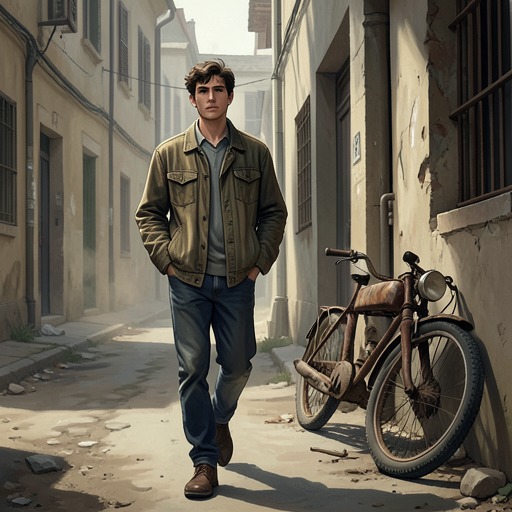
Hacine Bouali returns to Heillange
And Their Children After ThemHacine Bouali’s return to Heillange is marked less by a homecoming than by a reckoning. After an uneasy visit to his father, he finds the familiar group in the courtyard and discovers that the neighborhood has changed while he was away: younger boys now control the drug trade. When he insists on waiting for Kader, the reunion becomes the prelude to a confrontation over who holds power in the ZUP.
Arrival and the Visit to Bouali
Hacine returns to his father’s apartment with no settled place to sleep. Asked where he is going, he says that he has to see friends; when asked whether he has somewhere to stay, he brushes off the concern. His father has prepared his room, but Hacine has not yet found a place of his own. The exchange establishes both a practical uncertainty and the careful, awkward hospitality awaiting him at home.
The two go into the kitchen, filled with the smell of Moroccan soup. Bouali asks after his wife, Hacine’s mother, although he speaks with her every day. Hacine says she is fine and taking it easy; his father approves. This small domestic routine briefly gives the return the shape of an ordinary family visit, but it does not restore closeness. Bouali soon embraces his son again and hustles him out without explaining why.
Intrigued, Hacine stands on the doormat after the door closes. The stairwell is silent, and when he turns the handle, the door opens. Light from the kitchen reaches into the hallway, but he does not go farther: he feels like a burglar or a tomb robber, ashamed to cross the threshold. Then he hears his father urinating and lamenting his fate. Hacine quietly closes the door, leaving Bouali alone with the monotonous secrets of old age. The scene makes the apartment a place he can enter but cannot comfortably inhabit: his father offers him a room, yet the return reveals the distance between their lives.
The Courtyard and a Changed Neighborhood
Outside, Seb is the first to spot Hacine. He is sitting on a low wall, throwing small stones at a larger one, and has become skilled at the game. It is nearly dark; five boys are gathered as they usually are beneath a streetlight, smoking, talking, and sharing white rum brought back from la Réunion by Steve. Seb has traded his 49ers cap for a navy-blue-and-white Detroit one like the cap worn by Magnum in the old television series. The carnival women have not come that year, but the boys still occupy the courtyard, facing the empty space framed by the towers.
Hacine approaches holding his ax handle. The group has known for several hours that he is back and has spent the afternoon making fun of him. They wonder why he has returned to the neighborhood, since they believe he had been living like a mogul in Morocco and Spain. Their curiosity gives way to unease as they meet him in person. He answers each boy with no more than a terse word or two, and his coldness spreads through the group. Eliott looks at his friend and cannot recognize him, even while knowing it is him.
A ten-gram bar of hashish, pulled from Hacine’s pocket, briefly changes the mood. The boys start rolling blunts, and within ten minutes they are back on the wall, smoking and chatting. Hacine alone remains standing, leaning on his club. The moment restores a trace of the old group’s shared routine, but does not restore their old ease with him; he asks about the business from outside the circle rather than settling back into it.
The New Order and Kader
The boys say the drug trade has gone badly. Younger dealers, only fourteen or fifteen, now control it. They describe a generation that is bold, ambitious, constantly stoned, and interested in making money, with little respect for anyone. The younger boys crisscross the ZUP on scooters, pick fights, and use children younger still as lookouts. Families who want no part in the business find 250-gram soap bars hidden beneath children’s beds or in their grandmothers’ closets. Some of the young dealers carry guns.
Violence has become frequent enough that the police have increased surveillance and patrols, while generally staying in their cars unless serious disorder breaks out. The boys’ account makes clear that Hacine has not returned to the same neighborhood he left. The shared courtyard and familiar faces remain, but the trade has passed to a younger, more brazen cohort, and the adults and families around it are pulled into its risks whether they want involvement or not.
Hacine asks where Kader is. Nobody knows, though they say he usually comes by in the evening. Hacine declares that they will wait for him. The others lose their desire to smoke; now they understand why Hacine has returned. By the time Kader appears, almost midnight, the boys are stoned, hungry, and worn down by the waiting. Each time one speaks, Hacine seems to condemn them all to death. Thunder sounds intermittently, and heat lightning flickers on the horizon near the border. The oppressive night makes Kader’s arrival a relief, but also sharpens the sense that the confrontation can no longer be deferred. The return ends at that threshold: Hacine has come back not simply to reconnect with his friends, but to face the person associated with the changed business.