Hacine and Bouali's Fading Father-Son Bond
And Their Children After ThemHacine and Bouali's Fading Father-Son Bond is a relationship of care that repeatedly fails to become easy closeness. Bouali makes room for his son in his home and stands by him after a serious assault, but their most revealing moments are also marked by things left unsaid. When Bouali eventually returns to Morocco for good, practical concern gives way to distance: Hacine hears a stranger in his father’s voice and keeps postponing a visit he has promised himself to make.
A Room Kept Ready
On a visit to Bouali, Hacine is asked whether he has somewhere to sleep. He says he does, but his father has already prepared his room. The welcome is expressed through the ordinary work of making a home available rather than through a declaration of feeling. The room remains much as Hacine remembers it: salmon-colored sheets, a flowered quilt, a worn rug, old posters, weights, and a bottle of cologne still mostly full. These familiar belongings establish a material continuity between father and son even as their lives have moved apart.
Bouali’s care is accompanied by nearly continuous commentary on what he is doing. He narrates domestic tasks as he heats water, cuts vegetables, opens a window, and starts the washing machine. The habit keeps the visit filled with talk, but it also helps avoid serious questions. The family’s silences remain intact: Hacine’s brother, for example, is not mentioned again. Father and son share a meal and watch television, yet the routine does not itself resolve what they cannot discuss. Bouali’s readiness to provide a room is clear; emotional openness is less certain.
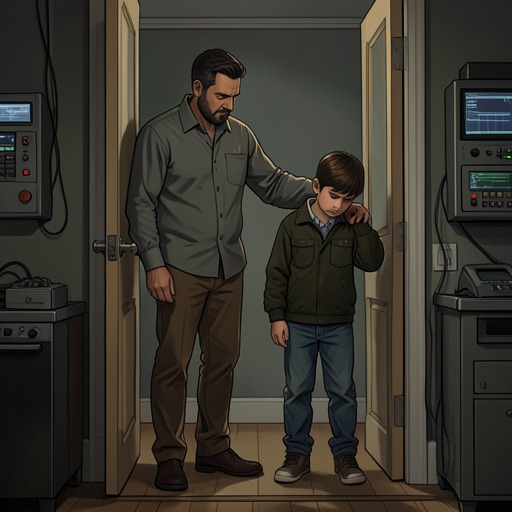
When Hacine prepares to leave, Bouali walks him to the door and places a hand on his back. The gesture is affectionate and unhurried. He asks whether his son will come back soon, and Hacine says that he will stick around now. For a moment, the exchange seems to offer a modest promise of renewed proximity. But after they hug, Bouali ushers Hacine out and closes the door. Hacine turns back and finds the apartment quiet; hearing his father alone, he does not re-enter. He closes the door again and leaves Bouali to his private routine. The scene holds welcome and separation together: each has offered contact, but neither crosses the final threshold toward a more candid conversation.
Care in a Moment of Crisis
The bond becomes more visible when Hacine is found in the men’s room at L’Usine, injured and lying in a pool of blood. Bouali kneels and takes his son in his arms. At the hospital, he comes to see Hacine every day. These actions give the relationship a force that everyday conversation had concealed: when Hacine is vulnerable, his father responds through physical presence and repeated visits.
That care does not erase what follows. Hacine loses his teeth, and the episode marks a change in his conduct: he no longer makes waves. After the trial, Bouali returns to Morocco, this time for good. The sequence sets a concentrated period of paternal attention beside a lasting geographical departure. Bouali has been there at the hospital, day after day, but the renewed closeness does not become a stable shared life. His return to Morocco leaves Hacine with memories of care and a growing inability to reach the man who gave it.
Silence Beyond the Family Home
Bouali’s testimony at Patrick Casati’s trial offers another glimpse of his manner with others. He answers politely and softly, and when the judge invites him to speak directly to Patrick, his former workmate, Bouali says he has nothing to say. His silence is interpreted as dignity and wisdom, though the narration leaves open whether it may simply reflect exhaustion. The moment does not disclose what Bouali feels about Patrick, but it echoes the reserve that shapes the father-son relationship: a consequential encounter arrives, and Bouali declines to put its meaning into words.
In later calls, Hacine hears his father’s voice as increasingly unfamiliar, as if Bouali were being erased from the life around him. He has been telling himself for months that he will go to see his father, yet fears finding himself face to face with a ghost. The fear expresses the distance as Hacine experiences it; it does not establish that Bouali has died. What has diminished is Hacine’s sense of access to him. The son’s promise to visit remains suspended between attachment and apprehension.
A Bond That Persists at a Distance
Hacine’s life with Coralie provides support as he confronts the prospect of losing contact with his father. She takes his hand and offers simple reassurance, helping him bear the loneliness associated with Bouali’s departure. Her support does not repair the relationship or substitute for a reunion. Instead, it makes visible how much Hacine still carries the bond: Bouali’s absence remains a source of grief even when Hacine cannot make himself act on his wish to visit.
The relationship’s defining pattern is therefore not a clean break, but care interrupted by withdrawal. Bouali prepares the bedroom, places a hand on Hacine’s back, holds him after the assault, and returns to the hospital each day. At the same time, their conversations avoid painful subjects, their parting ends with a closed door, and the father’s move to Morocco turns contact into a thin telephone connection. Hacine’s hesitation to visit completes the pattern from the other side. The bond endures in remembered gestures and deferred intentions, while the distance between father and son becomes harder to cross.