Hacine's Crisis in Family Life
And Their Children After ThemHacine’s Crisis in Family Life is the account of a new father who loves his infant daughter yet finds that parenthood has not relieved the anger and unhappiness he already carried. In the months after Océane’s birth, the ordinary work of caring for her, tensions with Coralie, and the close involvement of her parents turn home into a place where Hacine feels increasingly like a stranger. His escape into the 1998 World Cup offers distraction rather than resolution, until Coralie’s warning makes the risk to their family unmistakable.
A Household Organized Around the Baby
Since bringing Océane home from the maternity ward, Hacine and Coralie have lived by the recurring tasks of infant care: getting up at night, preparing bottles, changing diapers, taking walks, and continuing to work. The routine makes their days feel interchangeable and exhausting. Conversations between the couple readily become arguments; much of the time they pass one another in a daze, bound together by the practical work of sustaining their baby. Océane is six months old by early August, and her arrival has reorganized the household around her needs.
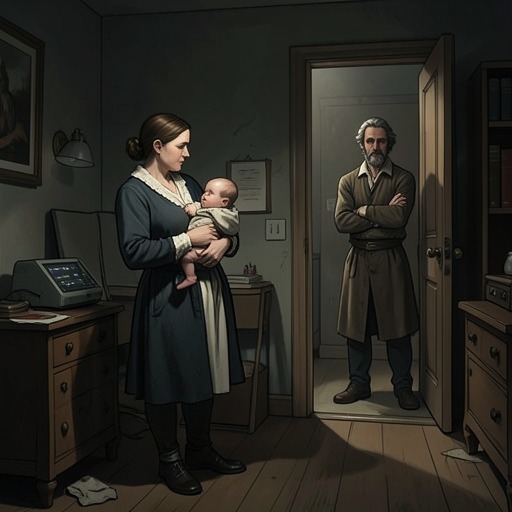
Coralie is also struggling with changes following pregnancy. She is distressed that she has not lost the weight she gained, cries easily, and is affected by changes in her body and mood. Hacine’s attempts to put her situation in perspective do not comfort her. Her parents’ frequent, unannounced visits add another strain. They come to see the baby and help, bringing soup, cleaning supplies, and an apron; Coralie’s mother also reorganizes the kitchen drawers. Their assistance is presented as kindness, but Hacine experiences it as an intrusion into the couple’s home and decisions, with little room to refuse without seeming ungrateful.
Hacine’s place in this new household is therefore double-edged. He appreciates that Coralie’s family has accepted him, yet resents their habits and assumptions. He feels alienated by their fixed mealtimes, careful accounting, conventional tastes, and trust in familiar authorities and television. Their faith in straightforward rules of right and wrong seems to him poorly suited to understanding contemporary politics, work, and public affairs. The contrast sharpens his sense that he is living inside a family’s settled way of life without feeling that it is his own.
Work, Alienation, and the Couple’s Disconnection
Hacine is employed on an open-ended contract at the Darty warehouse in Lameck, but work offers no reliable confidant. When he admits to coworkers that he cannot stand his situation, someone answers with the conventional assurance that having a child is the most beautiful thing in the world. The response closes down rather than opens up conversation: the accepted story of parenthood leaves little space for his exhaustion or ambivalence. Work and home thus reproduce the same pressure to treat family happiness as self-evident.
The strain also changes how Hacine understands Coralie. He had loved her sociability, cheerfulness, and appetite for trying things; he remembers her enjoyment of friends, food, and the elaborate preparations and small gifts of Christmas. Her exuberance made connection possible for him, someone who tended to retreat from opportunities and remain in his corner. Since Océane’s birth, however, Hacine sees that Coralie had carried an inner emptiness that the baby now fills. Océane has become the measure by which the household’s choices are made. Hacine does not blame the baby or resent her attention; he recognizes instead that parenthood has not filled a comparable space in him. His pre-existing neuroses, unhappiness, and anger remain, leaving him unable to explain why the new family life intensifies rather than settles his discontent.
The couple’s intimacy and communication contract along with their energy. They stop having sex, and Coralie often sleeps while Hacine sits with her father watching the news, wondering how he arrived at this life. His feeling of being a stowaway captures the distinction between being present in the household and experiencing it as his own. As the relationship deteriorates, he keeps his grievances to himself rather than finding a way to discuss them with Coralie.
The Motorcycle and the World Cup as Escapes
When a salesman at the store advertises a Suzuki DR, Hacine goes to see it and writes a check without thinking through the decision with Coralie. Their finances are already in difficulty; the purchase means they cannot take a vacation that year, and they no longer have a garage. Coralie also fears the danger of motorcycles and challenges Hacine’s maturity. The argument brings several aspects of their crisis together: his impulsive pursuit of an escape, their limited money, and Coralie’s sense that she is left to manage the consequences.
Hacine makes an effort afterward, and Coralie compromises, but their life together comes to resemble a war of attrition. She criticizes him for acting as he pleases and behaving like a child; he keeps his own reproaches inside. He rides in the evenings without a helmet, finding the outings reassuring. Their apparent stabilization remains fragile. During the World Cup, Hacine’s father-in-law teases him about Morocco’s prospects and mocks the team after its loss to Brazil; Morocco later beats Scotland, but does not reach the final. The taunts connect the tournament to Hacine’s family tensions, even as the competition becomes a larger refuge from them.
Rather than coming straight home after work for the France-Denmark match, Hacine goes to a bistro with coworkers. He wants to watch the game and cannot face the apartment, the in-laws, and the crying, but guilt spoils the outing. He misses France’s first goal because he is preoccupied with the scene he expects at home, then leaves at halftime, frustrated as well as guilty. When he returns, the apartment is empty: Coralie has taken Océane to her parents’ home and left a note. Hacine feels relief, eats alone, watches the rest of the match, and spends the night by himself. The episode briefly gives him the solitude he has been seeking, but it also exposes how far the family has withdrawn from one another.
Withdrawal and the Threat of Separation
The next morning in the shower, Hacine wonders what he is doing with his life and feels trapped. He loves Océane, who does not demand anything from him, but cannot see how to remain in the situation. He takes a Temesta and goes to sleep. Coralie returns the following morning, and for the rest of the week the couple barely speak. As France advances past Paraguay and then Italy, Hacine immerses himself in matches, commentary, news, and newspapers. The national excitement is both compelling and convenient: following the tournament lets him lose himself in a public story while avoiding the private crisis at home.
Coralie does not directly criticize him during this period, but Hacine reads her unhappiness in ordinary gestures: her footsteps, the drawers she slams, the way she shuts the refrigerator and eats yogurt. He recognizes her sadness, yet carries on as if nothing is wrong and expects an eventual explosion. His contribution to childcare becomes a bare minimum: he changes every other diaper, gives Océane a bottle now and then, and puts her to bed with perhaps a brief song. He sleeps on the sofa, physically and emotionally withdrawn from the shared household.
On the morning of the semifinals, Coralie wakes him with coffee. Her later warning gives the crisis its clearest consequence: she tells him that unless he changes, she will leave with their daughter and he will never see them again. The threat is not abstract; she leaves him responsible for Océane just as he has to get ready for work. Her mother arrives and takes the baby without making a scene, allowing Hacine to leave. The sequence makes clear both the precariousness of his domestic position and the practical support Coralie’s family can provide.
A Moment of Recognition
As Hacine prepares to go, he hears his mother-in-law soothing Océane until the baby laughs. The contrast between the smallness of the immediate task and the child’s capacity for happiness sharpens his awareness of how vulnerable she is. He kisses her on the head and fist before climbing onto his motorcycle; Coralie has taken the car. This brief act of affection does not resolve his withdrawal, but it places his love for Océane beside his recognition that caring for her carries serious responsibility.
The crisis is left at a point of confrontation rather than reconciliation. Hacine has made efforts and the couple has temporarily stabilized, but the motorcycle purchase, his retreat into the tournament, and his limited role in childcare have brought Coralie close to leaving. The World Cup supplies a collective drama into which he can disappear, while the private demands of family life remain waiting at home. The account’s central tension is not that Hacine lacks affection for his daughter; it is that affection alone has not made him feel at home in the life built around her.