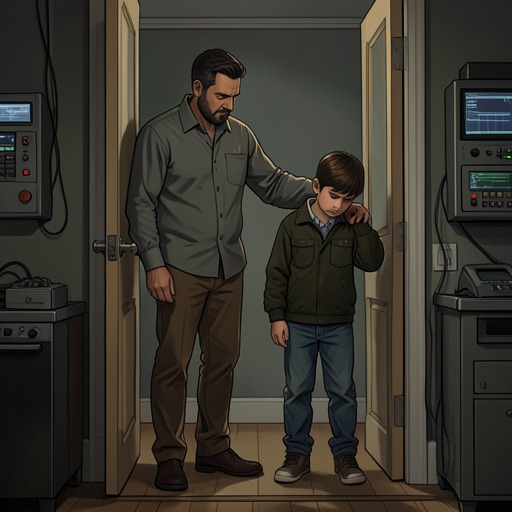
Hacine's Forced Return to Morocco and Reunion with His Father
And Their Children After ThemHacine’s relationship with his father moves between provision and command, and the separation imposed on them gives both its practical and emotional stakes. His father can prepare him carefully for a family visit, entrust him with the responsibilities of home, and later welcome him back with unmistakable pleasure; he can also insist that Hacine obey. When Hacine returns after two years away, the hostile words he had planned to say no longer fit the old man waiting at the door. Their reunion does not erase the history of coercion or absence, but it makes that history newly difficult to sustain as a simple quarrel.
Care and obligation before the separation
Two years before Hacine’s return to Heillange, he and his father travelled to Morocco in a car packed with goods for relatives and items to resell. On the ferry, his father cut his hair and took new clothes and leather shoes from his suitcase for him. The preparations were a practical form of paternal care: his father wanted Hacine to arrive looking presentable. On the other side of the Mediterranean, Hacine’s mother embraced him while the extended family waited nearby. Hacine felt embarrassed by the welcome and judged the relatives harshly at first, but his father’s attention to his appearance had already made the journey an occasion on which he was being presented to family.
The visit also exposed the unfinished house his father had been having built. Its incomplete walls and exposed construction materials made the delay visible, while the workers’ explanations and requests for permits and baksheesh accumulated around it. His father accepted responsibility for not having been there to supervise. The distance between France and Morocco was therefore more than a matter of travel: it left him absent from his wife and unable to oversee the home he meant to build. The unfinished house stands in the account as a material sign of that absence, and of his awareness that distance had consequences he could not simply delegate away.
Command, departure, and enforced responsibility
After the police detained Hacine in connection with the motorcycle affair, his father announced that they were leaving for Tétouan the next day. The police found hashish and a knife hidden in Hacine’s bed springs, held him for five hours, and released him; Hacine did not speak during the questioning. His father’s decision followed immediately. The text places that departure against an older pattern of threats: he had often told Hacine that another failure would bring severe punishment. The words are presented as sincere in tone but emptied of force through repetition, a contrast that complicates the father’s authority without making the threat itself benign.
At dawn, Hacine found his father waiting beside the traffic. His father’s body appeared frail, and Hacine considered that weakness before refusing to go. The refusal made explicit how little the move seemed to offer him. His father answered that he was not asking for an opinion, then invoked the shame of what had happened and insisted that Hacine obey. The exchange shows the relationship at its most openly unequal: Hacine objects, but his father treats the decision as settled. Their journey to Gibraltar passed with almost no conversation. At the crossing into Ceuta, Hacine remained in the car while the customs process stretched through a crowded, difficult scene; resentment, rather than reconciliation, accompanied the trip.
In Morocco, the obligation continued after the initial journey. When his father later returned to France, he charged Hacine with looking after his mother and supervising the construction, saying he was counting on him. Hacine promised to do so, although he would rather his father had stayed to handle the work himself. The promise exposes a double pressure: Hacine is made responsible for tasks that his father regards as necessary, while he resents being left to perform them in his father’s place. His mother’s repeated criticism of him and her concern about neighborhood opinion added to the strain of the household. Several times, Hacine went secretly to the stairwell to cry. His distress is described not as a break with his family but as a consequence of being confined within its expectations and the crowded life of the apartment.
Return and the failure of revenge
Two years later, Hacine came back to his father’s apartment carrying an ax handle and brooding over the recent disaster that had brought him there. A neighborhood boy recognized him after a two-year absence and hurried to spread the news of his return. His father was already waiting when Hacine reached the third floor; the door opened before Hacine could ring, and his father greeted him with a broad smile. The reception reverses the distance that had defined the preceding years: the father who once sent Hacine away is now ready to receive him before he has even knocked.
The brief embrace did not settle what had happened between them. His father glanced at the ax handle and asked what it was for. Hacine had spent the journey imagining cutting remarks, but facing his father in the building where he had grown up, he could no longer make those plans seem meaningful. He saw an old man as gentle, forgetful, and weary, and understood that his own preparations for confrontation were largely for show. He dismissed the handle as being for nothing and as foolishness. This is not a declared reconciliation: Hacine does not stay, and the evidence gives no account of a full explanation or apology. What changes is the immediate emotional balance. The father’s visible gladness and frailty interrupt the performance of revenge that Hacine had carried with him.
A tentative domestic closeness
Inside, Hacine’s father had made harira but forgotten the parsley and nearly run out of chickpeas; he had also bought tea and fresh mint. These ordinary details give their reunion a domestic scale. The father, whom Hacine found unexpectedly talkative, was no longer only the commanding figure associated with the departure. Hacine noticed signs of age in the apartment and sensed the accumulated passage of time there, while the familiar household setting connected the returning son to the home he had left.
When his father took him by the elbow to get his attention, Hacine felt the strength of the grip and was reassured. The gesture offers a small, physical confirmation that the old man is still present and capable of reaching him. Yet when his father asked whether he would sleep there, Hacine answered that he would not stay. The reunion therefore holds closeness and distance together: a welcome, a shared apartment, and a reassuring touch do not reverse Hacine’s decision to leave. The relationship’s lasting significance lies in that unresolved mixture. Its history includes care, delegated responsibility, repeated threats, separation, and a homecoming in which anger loosens without giving way to a complete repair.