Hacine–Anthony relationship
And Their Children After ThemHacine Bouali and Anthony Casati share a hometown, a working-class background, and years of uneasy proximity, but those common roots do not make them friends. Their relationship is marked first by a long silence and mutual uncertainty, then by an extraordinary public celebration that briefly makes contact possible. When they meet again during France’s 1998 World Cup semifinal, a conversation and the loan of Hacine’s motorcycle suggest a limited truce, not a full resolution of the past.
Shared Ground and Estrangement
Anthony and Hacine have grown up in the same town, attended the same schools, and left school too early. They have also known the boredom of similar jobs. Their fathers both worked at Metalor, tying the two families to the same industrial landscape. The history gives them plenty of points of contact, but, as Anthony reflects during their later meeting, shared circumstances have not translated into intimacy. They have encountered one another many times without becoming close; between them remains a palpable reserve.
That distance is not simply unfamiliarity. When they meet after a long interval, both recognize the other, yet neither seems prepared for what recognition requires. Hacine asks what they should do, and Anthony has no answer. Their hesitation makes the relationship’s old antagonism visible without spelling out a complete account of it: the past is present in their discomfort, but they have no ready language for it.
The Bastille Day Encounter
At a Bastille Day celebration by the lake, Anthony and Hacine first cross paths again in a secluded moment away from the festivities. The encounter begins with the relief of hearing another person nearby, but that brief ease ends when they realize who they are standing with. They remain speechless for a while, stunned by the coincidence and unsure how to behave. Hacine’s question about what to do receives no answer from Anthony, who is equally at a loss.
The fireworks begin just as the meeting stalls. In the sudden darkness, the crowd turns toward the display, and Hacine disappears. Anthony is left alone before hurrying back to his cousin and the others. The timing matters: while the two men cannot find a way into conversation, the celebration gathers the town into a shared spectacle. For a moment, the public event supplies a common focus they cannot yet make between themselves. Their reunion is real, but it does not immediately become reconciliation.
At a later gathering, Hacine again encounters Anthony and becomes increasingly watchful. The meeting leaves him feeling exposed and on guard, glancing around as though someone might be about to confront him. This reaction belongs to a tense evening that also brings him face to face with Patrick Casati, Anthony’s father, the man associated with the serious injury to Hacine’s mouth and the long period of hospitalization and recovery that followed. Keeping the two encounters distinct is important: Hacine’s history of physical injury is connected to Patrick, while his uneasy recognition of Anthony is part of the strained relationship between the two younger men.
A Reunion in the World Cup Crowd
Two years later, the semifinal between France and Croatia brings Anthony and Hacine together in L’Usine. They arrive separately amid the crowded streets and bars of Heillange. After Croatia scores, the bar falls silent; when Lilian Thuram scores for France, the room erupts. Anthony recognizes Hacine, and Hacine recognizes him, but the match and the cheering crowd take precedence over any private reckoning. In the rush of celebration, Anthony shakes Hacine, and Hacine raises both fists in the air.
The game’s emotional force briefly overwhelms the divisions between them. As France’s comeback gathers momentum, the narration describes a country imagining itself as united, with history, debts, and differences seeming to fall away. That feeling does not erase the pair’s personal history, but it creates an unusual opening: they participate in the same collective joy before they can manage an ordinary conversation. The celebration’s promise of unity is temporary, and the relationship’s subsequent awkwardness shows its limits.
After France wins, Heillange fills with honking cars, flags, firecrackers, beer, and embraces between strangers. Anthony and Hacine avoid each other for much of the evening even as they share the crowded celebration. Only late, outside L’Usine, do they begin speaking. Hacine makes the first approach, and Anthony agrees that the victory and the night have been remarkable. Their brief exchange does not turn them into confidants; it lets them acknowledge that they are together in a moment that neither would have chosen as a private meeting place.
A Limited, Practical Truce
As they talk, Anthony tells Hacine that his father died exactly two years earlier. He watches for a reaction, but the news appears to settle something between them: in Anthony’s account, it places that part of his life firmly in the past. Hacine asks what happened to Patrick. The question brings the deceased father into their conversation without forcing either man to recount every grievance between them. They can speak, but the exchange remains spare and halting.
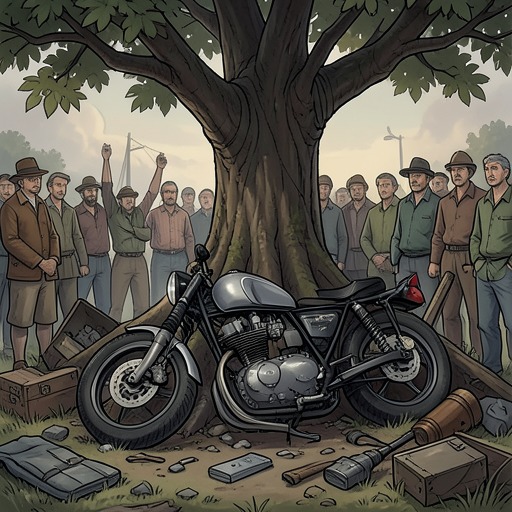
The conversation leads to a small act of trust. Anthony wants to ride Hacine’s Suzuki and becomes impatient as he waits for permission. Hacine sits calmly, smoking, while Anthony stands over him and urges him on. Their shared past—same town, schools, jobs, and fathers at Metalor—still does not make conversation easy. Yet Hacine eventually tosses Anthony the key, with a clear limit: Anthony is to ride to the end and come back. The permission is neither a grand gesture nor a surrender of caution. It is a practical, bounded concession.
The motorcycle gives their relationship a brief change of direction. Earlier, their recognition brought silence, retreat, and unease; now Hacine allows Anthony to take the Suzuki, and Anthony accepts the stated terms. The moment offers no proof that old hostility has disappeared, and the book does not present the two men as having repaired everything. Instead, their encounter suggests how shared history can remain difficult even when a small opening appears. Their temporary rapprochement depends less on declarations than on an ordinary, carefully limited act of trust.