Heat and the Motif of “Fever”
And Their Children After ThemHeat and the Motif of “Fever” is the book’s recurring way of joining summer weather to bodily strain, suspended expectation, and moments when that suspension breaks. In scenes around Heillange, heat is not simply scenery: it presses on people waiting, heightens their discomfort, and gives movement or arrival the force of temporary relief. The chapter title La Fièvre gathers these associations without making them resolve into a single explanation.
Weather as Collective Pressure
For several days, the air around Eliott has felt heavy and unsettled. Wind and lightning seem to promise rain, but each apparent change fails to bring relief, and the oppressive conditions resume. The weather’s repeated false starts shape the scene as an interval that cannot quite end: hope rises, then stalls. Eliott’s discomfort is concrete and persistent. His back and hands are damp, and his mother has to use talcum powder on him in the morning. The passage places the body, rather than an abstract forecast, at the center of the heat’s effects.
That pressure is also shared beyond Eliott. In a late-night gathering, Hacine’s companions are stoned, hungry, and increasingly unable to bear the wait for Kader. Thunder sounds intermittently, while heat lightning is visible near the border. The group’s impatience grows alongside the weather; the prospect of a shower and sleep becomes more appealing than continuing to wait. Kader’s arrival therefore changes the atmosphere of the gathering, not because the heat has lifted, but because the boys can finally stop waiting. The scene makes weather and social tension move together: both accumulate, and a change in the situation offers only an immediate, limited release.
Waiting, Pressure, and Stéphanie’s Future
At Heillange Train Station, the oppressive weather accompanies another kind of suspended time. Clémence and Stéphanie wait on an almost deserted platform for a train due at 4:42, which will stop for no more than two minutes. The station survives even though regional trains no longer stop there; its continued existence has become a political issue for the deputy mayor. Old advertisements and barely legible schedules make the place seem caught between a service that has largely vanished and the insistence that the town still needs it.
The two girls respond differently to the conditions. Clémence goes to wait in the shade, while Stéphanie, feverish, stares toward the point where the tracks converge. Her attention to the horizon belongs to a wider period of pressure: she has been working hard for her exams after her father demanded that she pass the baccalauréat with honors, tying that result to whether she can have a car and a vacation. Heat thus coincides with a threshold in her life, but the connection remains grounded in the scene’s circumstances: she is waiting in oppressive weather while a consequential result and an uncertain journey lie ahead. The passage does not make the train a solution; it emphasizes the short, precarious opening represented by its brief stop.
Heat, Movement, and Vulnerability
The ride with Anthony shifts the motif from waiting to movement. On warm evening roads, Stéphanie experiences the rising speed as an intense physical sensation and holds on to Anthony as they travel through open areas, woods, and fields. The changing landscape contrasts with the earlier scenes of people held in place by discomfort and delay. Yet movement does not erase vulnerability. At the Sailing Club, Anthony leaves to retrieve a bottle, and Stéphanie becomes frightened while alone in the dark. When a car approaches, she hides in a grove and waits until Anthony returns; her relief is immediate. The night’s exhilaration and her anxiety occupy the same sequence, showing that the passage from stillness to movement does not guarantee security.
The chapter’s account of their encounter at the Decommissioned Power Plant also turns on a shift from closeness toward separation. Afterward, they dress and leave the fire to die. Stéphanie holds on to the motorcycle’s saddle, and Anthony receives a brief farewell gesture. He tries for several days to understand the encounter as a triumph, but the narrative corrects that interpretation: Stéphanie, rather than Anthony, had directed what happened between them. In this sequence, physical intensity gives way to an uneven understanding of the relationship. Heat and summer movement form the setting for intimacy, but they do not establish mutual expectations or lasting attachment.
La Fièvre and the Motif’s Function
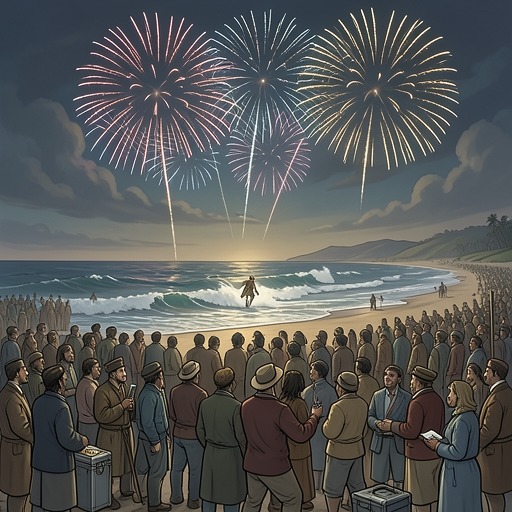
The heading La Fièvre follows the power-plant scene and introduces the date July 14, 1996. Its placement gathers the preceding images—oppressive air, frustrated expectation, feverish attention, and movement through the evening—into a seasonal frame. The heat repeatedly makes waiting palpable: Eliott endures discomfort; Hacine’s group grows impatient; Stéphanie watches the tracks while facing exam pressure. When action finally comes, whether Kader’s arrival or Anthony’s return, it provides a moment of relief without changing the wider conditions that produced the tension.
The motif’s force comes from that recurrence and its variations. Weather presses on different bodies and situations, but it does not dictate one outcome. It can accompany physical discomfort, intensify a group’s impatience, frame a consequential wait, or surround a brief experience of closeness and fear. The title La Fièvre names an atmosphere of heightened pressure rather than a single event. Across these scenes, summer becomes a condition in which pauses feel charged and small changes—a person arriving, a train expected, someone returning—carry unusual weight.