Heillange Bastille Day celebration at the American Beach
And Their Children After ThemHeillange Bastille Day celebration at the American Beach is a public gathering where the town’s divisions briefly share the same ground and gaze. Speeches, fireworks, and dancing turn the lakeshore into a communal spectacle, but the crowd’s temporary togetherness does not erase the separate lives and tensions unfolding within it.
Setting and Preparation
The gathering draws a broad cross-section of Heillange and its surroundings: older residents, unemployed people, business figures, young motorcyclists, families, workers, and visitors from the countryside. They arrive in large numbers, parking along the departmental highway, in fields, and even in the forest before moving together toward the lakeshore. The narration stresses the crowd’s differences, but also its ease in occupying the same route and public space.
The name American Beach has an accidental local history. In the 1960s, a man who operated a military-surplus shop and sold imported jeans built a drive-in there, claiming to be from Texas and dressing in cowboy boots. The theater did not last, but the name remained, detached from the failed business that gave rise to it.
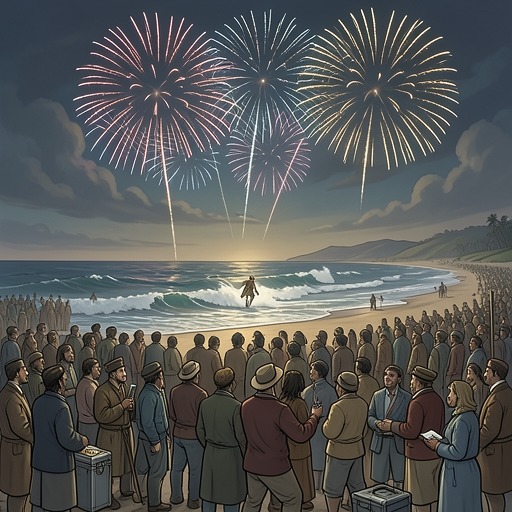
By the time Stéphanie and Clémence arrive, preparations are underway. A stage is ready for speeches, and a municipal worker tests the sound system. There is no band that year, judged too expensive and old-fashioned; a DJ is planned instead. The official refreshment area has long tables and benches, with a permitted seller of fries and sausages beneath a canopy. Other vendors later bring their own grills or fryers and sell informally, while the authorities generally let them do so. Some spectators have arrived early with folding chairs and coolers. A barge carrying fireworks waits offshore as people settle in along the shore.
Fireworks and the Shared Crowd
As darkness falls, the fireworks command attention across the beach. The display sends colored light over the audience, and the town’s investment in the show is apparent. Even Stéphanie and Clémence, who might otherwise have kept their distance from the sociable crowd and its popular music, become absorbed in the spectacle. Nearby, a father holds his daughter as she points out the colors in the sky; police officers also watch. The scene gathers people of different ages and positions around one shared object of attention.
The display’s ending moves the audience from watching to participating. After the fireworks, people applaud and go to find drinks; the dancing begins. A DJ starts with familiar popular songs, and couples take to the dance floor. Older people watch the younger crowd, while teenagers remain at its edge, attentive to one another and uncertain about approaching. The celebration thus makes sociability visible without suggesting that everyone experiences it in the same way: shared music and public space coexist with shyness, self-consciousness, and differences between generations.
Stéphanie and Clémence join the dancers, copying one another’s movements. Anthony Casati finds them there after returning from the forest, where Hacine Bouali has separated from him and gone off on his own. The party’s large-scale spectacle therefore contains smaller, more personal movements: Hacine’s departure, Anthony’s return to his cousin and companions, and the two young women’s brief shared moment on the dance floor. Patrick Casati has also set out for the lake, taking beers in his car and intending to give his son a present. The gathering brings these separate trajectories into the same public setting, without making them identical or resolving their differences.
The Celebration and National Belonging
The event’s importance lies partly in the contrast between the town’s varied population and the short-lived unity produced by the fireworks. The audience turns toward the same display, and the evening makes collective belonging tangible through a shared public ritual. That unity is not presented as a permanent social settlement: the party moves on to drinking and dancing, while the individuals within it retain their own histories and concerns.
A later scene in Heillange offers a related but distinct image of collective feeling. During France’s 1998 World Cup semifinal against Croatia, Anthony and Hacine recognize one another in a bar as Lilian Thuram scores; they join the surrounding spectators’ excitement. After France reaches the final, the town’s streets fill with honking cars, flags, painted faces, firecrackers, and embraces. The newspaper reporter hears a repeated collective pronoun in people’s accounts of the victory, while Algerian flags also appear and the local National Front office closes its shutter for the time being. This later episode is not part of the American Beach celebration, but it echoes the earlier gathering’s temporary convergence of people who ordinarily occupy different positions in Heillange. In both scenes, public festivity makes a shared identity perceptible without showing that underlying differences have disappeared.