Heillange’s postindustrial decline
And Their Children After ThemHeillange’s postindustrial decline is the valley’s passage from a region organized around its blast furnaces to a place of scarce work, makeshift livelihoods, and uneven new economic activity. The furnaces once drew in labor and materials on a vast scale; after their closure, their remaining structures became relics, while the people who had depended on industrial employment sought less secure ways to get by. The novel sets those remnants beside both the stasis of everyday life and the tentative revival brought by cross-border commuting.
The industrial system and its closure
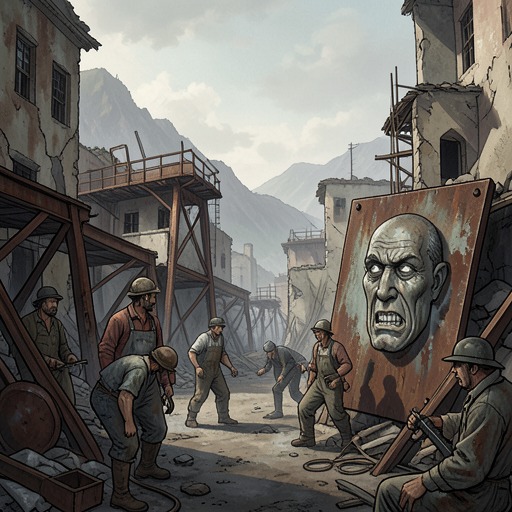
For a century, the Heillange blast furnaces consumed more than fuel and ore: they absorbed people and time as well. Carts on tracks carried in the raw materials, and ingots left by train, entering a wider network of rivers and streams that carried metal across Europe. The mill stood at a crossroads, sustained by roads and channels that connected the valley to the circulation of goods. Yet that circulation was not an uncomplicated source of prosperity. Once materials had been deposited and sold by weight, the network had also drained parts of the town, leaving behind absences that could be read in overgrown tracks, fading billboards, and bullet-riddled street signs.
Anthony knows the mill’s history from what he was told throughout childhood. In the furnaces, ore became cast iron at three thousand degrees; the men who tended the firebox were remembered as either proud or dead. For six generations the works hissed, moaned, and roared, including at night. Because stopping the machinery would cost too much, men were pulled from their beds and their wives rather than the furnaces being interrupted. This account makes industrial continuity intimate: the mill’s unceasing operation was sustained by claims on workers’ bodies and family lives, not simply by machinery and supply routes.
Work after the furnaces
The mill’s closure did not lead directly to stable replacement employment. Patrick Casati and Luc Grandemange had worked together at the Rexel warehouse shortly after the blast furnaces shut down. They belonged to a group of men who chose early retirement and entered training as forklift operators. At first the change seemed promising: driving the forklifts all day could almost feel like playing a game. The contrast between that initial sense of opportunity and Patrick’s later difficulties makes the industrial transition tangible at the scale of a working life.
Patrick lost his job and his driver’s license on the same day, for the same reason; the account does not specify that reason. He recovered his license after six months of administrative hassles and a period in rehabilitation with the Croix Bleue, but work remained scarce in the valley. He eventually tried to make a living independently, buying an Iveco dump truck, a mower, tools, and coveralls bearing his embroidered name. His small jobs were mainly paid under the table. In a good month he could earn four or five thousand francs, and Hélène Casati’s salary helped the household make ends meet. The equipment and personalized work clothes suggest the dignity of a trade, but the irregular earnings and dependence on informal jobs reveal its limits.
Summer brought more work, and Patrick pressed Anthony Casati into helping him mow lawns and clean swimming pools. His son’s labor was particularly useful when Patrick had a hangover; one morning Anthony had to trim the shrubs at Dr. Schmidt’s home. The scene links economic scarcity to family life without turning the side business into a secure solution: household needs are met through seasonal work, a parent’s fluctuating capacity, and a child’s contribution.
Idleness and the valley’s new economy
For the boys in the housing projects, decline is also experienced as time that seems to congeal. A little after three, the same midafternoon numbness settles over the area each day. Children and television sets fall quiet behind open windows; the towers appear to sway in the heat, while an occasional tuned-up motorbike cuts across the silence. The boys wipe sweat from their hats and feel sluggish, irritable, and out of place. Their imagined alternatives—a job, perhaps in an air-conditioned office, or a day at the seaside—measure the gap between what they want and the life their surroundings seem to offer. This is not simply an absence of work in the abstract: it is a repetitive daily condition, sharpened by heat, boredom, and the sound of movement passing through.
The valley is not entirely sealed off from change. Near the border, deserted settlements begin to come back to life as Luxembourg, short of workers, recruits from neighboring areas. Commuters travel abroad for better-paid jobs, though social services there are meager; their lives straddle the frontier, with work on one side and home on the other. Their movement helps revive places that had seemed moribund: a school is saved, a bakery opens beside a shuttered church, and houses appear in the countryside. Trains fill and highways clog each morning and evening with tired workers seeking their livelihood abroad. The new activity therefore complicates any account of decline as total disappearance: economic life returns, but its routes and conditions differ from those of the old industrial order.
The mill as ruin and contested memory
What remains of the blast furnaces is not a functioning center but reddish shapes behind a fence secured by a small padlock. Their afterlife offers no settled account of what the site should mean. Someone held an art opening there the previous year; a legislative candidate proposed turning the ruins into a theme park; children now attack them with slingshots. These uses—art, political proposal, casual destruction—set competing meanings against the remembered scale of the works. The mill that once organized six generations of labor has become an enclosed place for other people’s projects and gestures.
The danger of the ruin is concrete as well as symbolic. A firefighter reports that a boy was found there half dead after being struck in the temple. The incident gives the abandoned site a present consequence: it is not only evidence of what the valley has lost, but also a hazardous space where its young people spend time. Read alongside the cross-border revival and the boys’ recurring midafternoon stagnation, the fenced furnaces hold the novel’s central contrast in view. The old industrial system has stopped, but its effects persist in livelihoods, landscapes, and the uses—or lack of uses—available to the people left behind.