Henne Valley
And Their Children After ThemThe Henne Valley is a landscape of tributaries, hills, fields, roads, villages, and former industrial life, where the marks of prosperity and decline remain visible together. It gives intimate encounters a setting while carrying a history larger than any one life: a valley whose past has shaped its communities and whose future is still being argued over.
Landscape and Settlement
From a vantage point above the valley, the Henne winds and glitters in the distance. Six towns and smaller villages, factories and houses, families and routines occupy the landscape. Geometric fields of wheat and yellow rapeseed lay a precise patchwork over the hills; remnants of forest run between parcels, connect hamlets, and border gray roads used by ten thousand semis each year. In smaller valleys, an isolated oak can stand out against vivid green.
The scene resists a simple division between nature and human settlement. Waterways, fields, woods, roads, and built places compose a lived-in region, where daily routines and industrial infrastructure share the same ground. The valley’s scale also shifts the perspective on its inhabitants: from above, Anthony and Stéphanie appear small within a place that is itself only one part of a larger landscape.
Industrial History and Its Afterlife
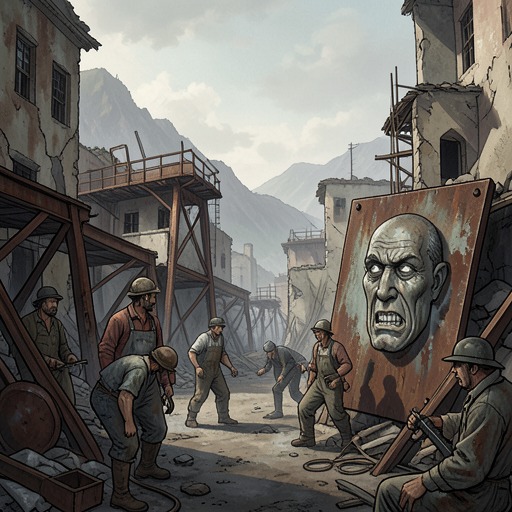
The valley’s visible contrasts record an uneven history. Some people grew rich and built tall houses that seemed to mock the everyday realities of the villages around them. The region’s history is also rendered through its costs: children, the account says, were devoured by wolves, wars, and factories. Industry belongs not only to a story of employment and wealth, but to a longer history of danger and damage.
By the time Metalor has been closed for ten years, local public life is still mourning the loss. At a gathering, a speaker argues that Heillange is too often discussed only through crisis, poverty, and social breakdown. Anthony pauses to listen: the remembered industrial past weighs on him as well, making later enterprise seem laughable and success appear small beside the era of the iron men. The valley’s history is therefore not merely background; it is a contested inheritance that can both explain loss and constrain how people imagine what might come next.
A Proposed Future
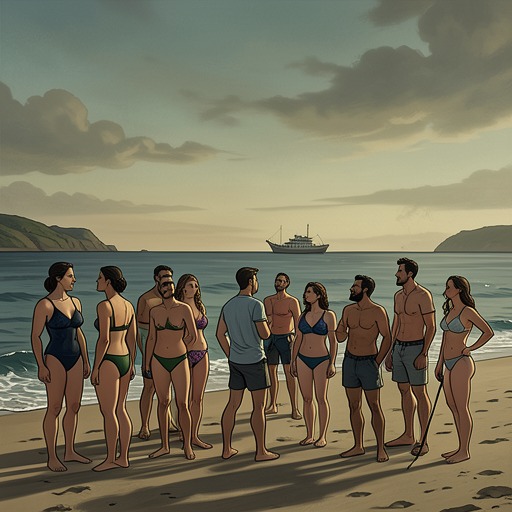
The speaker presents the Heillange Sailing Club as evidence that the valley can build a different future. Improvements have restored the campground, which has been nearly full ever since, and an aquatic complex is planned for the following year: a wave pool, waterslide, and twenty-five-meter lap pool. In this vision, leisure rather than production will drive the region’s next phase.
The case rests on the valley’s existing attractions and connections: sunny summer days, a lake, forests, countryside, and a first-class highway network. Its proximity to Luxembourg and Germany, as well as to Holland, Belgium, and Switzerland, is framed as an opportunity to attract visitors with money to spend. The speaker also points to possible subsidies from the region, Paris, and Brussels, presenting public support as a means of converting the area’s depressed status into investment. The audience applauds at length, receptive to a program that turns attention from mourning toward action.
Narrative Significance
The valley’s landscape gives personal experience a historical depth. As evening falls, Anthony and Stéphanie look out across a place that seems to amount to very little, yet contains towns, industry, families, and accumulated routines. Their encounter unfolds against this broad view, while the surrounding fields, roads, and settlements make their smallness tangible rather than diminishing the significance of what passes between them.
That contrast also anticipates the valley’s unresolved future. The account describes a subterranean history that will demand allegiances, choices, movements, and battles; the later speech offers a more hopeful vocabulary of recreation, infrastructure, and investment. Neither perspective erases the other. The Henne Valley remains at once an inhabited natural setting, the legacy of industrial transformation, and a place whose inhabitants must decide what can follow its losses.