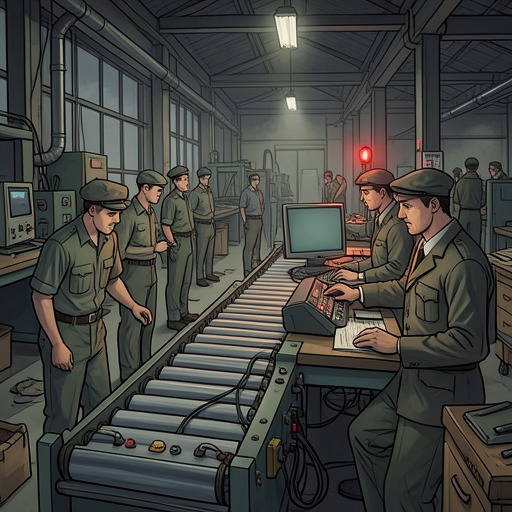
Metalor’s Racialized Labor Hierarchy
And Their Children After ThemMetalor’s Racialized Labor Hierarchy was an informal but entrenched system of workplace ranking in which race and national origin limited workers’ assignments and prospects for promotion. Its significance lies in the contrast between the mill’s apparent reliance on skill, seniority, and efficiency and the deeper rules that kept North African and Black workers subordinate. Malek Bouali’s decades at the steel mill reveal how those rules operated and how their effects outlasted the work itself.
Structure and Rules
The mill’s workers were divided into three broad ranks. Black and North African workers, including Malek Bouali, occupied the lowest. Above them were Polish, Yugoslav, and Italian workers, alongside French workers considered less competent. The highest positions were effectively reserved for those born in France: foreign workers who reached apprenticeship or journeyman status under unusual circumstances remained subject to suspicion and were liable to be treated as if they were at fault.
This order could not be explained by qualifications alone. Malek had followed orders and worked at the mill for forty years, yet his Arab identity continued to determine where he stood. He eventually earned a promotion, but that advancement did not undo the hierarchy or the contempt directed at him and other workers like him. As open expressions of that contempt became less common, the underlying discrimination persisted.
How the Hierarchy Was Maintained
The mill’s official logic might have suggested that assignments followed efficiency and workers’ strengths. In practice, production was organized through tacit rules, inherited forms of coercion, and classifications presented as natural. These practices disciplined workers and marked out their place in the workplace. The hierarchy therefore operated not only through explicit job categories but also through suspicion and the unequal treatment attached to being foreign.
Its persistence was especially stark as the valley became less competitive. The language of productivity did not remove racial distinctions; it coexisted with them. Malek’s long service and eventual promotion make the point sharply: individual effort could bring limited movement without changing the structure that had kept him at the bottom for most of his working life.
Layoffs and Work After the Mill
The closure and layoffs brought Malek’s industrial career to an end without resolving what it had cost him. He was collecting unemployment and using his Metalor layoff bonus to build a small house in Morocco; Rania had already returned there. The family had worked hard, but the prospects of the next generation remained a source of uncertainty. The hierarchy thus forms part of a wider account of industrial decline: the mill’s order shaped workers’ lives, while its disappearance left them with unemployment rather than a remedy for the inequalities built into their employment.
Later work in the valley changed the form of labor control without making work secure or autonomous. Hacine took a temporary job with Solodia on its Metalor cleanup contract, demolishing neglected worker housing with buckets, sledgehammers, and crowbars before helping clear the rubble. At first he worked at an unsustainable pace. Jacques, an experienced worker who gave the crew instructions, helped him learn to pace the day through scheduled cigarettes, coffee, and radio. Hacine came to understand that employers controlled much of his time and that he had to find small ways to manage its passage. This work was not the same racial ranking as the mill’s, but it shows workers still negotiating bodily effort and authority in the industrial landscape the closure left behind.
Related Forms of Social Sorting
The book places the mill’s hierarchy alongside other barriers to work and advancement, without making them identical. A young employment-law specialist, whose degree had led to a job in under two months, regarded unemployment as a distant threat while coaching Hacine on presenting his résumé. She was uneasy about his Muay Thai experience in light of his background. The episode sets her secure access to employment against Hacine’s need to make himself legible and acceptable to employers.
Education offers another contrast. Stéphanie Chaussoy came to see schooling as a system that sorted young people into unequal futures: underpaid manual work, less secure routes through ordinary university degrees, or a narrower path toward desirable careers for students with top marks and the means to continue. Her parents’ backup plan was a private preparatory school in Paris costing more than three thousand francs a month, plus living and travel expenses. These examples do not describe Metalor’s employment rules, but they extend the article’s central concern: opportunity is organized through thresholds that appear merit-based while remaining unevenly accessible. The mill makes that contradiction explicit by showing how national belonging and race could outweigh skill and seniority.