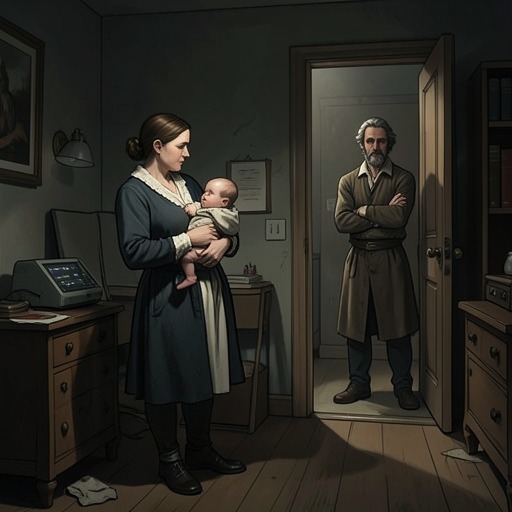
Océane
And Their Children After ThemOcéane, the infant daughter of Hacine and Coralie, becomes the new center of their household and a test of what family life can and cannot repair. Her dependence draws care from those around her, but it does not automatically create closeness between her parents. To Coralie, she fills a long-standing inner emptiness; to Hacine, she is beloved and vulnerable, yet unable to make a life that already feels unbearable suddenly sufficient.
Identity and Arrival
Océane is a girl whose parents have recently brought her home from the maternity ward. In Hacine’s account she is an Aquarius, and she will be six months old in early August. The details place her at the threshold between the helplessness of a newborn and the first signs of an emerging personality: she is still wholly dependent on adults, but already occupies the rooms, routines, and attention of an entire family.
Her early life is described through the practical work that attends her care. Hacine and Coralie get up at night, prepare bottle after bottle, change diapers, and take walks, all while continuing to work. The days seem to repeat, exhausting and indistinguishable. Their partnership begins to resemble a business organized around one purpose: keeping a fragile new life going. The contrast is important. Océane’s arrival gives the couple an urgent shared responsibility, but their conversations increasingly end in arguments, and they pass one another like zombies rather than finding renewed intimacy through parenthood.
A Household Reorganized Around the Baby
Océane’s birth also changes the couple’s relationship with Coralie’s parents. Now grandparents, they feel free to visit without warning, bring food, and help with the household. Coralie’s mother leaves an apron and cleaning products, undertakes housework, and even rearranges the kitchen drawers. The assistance is offered as kindness, but its frequency and confidence make it difficult for Hacine and Coralie to resist. The baby therefore draws an extended family into the intimate space of the couple’s home, where help can also feel like an invasion of their independence.
Hacine’s response to his in-laws is divided. He recognizes that they have adopted him, yet resents their habits and the rigid order they bring to everyday life. Sitting on the sofa with his father-in-law to watch the news, he wonders how he ended up in this setting and feels like a stowaway in his own life. Coralie, meanwhile, sleeps repeatedly; the couple have stopped having sex. These details do not make Océane responsible for their estrangement. Rather, they show the demands and adjustments surrounding her care alongside the distance that has opened between her parents.
Different Meanings for Her Parents
Océane’s birth leads Hacine to see Coralie differently. He recalls the cheerfulness, confidence, sociability, and appetite for fun that he loved in her, including her delight in Christmas and the pleasure she took in making the occasion special for everyone. He recognizes that she has always carried an emptiness, however, and believes that Océane has now filled it completely. From then on, the baby becomes the measure of things and a justification for decisions. This is Hacine’s interpretation of Coralie’s change: he sees her devotion not simply as a new task, but as the discovery of a purpose that had been waiting for her.
Hacine insists to himself that he is not jealous of Océane and does not resent her attention or wish to escape the work of caring for a baby. He loves her intensely. Yet he believes he never possessed the vacancy that her birth filled in Coralie. His own unhappiness and persistent rage remain, and the baby changes nothing—or, as he admits, the matter is more complicated than he can explain. The gap between his love for his daughter and his inability to feel that fatherhood has made life enough is central to his experience of her.
Vulnerability and Narrative Significance
The strain in the household becomes visible in small, concrete scenes. While Coralie confronts Hacine over his impulsive purchase of a Suzuki DR and the family’s precarious finances, Océane crouches in her crib and tears the men’s clothing pages from a La Redoute catalog. The ordinary mischief of the baby occupies the same room as Coralie’s exhaustion: she is on the verge of tears, troubled by changes to her body after pregnancy and struggling to regain her footing. Océane is not a solution to these pressures; her presence makes the new demands and altered circumstances unmistakable.
When Coralie leaves for her parents’ home with the baby after a bitter period of silence, Hacine feels relieved to find the apartment empty. He eats alone and watches the end of the match. His relief exposes how much he longs for escape from the domestic atmosphere, but it does not cancel his attachment to Océane. Later, after Coralie gives him an ultimatum, she leaves him with the baby while he is due at work. Her mother arrives and takes Océane without making a fuss, providing immediate care and allowing Hacine to get ready.
As he listens to the baby laugh at her grandmother’s playful attention, Hacine reflects on how little it takes to make this tiny life happy—and how easily an accident could end it. He kisses Océane on the head and fist before leaving on his motorcycle. The gesture makes tenderness and fear inseparable: he is alert to her vulnerability even while his own life remains unsettled. Océane’s narrative significance lies in this unresolved contrast. She is cherished, cared for by several adults, and the center of Coralie’s purpose, but her arrival does not reconcile her parents or quiet Hacine’s distress. Through her, the novel shows both the labor that sustains family life and the limits of expecting a child to repair the lives around her.