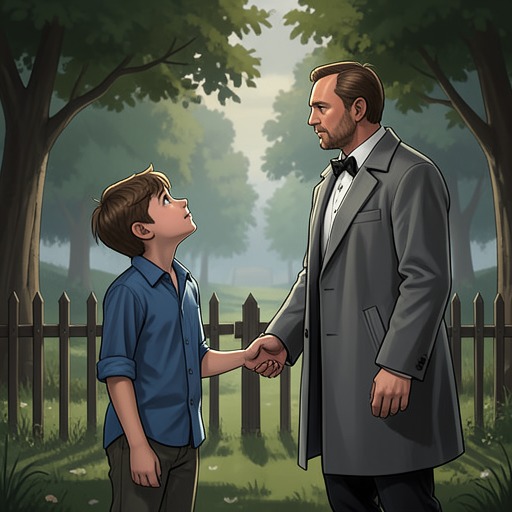
Patrick Casati's drowning
And Their Children After ThemPatrick Casati's drowning is disclosed in two stages: first as Hacine Bouali's unsettling encounter with a man who swims away from shore, then as the death Anthony Casati names as his father's. The sequence leaves Hacine alone with the man's clothes and hunting knife, while the later confirmation connects an apparently private episode to the loss that has shaped Anthony's life. Hacine witnesses the departure but is not shown causing it; the account holds on that distinction even as he reflects on his own capacity for violence.
The Encounter at the Lake
A man walks away from a dance despite being drunk, and Hacine struggles at first to keep up. They leave the festivities behind and continue south, separated by some distance. The man's course follows the shore toward the end of the beach. Their movement takes them away from other people and into a place where the sand gives way to mud, rushes, brambles, and tall grass. After roughly ten minutes, the man sits on a flat rock and looks out over the lake. Hacine approaches and watches from among the vegetation, waiting to see what he will do.
The man briefly appears to pass out, but wakes again. He complains as he removes his clothes, then enters the lake and floats before beginning to swim away from the shore. The action turns the scene from an episode of following and watching into a possible emergency. Hacine stands to keep the swimmer in view, but soon can see only a pale trace before the man disappears into the darkness. The account provides no indication that Hacine follows him into the water or reaches him.
Hacine's Response and the Abandoned Clothes
At the rock, Hacine calls out and waits, scanning the water. His calls do not reassure him, and he cannot bring himself to leave at once. The delay matters: although he has lost sight of the swimmer, he remains there, caught between wanting to go and an uncertain hope that the man may return. The scene does not explain what Hacine expects or establish that he could have changed the outcome; it records his hesitation without turning it into proof of responsibility.
Eventually, Hacine searches the belongings left on the rock. They include clothes and a hunting knife, but no watch or wallet. He takes the knife and puts it in his belt, telling himself there is nothing to feel guilty about. He then walks through the woods to the road. During that walk he thinks about the man and his son, and judges that he has the soul of a killer. The thought gives the episode a disturbing inward consequence, but it does not establish that he harmed the swimmer: the man's disappearance has occurred beyond Hacine's sight, and the account leaves the precise moment of death unseen.
Anthony's Later Confirmation
The identity and outcome become clear in a later conversation between Anthony and Hacine. Anthony says that his father died exactly two years earlier. Asked what happened, he answers that his father drowned, and confirms that it happened in the lake. Hacine remembers. This exchange retrospectively identifies the swimmer as Patrick Casati and binds the earlier scene to Anthony's family history. The two-year interval also gives the disclosure a clear temporal distance: the death belongs to the past, but naming it brings the memory into the present of their conversation.
The confirmation does not supply a fuller account of Patrick's final moments, nor does it claim that Hacine knows more than the earlier scene showed. Instead, the reader can place Anthony's statement beside Hacine's remembered sight of the man swimming out of view. The resulting connection is powerful precisely because it does not fill in what neither account establishes. Hacine was present as an observer at the lake; Anthony is the one who states that his father drowned there.
Consequences and Narrative Significance
The episode places Hacine near a death without making him its agent. His watching, calls, hesitation, and decision to take the hunting knife complicate his later self-image, while the absent swimmer's fate remains beyond his direct view. His reflection about being a killer is therefore not a confession to causing Patrick's death. It shows instead how readily he reads the event through a violent idea of himself, even when the narrative has not assigned him responsibility for the drowning.
For Anthony, the disclosure gives the loss a concrete form: his father died in the lake, and the death occurred two years before he speaks of it. For Hacine, Anthony's words attach a name and a family relationship to the man whose clothes he searched. The event thus joins two otherwise distinct experiences—the son's belated statement and the witness's memory—without making either one a complete account. The drowning is both a death in the story and a point of connection between Anthony and Hacine, shadowed by the difference between what Hacine saw and what Anthony can say.