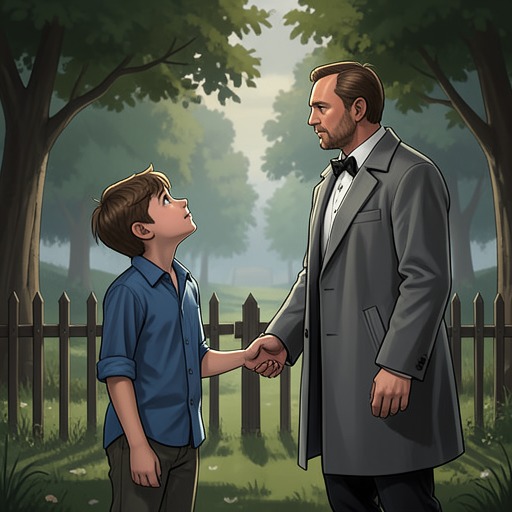
Patrick and Anthony's Awkward Closeness After Living Apart
And Their Children After ThemPatrick and Anthony’s relationship after living apart settles into an awkward closeness: the hostility that once connected them has faded, but neither quite knows how to inhabit the affection left behind. In their visits, tenderness appears through practical gestures—a hug at the door, a meal Patrick knows his son will eat, a hand raised toward a bruise—while the two remain cautious around painful subjects. Their care for one another is real, but it has not yet found an easy language.
A New Kind of Distance
When Anthony arrives at Patrick’s home around seven, punctual as usual, they hug on the threshold. The greeting is warm, but the scene immediately registers its uncertainty: the two now have to get along away from Hélène Casati’s eyes, and they do not know quite how. The dull hostility that had served as their means of connection has evaporated. In its place is affectionate embarrassment, a closeness that does not erase their history so much as leave them unsure what to do without their old antagonism.
Their conversation stays guarded. They exchange brief inquiries about how things are going, and both are especially careful to avoid hot topics. This avoidance is not proof that their differences have been resolved; rather, it shows how fragile the new ease is. They can share a threshold and a meal, but the old habits of resentment still shape what feels safe to say. The visit is therefore a small negotiation: each approaches the other, then holds back before the conversation can reopen conflict.
Care Made Practical
Patrick notices the cuts and bruises on Anthony’s face. His son’s lip is split, and one eye is surrounded by a rainbow-colored bruise. Patrick asks whether he has been in a fight and then asks to see the injuries more closely. Anthony says it is nothing and pulls away before Patrick can touch him. The movement is instinctive; Patrick lets his hand fall and does not insist. His concern meets a boundary, and he respects it, even though the unanswered question about what happened continues to bother him.
The scene gives their care a physical form without making it uncomplicated. Patrick wants to know why Anthony has been hurt and wants to put words to the injury; Anthony refuses both explanation and examination. Neither response cancels the attachment between them. Instead, the moment shows its limits: a father’s impulse to look after his son cannot automatically overcome a son’s reflex to withdraw, and Patrick’s decision not to press leaves the silence intact.
At dinner, attention shifts from the injury to a routine Patrick knows well. Anthony sits in the small living room facing the parking lot, having deliberately locked his motorbike outside where he can keep an eye on it. Patrick cooks in the kitchen, making spaghetti bolognese—the practical dish he prepares whenever Anthony visits. He knows that a half-pound package of pasta is enough for the boy, who wolfs it down, and takes pride in his appetite. The familiar meal becomes one of Patrick’s reliable ways of caring: not a declaration, but a repeated act tailored to what his son will eat.
The Son Patrick Remembers
Patrick’s pride in Anthony’s appetite carries the measure of a change he has watched over time. During childhood, Anthony was small, below average according to the charts in his health file. Patrick also remembers his son’s screwed-up eye and the way he clung to his mother’s skirts. Against that picture, the young man eating a generous serving seems to him evidence that some things have improved with time. His attention moves between past vulnerability and present growth; the meal allows him to take pleasure in a change that might otherwise remain difficult to express.
Yet pride does not keep worry out of the kitchen. While preparing the sauce, Patrick lowers the flame, adds onions and garlic to the meat, and stirs with a wooden spatula, still wanting to understand Anthony’s bruises. Domestic competence and paternal unease occupy the same scene. The familiar routine steadies their visit, but it cannot make Patrick’s concern disappear or persuade Anthony to explain himself. Their renewed bond is built from precisely this mixture: food offered, an injury noticed, a question left unanswered.
Hélène and the Unfinished Debt
Patrick tells Anthony that he is giving Hélène a present: he has been saving money for quite a while to treat her to a vacation. He explains the plan in relation to an old reproach—that she had criticized him for not taking the family on vacation—and says he does not want any more reproaches. The gift is directed toward Hélène, but Patrick chooses to disclose it to Anthony, drawing his son into a decision shaped by the parents’ shared past and their present distance.
Anthony tells his father that he cannot do it. Patrick reacts by asking whose side Anthony is on, and Anthony sees the old leathery face, prominent cheekbones, and fiery eyes beneath bushy eyebrows reappear. The familiar expression brings their former antagonism close again; Anthony returns to his plate, where the food has nearly gone cold and each bite costs him. The scene sharply contrasts the cautious affection of their greeting with the resentment still capable of resurfacing over a family matter.
Patrick then softens. He says Hélène can do whatever she likes and that he pays his debts. The change in tone does not settle the family history or make Anthony’s discomfort vanish, but it reframes the proposed vacation as an attempt to answer an old grievance. Across the visit, Patrick’s care remains indirect and sometimes entangled with defensiveness: he feeds his son, worries over his injuries, and wants to repay what he regards as an obligation to Hélène. Anthony accepts the meal and the visit without surrendering his reserve. Their relationship has moved beyond open hostility, but its affection is still tentative, mediated by familiar habits, unspoken concerns, and debts they do not experience in the same way.