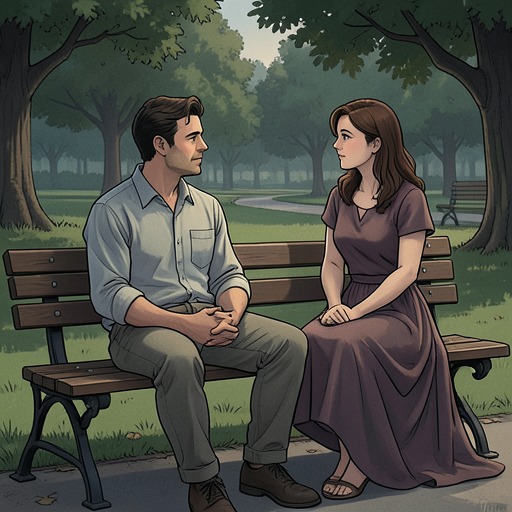
Patrick and Hélène's Cautious Reconnection After Divorce
And Their Children After ThemPatrick and Hélène’s cautious reconnection after divorce is marked by gestures that stop short of restoring their marriage. Their reunion at a funeral brings them into the same public space for the first time since the divorce became final; later, Patrick offers to pay for Hélène’s long-discussed vacation. His initiative meets her established refusal, while her response to his sobriety and generosity registers regret as well as distance. What remains between them is neither simple hostility nor a renewed partnership, but a familiarity shaped by shared losses and the habits of a life they once built together.
Divorce and Its Material Aftermath
The divorce is not merely a change in status: it follows the liquidation of the household Patrick and Hélène had spent twenty years trying to sustain. Their home was sold quickly and for very little, and the proceeds went to the bank to settle debts. Furniture, keepsakes, and clothes were discarded. The account of the division of property shows the marriage’s private history being reduced to financial arrangements, with Patrick still paying his lawyer two years later despite receiving little beyond the advice that he was in the wrong and the law would decide.
The settlement also undid Patrick’s assumptions about his place in the family. He had believed that he brought in the money, lived in his own home, and possessed a settled claim to his wife, house, and child. The notary’s intervention overturned those ideas. His near-fight during the division of belongings conveys how sharply the legal process exposed the gap between his sense of ownership and the actual arrangements. In its aftermath, the relationship appears as part of a wider collapse: the home and its contents are gone, and the former spouses are left to navigate the practical consequences separately.
Their son, Anthony, had been pressured to take sides during this wrenching period and refused. Hélène interpreted his reluctance as evidence that he did not love her enough; Patrick thought she had spoiled him. Their competing judgments show how the marital conflict continued to shape the family even after the couple separated. Anthony’s refusal to choose does not resolve his parents’ grievances, but it makes their reunion at the funeral a meeting in which old family positions remain present without being openly argued.
The Funeral Reunion
Hélène is extremely nervous on the drive to Saint-Michel d’Heillange Church. She keeps adjusting her hair and smoking; Anthony has to remind her twice that a traffic light has turned red. She tells him that nothing can be done about the situation, while trying to hold herself together behind large sunglasses. The reason for her anxiety is specific: she will see Patrick for the first time since their divorce became final. The funeral makes that encounter unavoidable, bringing an ended marriage back into view amid the town’s public rituals of mourning.
After the service, Patrick asks whether Hélène is all right. Anthony hugs his father and recognizes his cologne; Hélène gives Patrick a peck on the cheek. Outside, she folds the yellow service pamphlet, searches her purse for her sunglasses, avoids her former husband’s eyes, and crosses her arms. These small actions place tenderness and withdrawal side by side. She offers a familiar greeting, but does not meet his gaze; the exchange is civil and intimate in form, yet guarded in its aftermath.
When the family directs mourners toward L’Usine for brioche, coffee, and drinks, the former spouses remain within the same crowd. As the funeral party gathers, Anthony catches his parents looking at one another without speaking. Hélène looks away; Patrick lowers his eyes to his feet. Their silent exchange is not a declaration of renewed attachment, but it makes visible a connection that neither has simply put aside. The public setting holds them close enough to notice each other and crowded enough to keep their private history unspoken.
Patrick’s Offer and Hélène’s Reserve
At L’Usine, Patrick brings up the vacation he has offered to pay for. Hélène responds sharply, gripping her purse strap, and says nothing when he repeats that he will cover the trip. She has told him many times that it is out of the question. His offer therefore does not open a new possibility between them so much as revive a disagreement whose terms she has already made clear. He leaves the decision with her, saying she can let him know when she has made up her mind.
The offer nevertheless carries a particular weight because Patrick makes it amid the aftermath of the funeral and their financial losses. The scene gives no indication that Hélène accepts, and her silence should not be mistaken for consent. His willingness to pay is a practical gesture toward a former partner, but she remains guarded and maintains the boundary she has stated before. Their interaction occupies the uncertain territory between continued care and respect for separation: Patrick makes an approach; Hélène does not reciprocate it in the moment.
Sobriety, Regret, and What Remains
The drinks at the gathering sharpen the contrast between the marriage’s past and its present. Patrick orders beer for the others and Perrier for himself. Hélène watches him and thinks of the years wasted and ruined by pride and binges; seeing him drink water and offer to pay for her trip makes the cost of those years newly visible to her. Her regret is not presented as a reversal of the divorce. It is an awareness of what has been lost, including the possibility that Patrick’s later gestures arrive after damage that cannot simply be undone.
The relationship’s tentative warmth is clearest in its ordinary gestures: Anthony’s protective reassurance to his nervous mother, Patrick’s check-in after the service, Hélène’s kiss on his cheek, and Patrick’s offer to pay for a vacation. Each is qualified by a countergesture or an unresolved history. Hélène avoids his eyes and refuses the trip; Patrick’s financial offer cannot restore the home or erase the legal and emotional struggle. Their cautious reconnection thus remains a form of contact rather than a reunion—a brief, public negotiation between care that persists and a marriage that has ended.