Patrick’s hunting knife
And Their Children After ThemPatrick’s hunting knife is a gift intended to bring Patrick and Anthony together, but the evening on which Patrick sets out to give it does not unfold as planned. First wrapped and left waiting at home, then carried at Patrick’s waist through the crowd, the knife becomes a persistent physical link to his absent son. Its final appearance beside the lake, where Hacine finds it and takes it, gives the object a second, more unsettled history without showing it used to injure anyone.
Intended as a Gift
Patrick retrieves the present from the cupboard under the sink and sets it on a small desk. It is nearly three o’clock. He waits, staring at the shiny wrapping and curly ribbon, while the day slips away. The scene makes the gift’s purpose clear through its circumstances: Anthony has not arrived, and Patrick complains that the boy does not care about anyone. The knife is meant for his son, but the present remains unopened while Patrick waits for a meeting that has not happened.
After drinking three beers, Patrick falls asleep. When he wakes, it is past eight and he feels stiff; the day, as he sees it, has been lost. Only then does he tear open the wrapping and examine what he bought. The rectangular box contains a substantial hunting knife with a broad, nearly black blade, its swollen outline compared to a Judas-tree leaf. Patrick tests its sharpness, slides it into its sheath, and fits the sheath into his belt. These details establish the object as both an expensive-looking gift and a practical weapon. Yet the immediate reason he takes it is not a stated plan to use it: since Anthony has failed to come, Patrick decides to go and find him, determined to deliver the present anyway.
Carried into the Search
Before leaving, Patrick takes beers for the road, gets into his 205 hatchback, and drives toward the lake. There he moves through a crowded gathering in search of Anthony. Someone points toward a figure who might be his son, and Patrick makes his way through people coming in the opposite direction. The knife remains at his waist, concealed beneath his polo shirt. Its presence gives the search a tangible edge, but the scene does not show him drawing it or threatening anyone with it.
Patrick eventually reaches Anthony’s cousin and a group that includes Carine and children. The hoped-for encounter is therefore not a private father-and-son exchange arranged around the gift. Instead, the knife stays hidden while Patrick attempts to re-enter his son’s social world in the middle of a crowd. His carrying it close to his body connects the practical act of looking for Anthony with the emotional purpose of the evening: he has come to give his son something, though the encounter does not become the simple delivery he had imagined.
Missing, Found, and Taken
Later, Patrick stands unsteadily and pats himself down, then says that he is looking for his knife. He searches the ground, finds it, and slips it back into his belt, pulling his shirt over it again. He then takes up a bottle and finishes it. The small sequence gives the knife a repeated, concrete role in the evening: it is not merely an unopened present from earlier, but an object whose presence Patrick checks and restores amid his drinking and movement through the gathering.
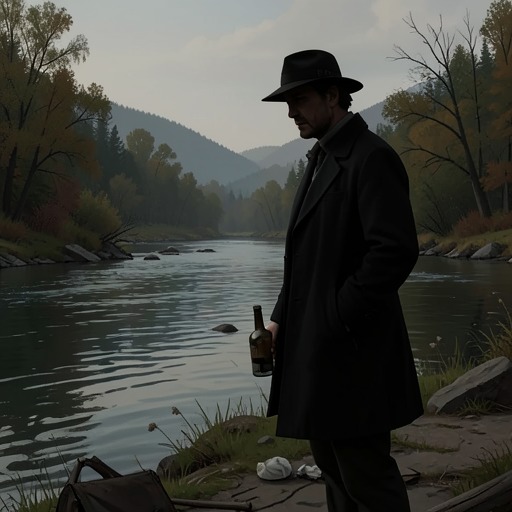
The knife’s next appearance changes its relationship to Patrick. Hacine finds it on a flat stone beside the clothes left there by a man; there is no watch or wallet among the belongings. Hacine slips the knife into his own belt and walks through the woods toward the road. The account does not show how the knife came to rest on the stone, nor does it describe Hacine using it. It does establish that he takes it, and that he leaves the lakeside thinking about the man and his son. The object once intended to close a distance between father and child is now carried away by someone else, after the man has left it with his clothes.
Object and Aftermath
The knife’s narrative significance lies in this sequence of changing custody, not in a demonstrated act of violence. At first it is enclosed in gift wrap and associated with Patrick’s effort to reach Anthony. Once unwrapped, its dark blade and sheath make it visibly different from an ordinary keepsake; nevertheless, Patrick’s stated purpose in taking it to the lake is to give it to his son. Later, he checks that it is still with him, and finally it is found among the belongings left on the stone.
That movement leaves the intended gift unresolved. Hacine’s taking the knife does not complete Patrick’s gesture toward Anthony, and the story does not say that Anthony ever receives it. Instead, the object carries the aftermath of the lakeside scene into Hacine’s departure. The juxtaposition of the knife, the clothes, and Hacine’s thoughts about the man and his son makes the weapon part of a charged scene of absence, while preserving an important limit: the evidence never identifies the knife as the cause of what has happened. Its path from wrapped present to concealed possession to abandoned belonging gives material form to the evening’s broken connection without explaining away the uncertainty surrounding it.