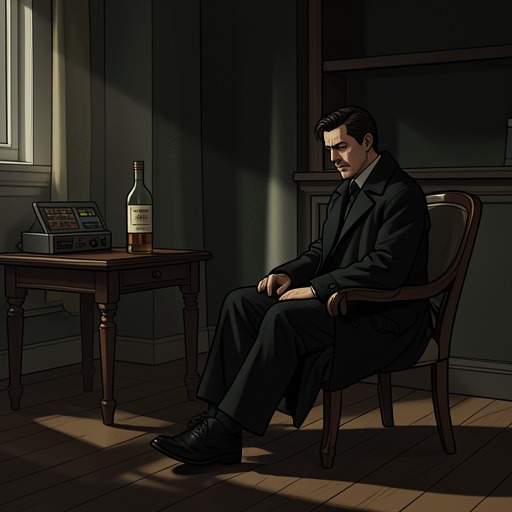
Patrick's Sobriety and Recovery
And Their Children After ThemPatrick's sobriety is not a clean break that immediately restores him; it forces him to inhabit the time, body, and relationships that drinking had helped him evade. After roughly twenty years in which he was drunk for much of his life, he must endure withdrawal and then learn how to live without alcohol's false momentum. A bicycle, renewed work, and a jar of saved francs become modest forms of recovery, while boredom and regret remain difficult to outlast.
Withdrawal and the Changed Body
At first, quitting drinking puts Patrick through an ordeal more severe than anyone around him could imagine. Alcohol has become, in his experience, almost an organ: intimate, embedded, and seemingly necessary to keep the body going. Stopping feels like an amputation rather than a simple decision. He weeps and screams at night, spends hours in scalding baths with his teeth chattering, and suffers migraines, aches, and night sweats for two months. Then one morning he wakes up weaned. Even his smell has changed, registering sobriety as a physical alteration, not merely a promise to behave differently.
The new bodily economy brings gains and losses. Patrick's belly grows from eating sweets, but he sleeps more soundly and feels better on waking. He no longer has the same morning disorientation, yet also loses the rush of the first drinks, which had seemed to fuel the boiler and offer a counterfeit second youth. Sobriety improves some ordinary measures of well-being while removing a pleasure he had relied on. The account refuses to make recovery a simple exchange of sickness for health: each improvement arrives with an absence.
Alcohol's absence also creates room for another habit. Patrick drinks a couple of quarts of Coke a day, enough to leave him bloated and belching loudly. In empty hospital corridors, the belches seem almost pyrotechnic; when one erupts at a red light, other drivers turn to look, and Patrick gives them a small military salute from his Districan vehicle. The episode makes his recovery comic without making it trivial. He has stopped drinking liquor, but his body and daily routines still bear the marks of appetite and excess.
Time, Isolation, and Regret
The deeper difficulty is not only what alcohol did to Patrick's body, but what it had done to his sense of time and other people. Sober, he finds himself waking from a twenty-year sleep. He had imagined friendships, interests, political opinions, authority, certainties, and hatreds as parts of a full social life; in retrospect, he recognizes that he had been drunk three-quarters of the time. Without alcohol, he feels bereft and must rediscover nearly everything. The sharpness of other people and the weight of ordinary human contact become hard to endure. Sobriety exposes rather than resolves the distance between Patrick and the life he had thought he was living.
After his separation, Patrick rents a small apartment outside town in a hurry, expecting to find something better when the divorce is final. A year and a half later, he is still there. He wanders for days with strength but no clear purpose, and sometimes stands before the bathroom mirror, grabbing his belly with both hands. He complains about the cost of living, about Anthony Casati's repeated mistakes, and about Hélène Casati; beneath the complaints lies his recurring bitterness over the waste of his own youth. Giving up alcohol does not automatically repair these relationships or release him from resentment. It makes the losses harder to blur.
Work offers structure, though not an idealized new beginning. Patrick finds another job with Districan, servicing vending machines in a hospital. The company expects its workers to wear a cap, but in the middle of July he works bareheaded, confident that no supervisor will appear. On a day when Anthony is coming to dinner, Patrick works through lunch to finish the hospital route and get home early. After three o'clock, he records visits at a few machines without restocking them. His small evasion shows a worker adapting the job to the demands of his own life, even as the work remains repetitive and regulated. The Coke he takes from a machine is a telling substitute: a new vice embedded in the routines of recovery.
Small Measures of Progress
Patrick's first step toward something better is buying a bicycle. It is inconvenient in a one-bedroom apartment already full to bursting, since he has no garage, but he rides anyway. Along the canal he meets other cyclists and sits on the bank watching the water flow. The boredom that once might have seemed like emptiness becomes, for a while, a pleasure he can inhabit. This is no dramatic reinvention; it is a change in what he can bear, and in how he spends an afternoon.
The savings jar gives that change a measurable form. Patrick puts aside the twenty or thirty francs he used to spend on drinking each day. After ten months, he has accumulated more than five thousand francs. The money comes from a repeated refusal, converted into something he can see and count. When two companions ask what he plans to do with it, their brotherly look and the barber's raised glass turn the accumulated savings into a small occasion. Patrick answers the toast with a sarcastic nod, as if recognizing that his friends have found an excuse to celebrate. The jar is both evidence of abstinence and an open question: the passage shows the sum and the social moment around it, but not what he ultimately decides to buy.
Recovery Without Erasure
Patrick's sobriety changes his relationship to ordinary time more than it supplies a new identity. He can sleep better, wake with less discomfort, ride beside the canal, work, and save money; he also faces the boredom, isolation, physical dissatisfaction, and regret that alcohol had helped keep at a distance. His improved circumstances are real but partial. Even the savings are made possible by a daily accounting of what he no longer drinks, while the Coke habit and workplace shortcuts reveal that recovery does not turn him into an entirely different man.
The narrative sets Patrick's private effort against a wider atmosphere of precarious work and economic constraint. At the hospital, he moves from machine to machine under workplace expectations, finding a way to finish early when Anthony is coming over. At home, he remains in the apartment he rented after separating from Hélène, still burdened by anger and the sense that his youth was squandered. His progress therefore consists not in escaping those conditions but in making limited, concrete choices within them. Sobriety gives him back the unhurried ride, the better night's sleep, and the francs in the jar; it also leaves him awake to the difficult life those gains cannot erase.