Six-Fours
And Their Children After ThemSix-Fours is the seaside setting of a two-week camping holiday that gives Hacine Bouali an unexpected experience of ease and belonging. The stay with Coralie begins as ordinary leisure, but its simple routines and the journey home prompt Hacine to consider how paid vacations shape French identity—and how that freedom remains bounded by work.
Setting and stay
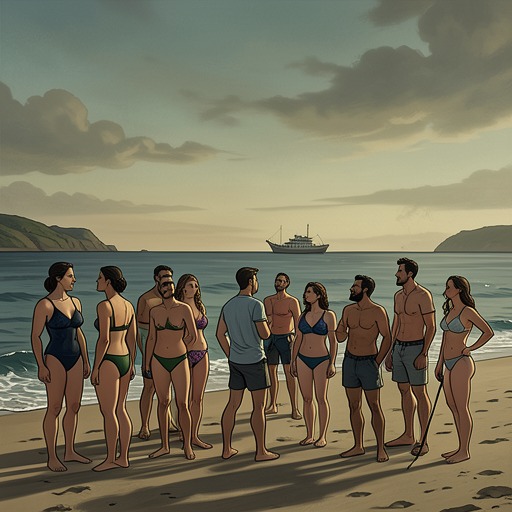
Coralie chooses a camping resort in Six-Fours, among parasol pines, with three swimming pools and families who return regularly. She and Hacine drive there in their Fiat Pronto and spend two weeks doing little beyond settling into the campground and going to the beach. They rise early for breakfast in front of their tent, talk with nearby campers, and spend their days in flip-flops, taking turns swimming so someone can watch their belongings.
Their meals are uncomplicated: tomatoes and roast chicken, fried eggplant, rice salad, and sardines. After lunch, they doze in canvas chairs while the midday heat quiets the campground. Nearby, a middle-aged couple listens to the Tour de France on a transistor radio, while children call and splash at the pools. These details make Six-Fours a place of shared, modest routines rather than dramatic escape.
Hacine’s view of vacation
To Hacine’s surprise, he enjoys the stay. The languid hours are familiar to him, but he sees a difference between this holiday in France and holidays in Morocco. French leisure appears highly organized to him: even shopping, going to the beach, using the showers, and washing dishes seem to carry an anxious sense of purpose. Beneath the relaxation, he feels, is the certainty that the holiday will end and everyone must return home.
That limit gives the vacation a double character. Six-Fours offers Hacine a welcome suspension of ordinary pressures, yet the leisure feels authorized and temporary, as if its boundaries are set by the approaching return to work. His observations turn the campground into a vantage point from which he can compare not just two kinds of holiday, but two different experiences of belonging.
The journey home and significance
The return north changes Hacine’s sense of where he belongs. As he and Coralie drive up the A7 through traffic jams, gas stations, tollbooths, and rest stops, he feels accepted among the other travelers. The seasonal crossing of vacationers—some returning in July as others head out in August—seems to him to bind people together through a common rhythm of departure and return.
For Hacine, that shared movement makes paid holidays a powerful expression of French identity, more immediate than school or voting. Yet the feeling of freedom does not last without qualification: the vacationers must go back to work. On Sunday, July 14, Hacine knows his own job starts the next day. Six-Fours therefore marks both a brief experience of ease and the point from which the obligations waiting at home come back into view.