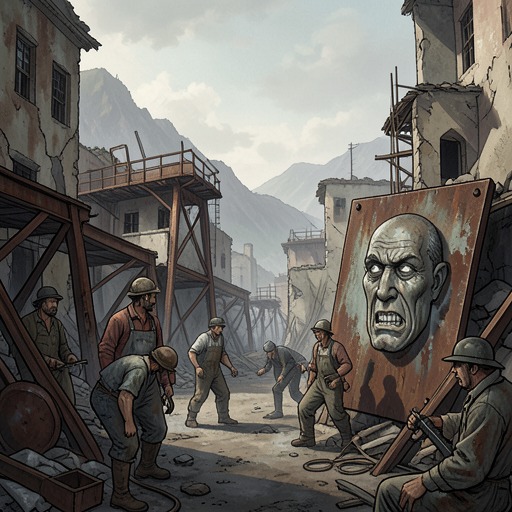
The Glorious Thirty Years
And Their Children After ThemThe Glorious Thirty Years, the prosperous decades between 1945 and 1975, appears in the novel less as a self-contained historical era than as a promise embedded in buildings, work, and family life. Its structures remain after its confidence has faded: the housing it produced is crumbling, industrial employment has vanished, and the crisis that follows is experienced not as a passing interruption but as a lasting social position.
A period built into the landscape
The ZUP Residential District where the Bouali family lives was built during The Glorious Thirty Years. It consists of fewer than a dozen low buildings, arranged from above like five pips on a die, alongside three fifteen-story towers, including the Manet tower. The modest scale distinguishes it from the vast housing developments elsewhere, but does not protect it from deterioration.
As tenants leave, those who remain extend their living space into vacant apartments, joining rooms to create larger homes while rents stay unchanged. The buildings’ peeling stucco, rusting balconies and stained facades register the distance between the period of construction and the present. Residents who can leave have moved elsewhere, while long-settled families continue to inhabit the district. The towers are expected to be demolished, not in a spectacular collapse but wall by wall, reducing decades of ordinary life to rubble.
The lives formed by its promises
The period’s social world is recalled through Hélène’s youth. She and her sister danced, skipped classes, listened to yé-yé music and resisted expectations that young women should follow a prescribed pattern of respectability. Their independence brought them neighborhood stigma, even as it gave them a sense of power over their own choices. The recollection places that defiance against a society in which women were often expected to work in shops or remain in the kitchen.
Work and self-sufficiency also shape Patrick Casati’s memories of growing up. His parents had little schooling, and he left school at fourteen. He learned practical skills—cutting wood, repairing a roof, laying tiles and maintaining a home and garden—and remembers a youth spent outdoors with his brothers. Later summers took different forms: periods broken up by jobs, adult holidays limited to three weeks of paid leave, and unemployed summers marked by guilt and brooding. His account traces how a working life could be organized around physical labor, then leave a person unsure what to do when that labor was no longer available.
Prosperity’s aftermath
The novel sets the period’s promise against the closure of the factories and the hardships that follow. In its portrait of working-class women, salaried employment and later leisure—group outings, organized trips and holidays—offer some release after years of worry and constrained means. Yet that change comes after long histories of family burdens, unemployment and industrial decline. The women’s hard-won freedom sits beside the losses of men whose lives had been bound to the factories.
The contrast is sharpened by the description of the crisis as no longer a temporary event but a position in the order of things, passed down as a destiny. The Glorious Thirty Years thus remains visible in what it built and in the expectations it left behind, while the novel’s later generations confront an economy and a landscape from which the old sources of stability have receded.