The Pull Between Leaving Heillange and Belonging
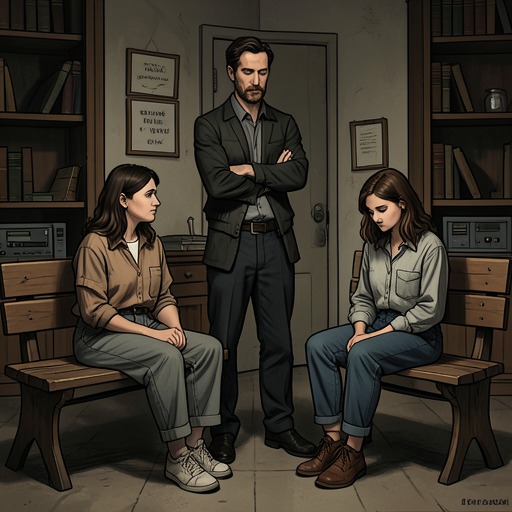
And Their Children After ThemThe Pull Between Leaving Heillange and Belonging is a tension shaped less by a simple choice between staying and going than by the unequal ways its characters experience each possibility. Stéphanie looks toward a life beyond Heillange and makes plans to pursue it; Anthony repeatedly circles through the town he has left, unable to turn attachment into either a homecoming or a future. The novel makes belonging neither uncomplicated comfort nor mere confinement: it can survive as an intimate bodily imprint even when the person who carries it knows that the town offers little reason to return.
Departure as a Chosen Future
Stéphanie’s determination is stated without apology. In a conversation whose preceding circumstances are not fully supplied here, someone says, “I don’t know. I didn’t want to come back here. I’m never coming back.” The refusal makes return sound like a decision already made, rather than a possibility still being weighed. Another declaration in the same exchange insists, “I know what I want, and I’m not ashamed to be successful.” Together, the statements place leaving beside ambition: the desired future is not just elsewhere, but one in which wanting success need not be disguised as a fault. The excerpt does not establish who speaks each line, so their significance lies in the contrast they make available, not in an assumed attribution.
Stéphanie’s later plans give that outward movement a concrete destination. She turns her back on Anthony and enters the house, with only a few days remaining before her flight to Canada. Her boyfriend is waiting in Ottawa, where he has completed a journalism degree and secured an internship with a local paper. Stéphanie is meant to stay three weeks, but privately plans to enroll at the university and work as a waitress. She expects tips to make that arrangement viable. The plan is provisional in its practical details but expansive in its horizon: she imagines a vast, new country and a life whose direction no longer depends on Heillange. The difference between the official three-week visit and her secret intention to stay longer makes departure feel like the beginning of a self-authored future, not simply a visit abroad.
Anthony’s Return to the Town He Left
Anthony’s attachment takes a different form. After getting a small one-bedroom apartment, furnishing it from Confo, and buying a new Clio Williams that strained his paycheck, he accumulates debts and still hopes to buy a motorcycle for the summer. His mother criticizes his careless spending, but his employment keeps her from objecting further. His romantic life, by contrast, is lean. He sometimes meets women on Saturday nights, at parties or at the Papagayo, but regards these one-night encounters as separate from the ideal he keeps to himself. The distinction helps explain why Stéphanie remains more than a past sexual encounter: she represents a desire that ordinary nights out do not displace.
He does not speak about that longing. Late at night, especially after drinking more than usual, he takes a beer down the two flights from his apartment to the parking lot, gets into the Clio, finds music on the radio, lights a cigarette, and drives north toward Stéphanie’s neighborhood. The route is not described as a purposeful attempt to reach her. He drives without pushing the car, following the docks along the Henne Valley and passing through streets he knows too well. Streetlights punctuate the drive, while old songs draw him into feelings of disappointment, failed love, loneliness, and time passing. Johnny Hallyday’s songs give those feelings a soundtrack, but the town supplies their geography.
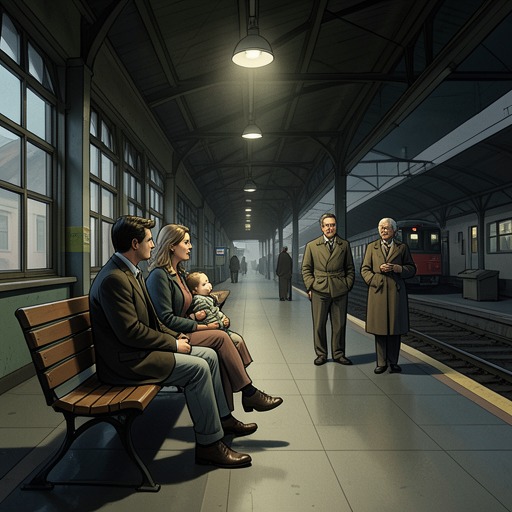
That geography is insistently particular. Anthony passes the steel mill caught in the spotlights, the bus shelters where he waited for school buses, his old school, busy kebab stands, and the train station from which he left and to which he returned defeated. He remembers bridges where he used to spit into the river out of boredom. The route also takes in the betting shop, McDonald’s, empty tennis courts, and dark swimming pool before moving toward residential streets, open country, and what the narrative calls nothingness. The sequence joins public landmarks to private memory: the town is not an abstract hometown but a chain of places accumulated through waiting, boredom, departure, and return.
Near Stéphanie’s house, Anthony turns up the volume, drinks his beer, and watches the Chaussoys’ beautiful house from a distance. Its grille and electronic gate mark a boundary as visible as the emotional distance between them. He wonders whether Stéphanie is home, decides she probably is not, smokes, lets his thoughts wander, and eventually drives away. The repeated journey brings him close to her neighborhood without bringing him into her life. Its ending is not a reunion but a retreat home, “like a fool.” The drive lets him revisit desire and place together while preserving the separation that makes both painful.
The Unequal Meaning of Home
The contrast between Stéphanie’s departure and Anthony’s nighttime circuit is sharpened by their final encounter. After she asks him to take her home, he tells her, “I know. I’m taking you home now.” On the journey she shivers in the passenger seat, and he gives her a sweatshirt from the backseat. They do not speak again. Anthony checks his watch at intervals: his bag is in the trunk and his train leaves in a few hours. He has finally slept with Stéphanie, but the encounter leaves him with bitterness and fatigue, not a story of triumph to share. The physical fact of intimacy does not overcome the emotional distance between them.
When they are close to her house, Stéphanie asks him to stop. After his apology and her farewell, she slams the door and walks away barefoot, carrying her sneakers, without turning around. Anthony watches her go, then consoles himself with the thought that he has at least slept with her before making a U-turn. The bluntness of that consolation exposes how little possession of the moment can substitute for mutual closeness. Home is where he takes her, but it is also the threshold at which she leaves him behind. In a few days, she will board the plane for Canada, where her boyfriend and her plans for university await; Anthony’s train, meanwhile, is already approaching as a practical deadline.
The two directions therefore carry different emotional weights. Stéphanie’s departure is connected to intention and imagined possibility, even if her plans are not yet secure. Anthony’s movement toward her house is repetitive and private, driven by an attachment he does not openly discuss. He can navigate the town with ease, but that familiarity does not give him access to the future he wants. His visits bring him near the Chaussoys’ house and then send him home again. The town and Stéphanie become linked in his longing, but the narrative does not make either one available to him simply because he remembers or desires them.
Belonging as a Bodily Imprint
The novel finally gives belonging its strongest expression through sensation rather than successful return. At the end, as others swim toward open water and people on shore cheer them on, Anthony prefers not to watch. He climbs onto the Suzuki and reaches the departmental highway. The motorcycle’s panicked vibration in his hands, its harsh noise, and the smell of its exhaust accompany his departure from the gathering. Yet the ride does not erase the place. The July light, the woods’ shadows, wind on his face, the smell of the air, and the familiar texture of the road bring back the valley through the body. The road is compared to a girl’s skin, joining physical memory to the novel’s recurring entanglement of desire and place.
That final ride holds departure and attachment together rather than resolving them. Anthony can leave the shore and take the highway, but the valley’s impressions remain in his flesh. The narrative names this condition “the terrible sweetness of belonging”: sweetness because the place is known with intimate precision, terrible because such knowledge is not the same as a viable future or a recovered relationship. Stéphanie’s imagined transatlantic life and Anthony’s sensory return to familiar roads thus stand as opposing movements, neither reduced to a simple moral choice. One looks outward toward a life that might be made elsewhere; the other discovers that leaving does not prevent a home place from continuing to claim the body.