The industrial crisis as a permanent condition
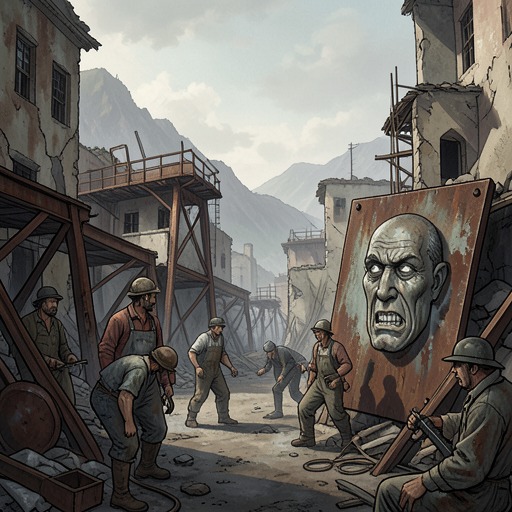
And Their Children After ThemThe industrial crisis as a permanent condition names the transformation of economic collapse from an episode into the ordinary shape of life in Heillange. Factory closures and the silence of the blast furnaces are not treated as a temporary interruption before prosperity returns: they reorganize work, family expectations, and the uses people can make of their abilities. Patrick Casati experiences that change as the waste of a life trained for labor; Anthony Casati encounters it through precarious jobs and a more or less permanent factory position; the women around them have endured its consequences for decades. The crisis persists not only in unemployment, but in the routines and futures it makes seem unavoidable.
From useful work to wasted capacity
Patrick’s sense of the crisis begins in a working-class ethic that makes idleness almost intolerable. His parents had little schooling, and he left school at fourteen. He later consoled himself with the claim that his certificate was worth more than a baccalauréat, but his formation came chiefly through practical skills: cutting wood, making fires, laying tiles, repairing a faucet, patching a roof, tending a house and garden, and doing basic carpentry. He and his brothers spent their youth outdoors gathering mushrooms and fruit. In this outlook, even the steel mill could count as a kind of outdoor work; office labor, by contrast, seemed to mean sitting with a pen and being diminished by thought. The mill belonged to a world in which collective effort and tangible tasks supplied a standard of usefulness.
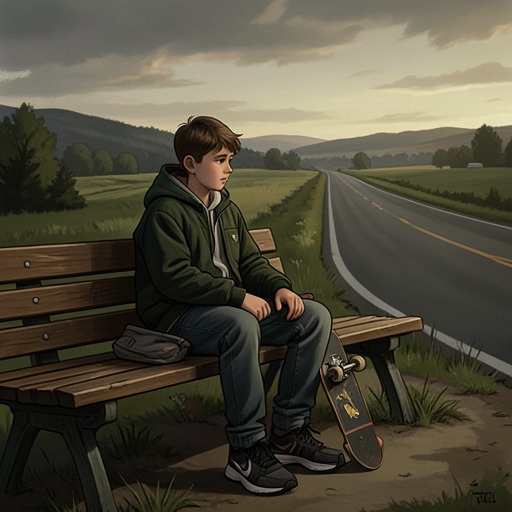
That standard survives in Patrick even as the life that supported it has receded. He is acutely conscious that his strength has nowhere to go. His hands remain heavy and capable, and he imagines them taking hold of a tool and shaping something, but his days offer little outlet for that capacity. The contrast is not simply between employment and unemployment: it is between a learned identity grounded in making and maintaining things and a present in which that competence cannot give his life direction. His despair makes economic decline intimate. What has been lost is not only a workplace, but also the social meaning through which work once organized skill, pride, and time.
The repetition of Patrick’s domestic life gives this loss its daily measure. He spends evenings drinking in front of the television, wakes during the night with back pain, and returns to the same cycle of work, exhaustion, and drinking. When Anthony is expected, Patrick clears away empty bottles, takes five full bags to the recycling bin, and makes the apartment immaculate. The preparation briefly interrupts the housebound routine, but does not resolve the emptiness beneath it. His wish to put his hands to work remains bound up with anxiety and the risk of violence. The crisis therefore registers both as a failure of opportunity and as a pressure that narrows how Patrick can live with himself and others.
Anthony’s work and the reproduction of insecurity
Anthony’s employment after leaving the army shows a younger generation entering a changed labor market without escaping the old expectation that a person must prove his worth by working. He is afraid to cash the army’s check, imagining that the money would disappear and leave him poor and dependent on his mother again. Instead, he takes temporary jobs: cleaning bathrooms at the Saint-Vincent clinic and at the abattoirs, working as a school janitor, and joining the kitchen crew at the prefecture. Because the prefecture is far from home, fuel consumes nearly all his pay. For eight weeks he rises at dawn, drives sixty miles, works four hours, and drives back, earning barely four thousand francs a month. The toll is severe, but Hélène Casati does not reproach him; in her family, killing oneself with work is treated as normal.
That expectation begins to shape Anthony’s own outlook. He takes up complaints about taxes, immigrants, and politicians, and understands himself as useful yet exploited, part of a large majority convinced that there is nothing to be done. His working life does not provide a straightforward route out of poverty or a stable sense of advancement. Instead, the obligation to work coexists with low pay and limited control, allowing economic grievance to become part of everyday identity.
After moving through five nursing homes in three months, Anthony works at the Vivarte warehouse, Liqui Moly, the Merax print shop, and then the Gordon metalworking plant. There he finds a more or less permanent position stacking sheets of metal, rods, and grillwork in a precise pattern. The pieces become a cubic stainless-steel structure, lifted by large forklifts and put into ovens heated to more than two thousand degrees; the process produces air conditioners sold across Europe, though with increasing difficulty. Industrial production continues, but its future is uncertain. Supervisors watch the workers and the successive temporary hires, who can be dismissed as soon as the economy weakens. Above them are bosses, engineers, and executives, encountered at the canteen as if they belonged to another world. The factory’s hierarchy and its reliance on disposable labor make the crisis visible inside the workplace itself.
Anthony finds companionship among Cyril, Krim, Dany, le Zouk, and Martinet. They look forward to seeing one another in the morning, eat together, and secretly smoke during breaks on pallets in the courtyard behind workshop C. After work, they share similar wages, pastimes, and worries about the future. Yet the very problems that unite them are difficult to discuss. They have all wanted to leave Heillange, fear that they are living lives like their fathers’, and struggle to acknowledge the slow repetition of their days without adding shame to their sense of submission. In this way, insecure work reproduces more than material vulnerability: it carries forward a family likeness that the young men recognize but cannot easily break.
Crisis as inheritance and social order
The novel’s account of women’s lives makes explicit why the crisis cannot be confined to a particular moment. Many women have lived through pregnancies and marriages marked by husbands’ dismissal from work, depression, unemployment, or violence. Factory closures and silent blast furnaces leave men burdened by the loss of the world that had once organized their lives; the effects also fall on the women who have held households and families together. Sons, too, often cause years of worry before settling down, frequently through a relationship. The sequence links industrial decline to domestic strain and to the transmission of insecurity between generations.
At the same time, the women’s later independence complicates a purely downward account. Single women, widows, and abandoned women organize outings and trips, visit castles and villages, and spend money on meals and holidays after years of worry and careful saving. Many are daughters of working-class families who entered salaried employment in large numbers. Their new enjoyment of life is a real change in what they can claim for themselves, but it arrives after a lifetime shaped by hardship and endurance. Their experience marks an opening within the inherited order, not proof that the economic crisis has ended.
The narrator’s decisive formulation is that crisis has become a position in the order of things, a destiny. That description gathers the separate threads of the concept: the factory’s uncertain market, workers’ vulnerability to dismissal, Patrick’s stranded capacities, Anthony’s succession of jobs, and the family patterns that make precariousness appear normal. The word destiny conveys how structural conditions can be mistaken for personal fate. Yet the varied responses in the novel—Patrick’s frustration, Anthony’s uneasy identification with the exploited majority, and the women’s newly organized pleasures—also show that this permanence is lived unevenly. The crisis is enduring not because nothing changes, but because change itself takes place inside constraints inherited from the vanished industrial world.