Framed nursery rhyme
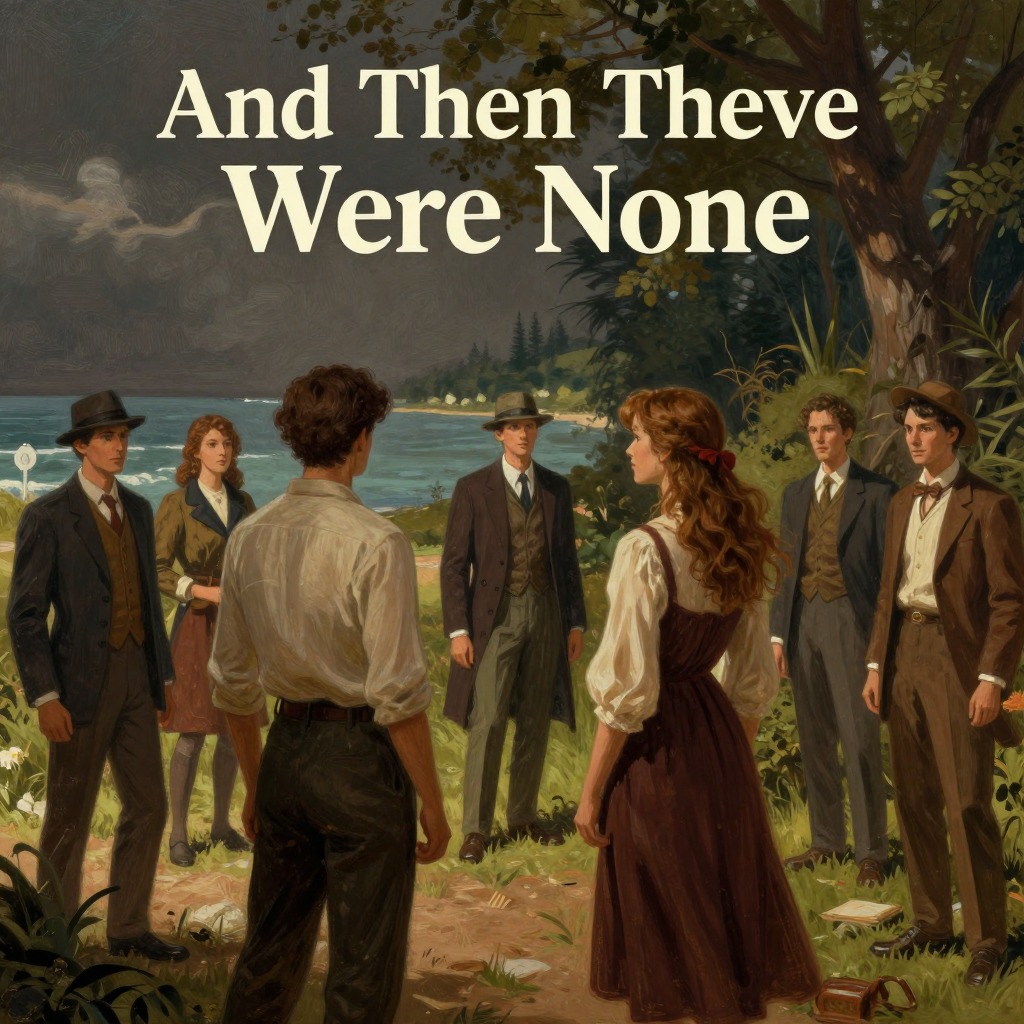
And Then There Were NoneThe framed nursery rhyme of "Ten Little Indian Boys" is a central prop in Agatha Christie's And Then There Were None, serving as both a decorative object in each guest's bedroom and a macabre blueprint for the murders that unfold on Indian Island. Its presence in every bedroom, combined with the matching set of ten china figurines on the dining table, transforms a childhood rhyme into a death warrant, dictating the order and method of each killing and becoming the murderer's signature.
Appearance and Placement
The framed rhyme is first encountered by Vera Claythorne in her bedroom shortly after her arrival on Indian Island. It hangs over the mantelpiece in a gleaming chromium frame, a large square of parchment bearing the complete text of the old nursery rhyme. Vera immediately recognizes it from her childhood and smiles, thinking it a fitting decoration for an island named after the rhyme. The same framed rhyme is found in every guest's bedroom, as confirmed when the guests compare notes at dinner: each room contains a copy. This uniformity suggests deliberate planning, not mere coincidence, and the rhyme's prominent placement ensures that every guest is constantly reminded of the words that will soon become their epitaph.
The Rhyme as a Prophecy
The nursery rhyme itself recounts the sequential deaths of ten little Indian boys, each verse describing a different fatal mishap: one chokes himself, one oversleeps, one stays in Devon, one chops himself in half, one is stung by a bumblebee, one gets in Chancery, one is swallowed by a red herring, one is hugged by a bear, one gets frizzled up, and the last hangs himself. The rhyme's structure of inexorable diminishment—from ten to none—mirrors the fate of the ten people on the island. As the murders progress, each death corresponds to a verse in the rhyme: Anthony Marston chokes on cyanide ("One choked his little self"), Mrs. Rogers dies in her sleep ("One overslept himself"), General Macarthur is killed while sitting by the sea ("One said he'd stay there"), Rogers is chopped with an axe ("One chopped himself in halves"), Emily Brent is stung with a hypodermic syringe ("A bumblebee stung one"), Justice Wargrave is shot while dressed as a judge ("One got in Chancery"), Dr. Armstrong is drowned ("A red herring swallowed one"), Blore is crushed by a marble bear clock ("A big bear hugged one"), and Vera Claythorne hangs herself ("He went and hanged himself"). The rhyme thus functions as a prophetic script, with the murderer meticulously staging each death to match the corresponding verse.
Connection to the China Figurines
The framed rhyme is directly linked to the set of ten china Indian boys that sit on a circular glass stand in the center of the dining table. The guests notice the figurines at dinner and immediately connect them to the rhyme in their bedrooms. As each guest dies, one china figure disappears from the table, creating a visible countdown of the remaining victims. The butler Rogers is the first to notice the discrepancy: after Anthony Marston's death, he finds only nine figures; after Mrs. Rogers' death, only eight. This pattern continues throughout the novel, with the diminishing number of figurines serving as a grim tally of the murders. The framed rhyme and the china figures together form a coordinated system of symbolic representation, with the rhyme providing the narrative and the figurines marking the progress.
Thematic Significance
The framed nursery rhyme embodies the novel's central themes of justice, guilt, and inevitability. The murderer, Justice Wargrave, reveals in his confession that the rhyme fascinated him as a child—"the inexorable diminishment—the sense of inevitability." He deliberately chose to model his murders on the rhyme, seeing it as a fitting framework for his grand scheme of executing those who had escaped legal punishment. The rhyme's presence in every bedroom ensures that the guests are constantly confronted with the prophecy of their own deaths, heightening their fear and paranoia. The final verse, "One little Indian boy left all alone; He went and hanged himself and then there were none," directly foreshadows Vera Claythorne's suicide, as she climbs onto a chair, adjusts a noose around her neck, and kicks the chair away. The framed rhyme thus becomes a self-fulfilling prophecy, a literary device that transforms a childhood game into a deadly ritual of retribution.