
The Limits of Scientific Knowledge
AniaraThis flow traces science’s movement from trusted control to intellectual humility when physical law cannot provide meaning, rescue, or moral guidance.
increasing Bearing strength in each event
 decreasing
Bearing strength in each eventdecreasingEngineering Confidence
Engineering Confidence
A voyage built on systems
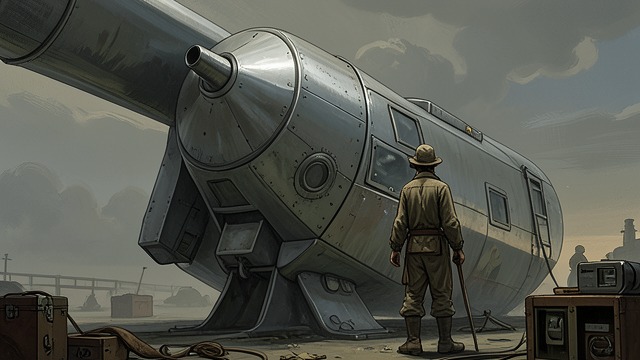
The launch depends on technical procedures, navigation, and the machinery of a large transport craft. Passengers trust that expertise can move them safely toward new settlements.
A fragile assurance
The early failure reveals how dependent human plans are on systems they cannot fully control. Technical sophistication does not guarantee that the world will cooperate with intention.
The Astronomer’s Lecture

The Astronomer’s Lecture
Space reconsidered
The chief astronomer challenges the passengers’ familiar idea of space, describing their ship as a tiny bubble in a vast and difficult-to-know reality. His account unsettles ordinary assumptions about motion and scale.
Knowledge humbled
Scientific insight clarifies the limits of measurement without giving the passengers an actionable destination. The lecture makes intellectual certainty feel as precarious as the journey itself.
The New Theorem

The New Theorem
A genuine discovery
Isagel’s breakthrough in the Law of Aleph Numbers demonstrates the power of rigorous thought. Her result is not a delusion; it is a real intellectual achievement.
Knowledge stranded
Without a world in which to apply it, the theorem cannot transform shared life. The episode distinguishes the value of discovery from the conditions required to make knowledge socially fruitful.
The Calculator’s Mockery

The Calculator’s Mockery
Hope quantified
A calculating system repeatedly reduces hope to numerical results and exposes the weakness of the passengers’ reasoning. Its precision makes thought itself seem vulnerable to ridicule.
Measurement without wisdom
Calculation can test possibilities but cannot decide what deserves care or whether continued life is meaningful. The episode separates numerical competence from moral understanding.
Law and Compassion

Law and Compassion
A distinction made
The narrator accepts that the universe operates according to regular physical laws. He rejects the assumption that cosmic order alone provides a moral or spiritual truth.
A human measure
Compassion becomes the value by which action and civilization should be judged. The distinction answers the poem’s repeated question about what knowledge cannot supply: the responsibility to care.
At launch
During the sixth year
Several years into the voyage
During the middle years aboard
In the final reflections
