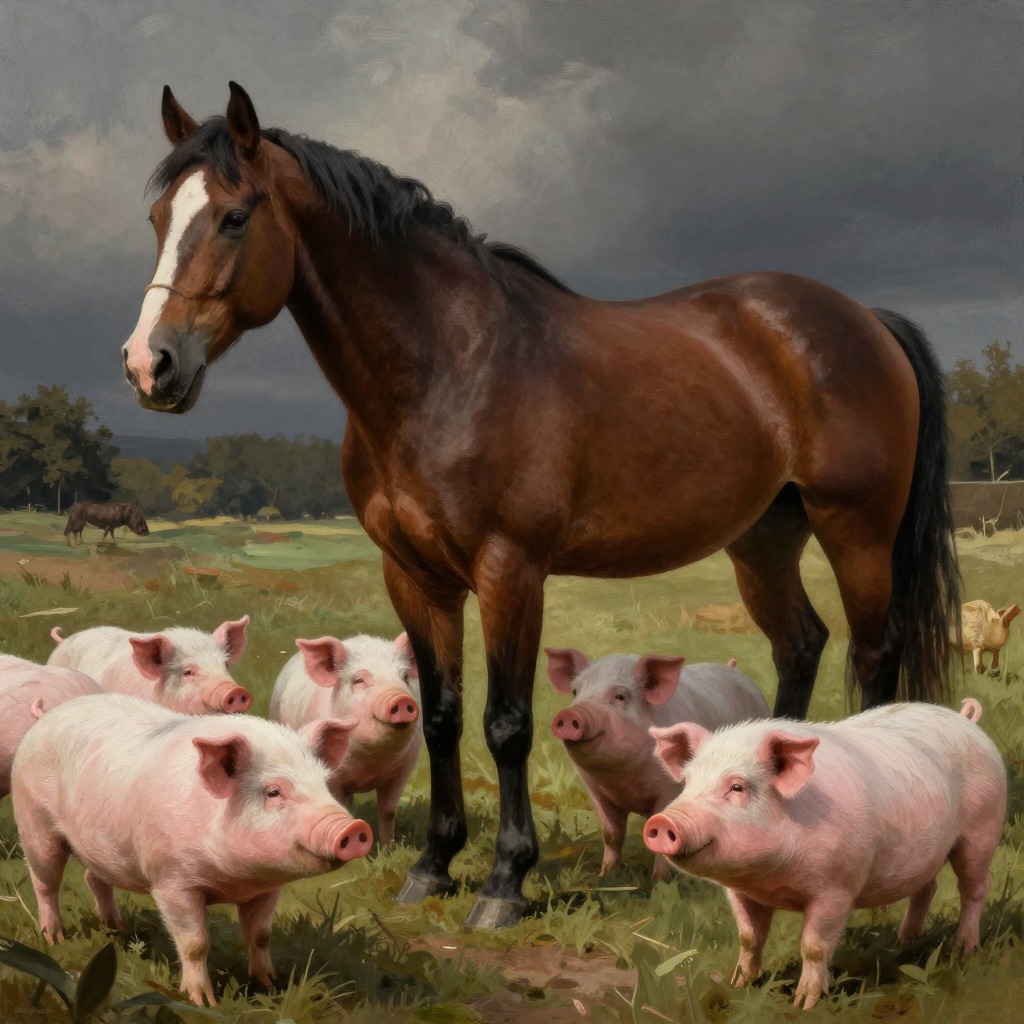
All animals are equal but some are more equal than others
Animal FarmThe phrase 'All animals are equal but some are more equal than others' is the final, openly paradoxical commandment inscribed on the wall of the big barn, serving as the ultimate ideological justification for the pigs' tyranny. It represents the terminal point of the revolution's corruption, where the founding principle of Animalism is inverted into its opposite, and the pigs' rule is no longer disguised as a collective enterprise but asserted as a natural hierarchy.
Origin and Inscription
The phrase first appears on the wall of the big barn after the pigs have fully consolidated their power and begun to adopt human habits. When Clover, her eyesight failing, asks Benjamin to read the Seven Commandments, he finds that only a single commandment remains. It reads: 'ALL ANIMALS ARE EQUAL BUT SOME ANIMALS ARE MORE EQUAL THAN OTHERS.' This inscription replaces the original seven laws, which had been progressively altered to accommodate the pigs' behavior—first the addition of 'with sheets' to the bed rule, then 'without cause' to the killing rule, and finally 'to excess' to the alcohol rule. The new single commandment does not merely amend a previous rule but abolishes the entire framework of equal law, replacing it with a self-contradictory statement that legitimizes inequality by linguistic fiat.
Ideological Function
The commandment functions as the pigs' master ideological tool, retroactively justifying every inequality that has already been established. It provides a philosophical veneer for the pigs' exclusive consumption of milk and apples, their residence in the farmhouse, their sleeping in beds, their drinking of alcohol, and their use of violence against other animals. The phrase 'more equal' is a deliberate paradox that destroys the meaning of equality itself: if some can be more equal, then equality is no longer a universal condition but a privilege granted by power. This mirrors the pigs' earlier rhetorical strategies, such as Squealer's claim that the prohibition on trade had never been passed, or that the pigs' special rations were necessary for the welfare of all. The new commandment makes such casuistry unnecessary by openly declaring that the pigs are a superior class.
Connection to the Original Principle
The original Seventh Commandment, 'All animals are equal,' was the foundational promise of the Rebellion, echoing Old Major's vision of a society where 'weak or strong, clever or simple, we are all brothers.' The transformed version directly negates this promise. The animals' memory of the original ideal persists only as a dim, unarticulated sense of loss. Clover, looking at the half-finished windmill after the executions, recalls the night of Major's speech and the hope of a society where the strong protect the weak, but she cannot find words for her disillusionment. The new commandment is the pigs' answer to that unspoken grief: it declares that the hierarchy they have built is not a betrayal of the revolution but its logical fulfillment.
Consequences and Thematic Significance
The inscription of the new commandment immediately precedes the pigs' final transformation into the likeness of their former human masters. The day after it appears, the pigs supervising work carry whips. Napoleon is seen strolling in the farmhouse garden with a pipe in his mouth, and the pigs begin wearing Mr. Jones's clothes. The commandment thus marks the point at which the pigs no longer need to pretend that they are not human. The final scene of the novel, where the animals at the window cannot distinguish pig from man, is the visual realization of the commandment's logic: if some animals are more equal than others, then the distinction between animal and human—the very basis of the Rebellion—has also collapsed. The phrase has become a proverbial expression for any system that proclaims equality while institutionalizing privilege, and within the novel it stands as the epitaph of the revolution's ideals.