Battle of the Windmill
Animal FarmThe Battle of the Windmill is the second and far more destructive military engagement between the animals of Animal Farm and the human forces of Mr. Frederick of Pinchfield Farm, occurring shortly after Frederick's fraudulent purchase of the farm's timber. Unlike the swift and triumphant Battle of the Cowshed, this battle is a savage, costly affair that results in the complete demolition of the windmill by explosives, the deaths of several animals, and the revelation that the pigs' leadership has led the farm into a cycle of exhausting reconstruction and ideological betrayal.
Background and Causes
The battle is the culmination of a long period of escalating tension and deception. Throughout the summer, Napoleon had been engaged in complicated negotiations with both Mr. Pilkington of Foxwood and Mr. Frederick of Pinchfield over a pile of well-seasoned timber. The animals distrusted Pilkington but greatly preferred him to Frederick, whom they both feared and hated. Rumours of an impending treacherous attack grew stronger as the windmill neared completion; Frederick, it was said, intended to bring twenty men all armed with guns. Napoleon, however, had been secretly in league with Frederick all along, and after a period of seeming friendship with Pilkington, he announced that he had sold the timber to Frederick. The payment was made in five-pound notes, which were later discovered to be forgeries. Frederick had got the timber for nothing. Napoleon immediately pronounced the death sentence upon Frederick and warned that the worst was to be expected. Sentinels were placed at all approaches to the farm, and four pigeons were sent to Foxwood with a conciliatory message, hoping to re-establish good relations with Pilkington.
The Attack and Destruction of the Windmill
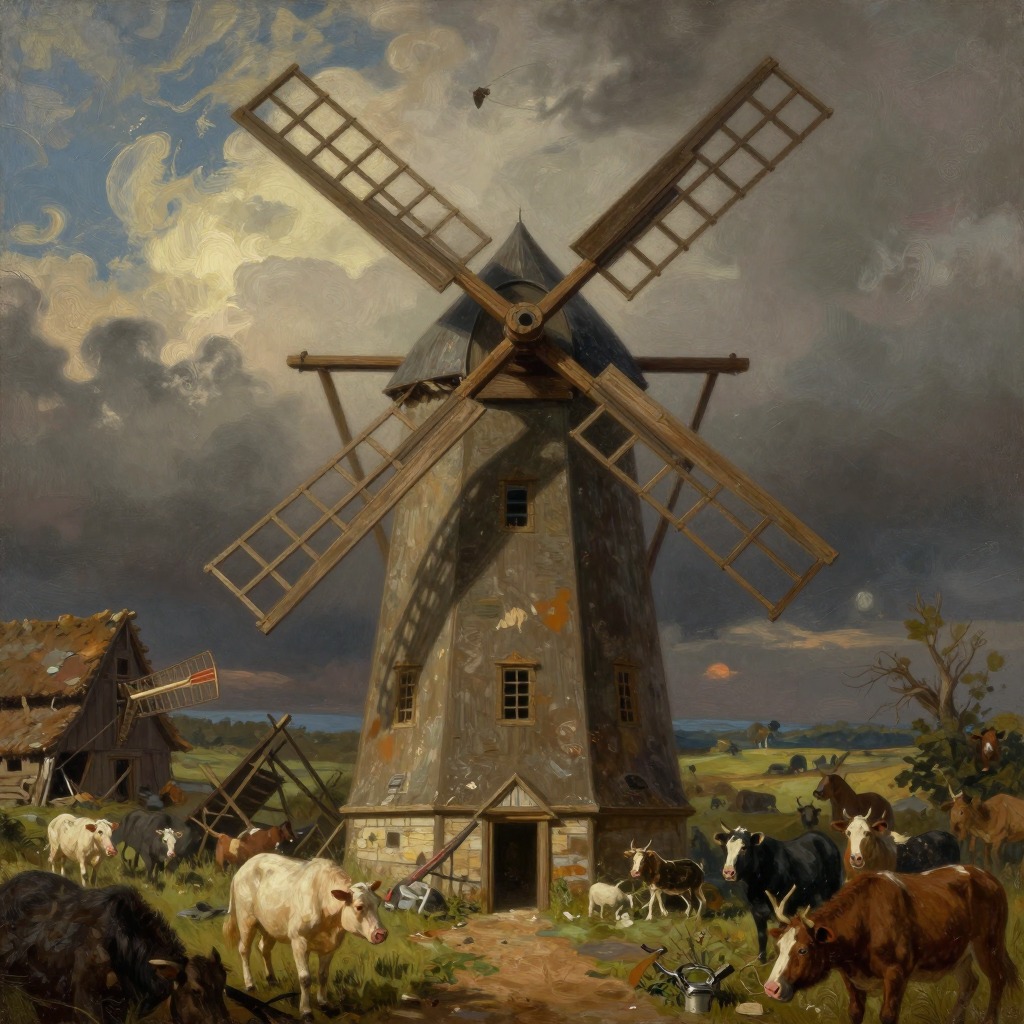
The very next morning, the attack came. The animals were at breakfast when look-outs reported that Frederick and his followers had already come through the five-barred gate. There were fifteen men, with half a dozen guns between them, and they opened fire as soon as they got within fifty yards. The animals could not face the terrible explosions and the stinging pellets, and in spite of the efforts of Napoleon and Boxer to rally them, they were soon driven back. A number of them were already wounded. The whole of the big pasture, including the windmill, fell into the hands of the enemy. The four pigeons sent to Foxwood returned, one bearing a scrap of paper from Pilkington with the words: "Serves you right." Meanwhile, Frederick and his men halted about the windmill. Two of them produced a crowbar and a sledge hammer and began drilling a hole near the base of the structure. Benjamin, watching intently, realized they were going to pack blasting powder into the hole. A deafening roar followed; a huge cloud of black smoke hung where the windmill had been. The windmill had ceased to exist, its stones flung to distances of hundreds of yards.
The Counter-Attack and Aftermath
At the sight of the windmill's destruction, the animals' courage returned. A mighty cry for vengeance went up, and without waiting for further orders they charged forth in a body. This time they did not heed the cruel pellets. It was a savage, bitter battle. The men fired again and again, and when the animals got to close quarters, lashed out with their sticks and heavy boots. A cow, three sheep, and two geese were killed, and nearly everyone was wounded. Even Napoleon had the tip of his tail chipped by a pellet. But the men did not go unscathed either: three had their heads broken by blows from Boxer's hoofs; another was gored in the belly by a cow's horn; another had his trousers nearly torn off by Jessie and Bluebell. When Napoleon's nine bodyguard dogs, who had made a detour under cover of the hedge, suddenly appeared on the men's flank, panic overtook the humans. Frederick shouted to his men to get out, and the enemy ran for dear life. The animals chased them to the bottom of the field. They had won, but they were weary and bleeding. The sight of their dead comrades stretched upon the grass moved some of them to tears. They halted in sorrowful silence at the place where the windmill had once stood; even the foundations were partially destroyed. Squealer, who had been absent during the fighting, appeared and declared the victory, but Boxer, his knees bleeding and a dozen pellets lodged in his hind leg, pointed out that the windmill had been destroyed. Squealer insisted that they had won back every inch of their soil. The battle was named the Battle of the Windmill, and Napoleon created a new decoration, the Order of the Green Banner, which he conferred upon himself. Two whole days were given over to celebrations, with songs, speeches, and a special gift of an apple for every animal. In the general rejoicings, the unfortunate affair of the banknotes was forgotten.
Consequences and Significance
The Battle of the Windmill marks a decisive turning point in the narrative, exposing the hollowness of the pigs' leadership and the futility of the animals' sacrifices. The windmill, which had been the central symbol of the animals' hopes for a better life—a project that had required them to work a sixty-hour week, endure food shortages, and even face the destruction of the first windmill by a storm—was now obliterated by human explosives. The rebuilding of the windmill, with walls twice as thick as before, had already demanded tremendous labour; after the battle, the animals faced the prospect of starting again from the foundations. Boxer, for the first time, felt that his great muscles were not what they had once been. The battle also accelerates the pigs' consolidation of power and the erosion of the original principles of Animalism. The Seven Commandments, which had already been subtly altered, would later be reduced to the single maxim "All animals are equal but some animals are more equal than others." The song 'Beasts of England', which had been the anthem of the Rebellion, had already been abolished. The battle thus serves as a brutal demonstration that the animals' struggle has been co-opted by a new elite, and that the promise of freedom and equality has been replaced by endless toil and ideological manipulation.