Boxer
Animal FarmBoxer, the enormous and loyal cart-horse, is the embodiment of unwavering dedication and physical strength on Animal Farm, whose tragic fate reveals the brutal exploitation and betrayal at the heart of the pigs' regime. Nearly eighteen hands high and as strong as any two ordinary horses put together, he was universally respected for his steadiness of character and tremendous powers of work, though a white stripe down his nose gave him a somewhat stupid appearance and he was not of first-rate intelligence. From the earliest days of the Rebellion, Boxer was one of the most faithful disciples of the pigs, absorbing everything he was told and passing it on to others through simple arguments, unfailing in his attendance at secret meetings and leading the singing of 'Beasts of England'.
Identity and Introduction
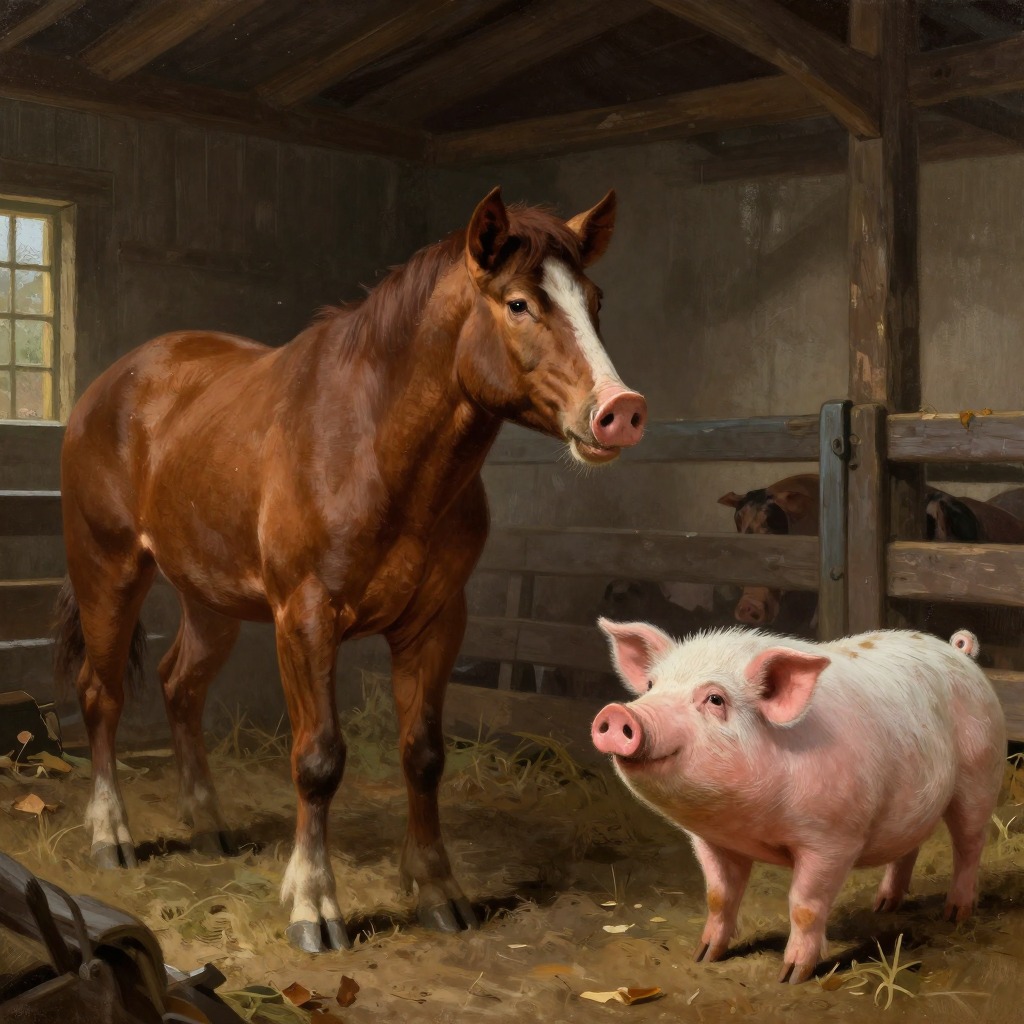
Boxer was introduced on the night of Old Major's speech, entering the big barn with Clover, walking very slowly and setting down his vast hairy hoofs with great care lest there should be some small animal concealed in the straw. He was an enormous beast, nearly eighteen hands high, and as strong as any two ordinary horses put together. A white stripe down his nose gave him a somewhat stupid appearance, and in fact he was not of first-rate intelligence, but he was universally respected for his steadiness of character and tremendous powers of work. He was devoted to Benjamin, the cynical donkey, and the two of them usually spent their Sundays together in the small paddock beyond the orchard, grazing side by side and never speaking.
Arc Through the Plot: Unquestioning Labor and Loyalty
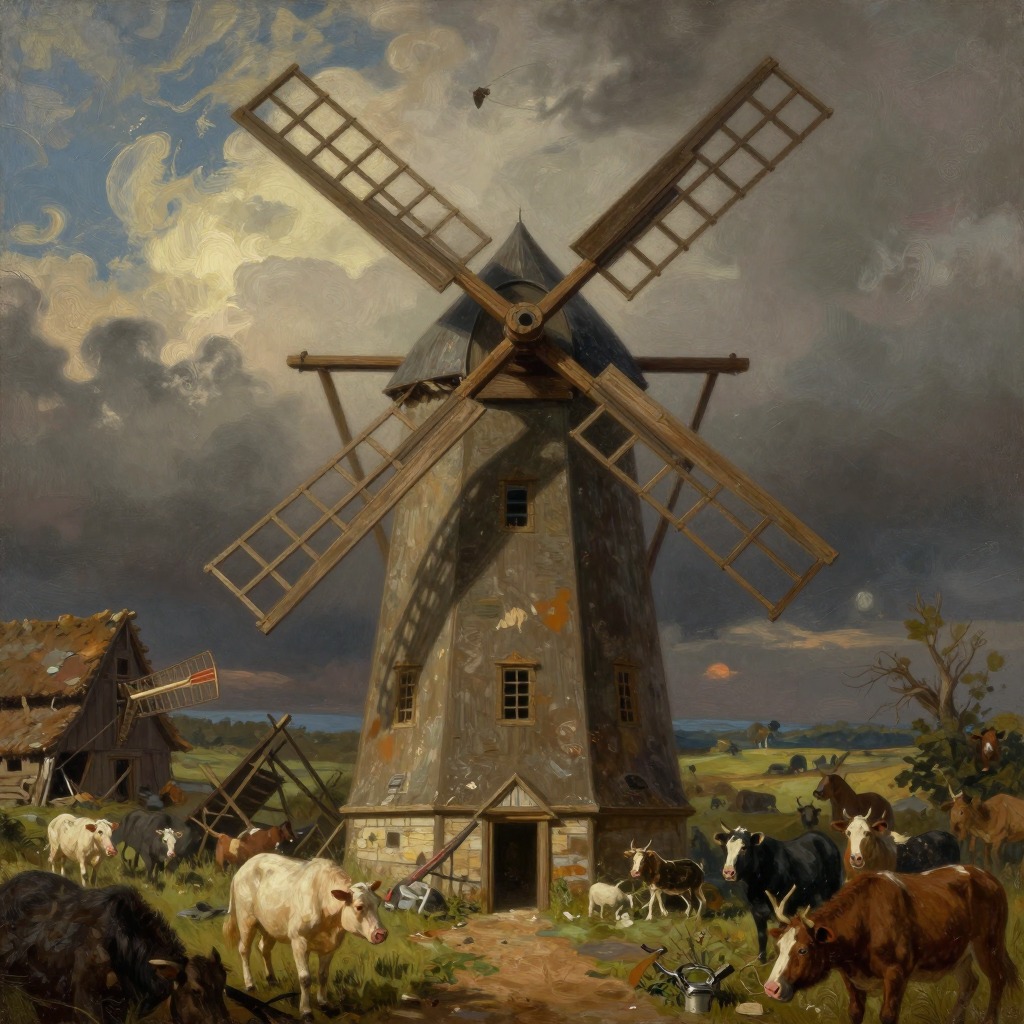
Boxer's role on the farm was defined by his immense physical strength and his unquestioning acceptance of the pigs' authority. After the Rebellion, he seemed more like three horses than one; there were days when the entire work of the farm seemed to rest on his mighty shoulders. From morning to night he was pushing and pulling, always at the spot where the work was hardest. He had made an arrangement with one of the cockerels to call him in the mornings half an hour earlier than anyone else, and would put in volunteer labour at whatever seemed to be most needed before the regular day's work began. His answer to every problem, every setback, was "I will work harder!"—which he had adopted as his personal motto. After Snowball's expulsion, he adopted the additional maxim, "Napoleon is always right." These two slogans seemed to him a sufficient answer to all problems. He made arrangements with the cockerel to call him three-quarters of an hour earlier in the mornings instead of half an hour, and in his spare moments he would go alone to the quarry, collect a load of broken stone, and drag it down to the site of the windmill unassisted.
Key Actions and Objectives
Boxer's primary objective was to serve the farm and its leader, Napoleon, with all his might. He was the admiration of everybody for his work ethic. During the Battle of the Cowshed, he delivered the most terrifying spectacle, rearing up on his hind legs and striking out with his great iron-shod hoofs like a stallion. His very first blow took a stable-lad from Foxwood on the skull and stretched him lifeless in the mud, an act that filled him with sorrow. "I had no intention of doing that," he said sorrowfully. "I forgot that I was wearing iron shoes. Who will believe that I did not do this on purpose?" He was awarded the "Animal Hero, First Class" medal for his bravery. During the rebuilding of the windmill, his strength seemed equal to that of all the rest of the animals put together. When the boulder began to slip and the animals cried out in despair, it was always Boxer who strained himself against the rope and brought the boulder to a stop. To see him toiling up the slope inch by inch, his breath coming fast, the tips of his hoofs clawing at the ground, and his great sides matted with sweat, filled everyone with admiration.
Relationships and Conflict
Boxer's closest relationships were with Clover and Benjamin. Clover, a stout motherly mare, warned him sometimes to be careful not to overstrain himself, but Boxer would never listen to her. Benjamin, the cynical donkey, was devoted to Boxer without openly admitting it. After the executions, when the other animals were shaken and miserable, Boxer remained on his feet, fidgeting to and fro, swishing his long black tail against his sides and occasionally uttering a little whinny of surprise. He said, "I do not understand it. I would not have believed that such things could happen on our farm. It must be due to some fault in ourselves. The solution, as I see it, is to work harder." He then moved off at his lumbering trot and made for the quarry, collecting two successive loads of stone and dragging them down to the windmill before retiring for the night. His conflict was not with other animals but with the reality of his own failing body, which he refused to acknowledge. When Squealer cast a very ugly look at Boxer with his little twinkling eyes after Boxer questioned Snowball's guilt, it signaled a deeper conflict with the regime's narrative.
Change and Ending: The Tragic Fall
Boxer's physical decline was gradual but inexorable. After his hoof healed from the Battle of the Windmill, he worked harder than ever, but his hide was less shiny than it had used to be, and his great haunches seemed to have shrunken. The spring came and Boxer grew no fatter. Sometimes on the slope leading to the top of the quarry, when he braced his muscles against the weight of some vast boulder, it seemed that nothing kept him on his feet except the will to continue. At such times his lips were seen to form the words, "I will work harder"; he had no voice left. Late one summer evening, he fell while dragging a load of stone down to the windmill. He was found lying on his side, his neck stretched out, unable even to raise his head, his eyes glazed, his sides matted with sweat, a thin stream of blood trickling from his mouth. He told Clover, "It is my lung. It does not matter. I think you will be able to finish the windmill without me." Despite Clover and Benjamin's warnings, the pigs arranged for him to be taken to the hospital in Willingdon. The van that came for him was from Alfred Simmonds, Horse Slaughterer and Glue Boiler. Benjamin read the lettering aloud: "'Alfred Simmonds, Horse Slaughterer and Glue Boiler, Willingdon. Dealer in Hides and Bone-Meal. Kennels Supplied.' Do you not understand what that means? They are taking Boxer to the knacker's!" Boxer's face appeared at the small window at the back of the van, but his strength had left him, and the sound of his drumming hoofs grew fainter and died away. He was never seen again. Three days later, Squealer announced that Boxer had died in the hospital, having received every attention a horse could have, and that his last words were "Forward, comrades! Forward in the name of the Rebellion. Long live Animal Farm! Long live Comrade Napoleon! Napoleon is always right."
Thematic Significance
Boxer's story is the central tragedy of Animal Farm, illustrating how the pigs' regime exploited the loyalty and labor of the most dedicated workers. His unquestioning faith in Napoleon and his motto "I will work harder" became tools of his own destruction. The pigs' betrayal of Boxer—selling him to the knacker's while pretending to send him to a hospital—exposes the complete corruption of the revolutionary ideals. His death marks the point of no return for the farm, after which the pigs openly adopt human habits, including wearing clothes and walking on their hind legs. Boxer's fate demonstrates that under the new tyranny, the strongest and most loyal are the most easily exploited and discarded. The pigs' memorial banquet and Napoleon's oration in his honor, complete with a wreath from the farmhouse garden, are hollow gestures that mask the brutal reality of his end. His two maxims, "I will work harder" and "Comrade Napoleon is always right," are held up by Napoleon as examples for all animals to follow, cementing the ideology that led to his death.