Boxer's Death
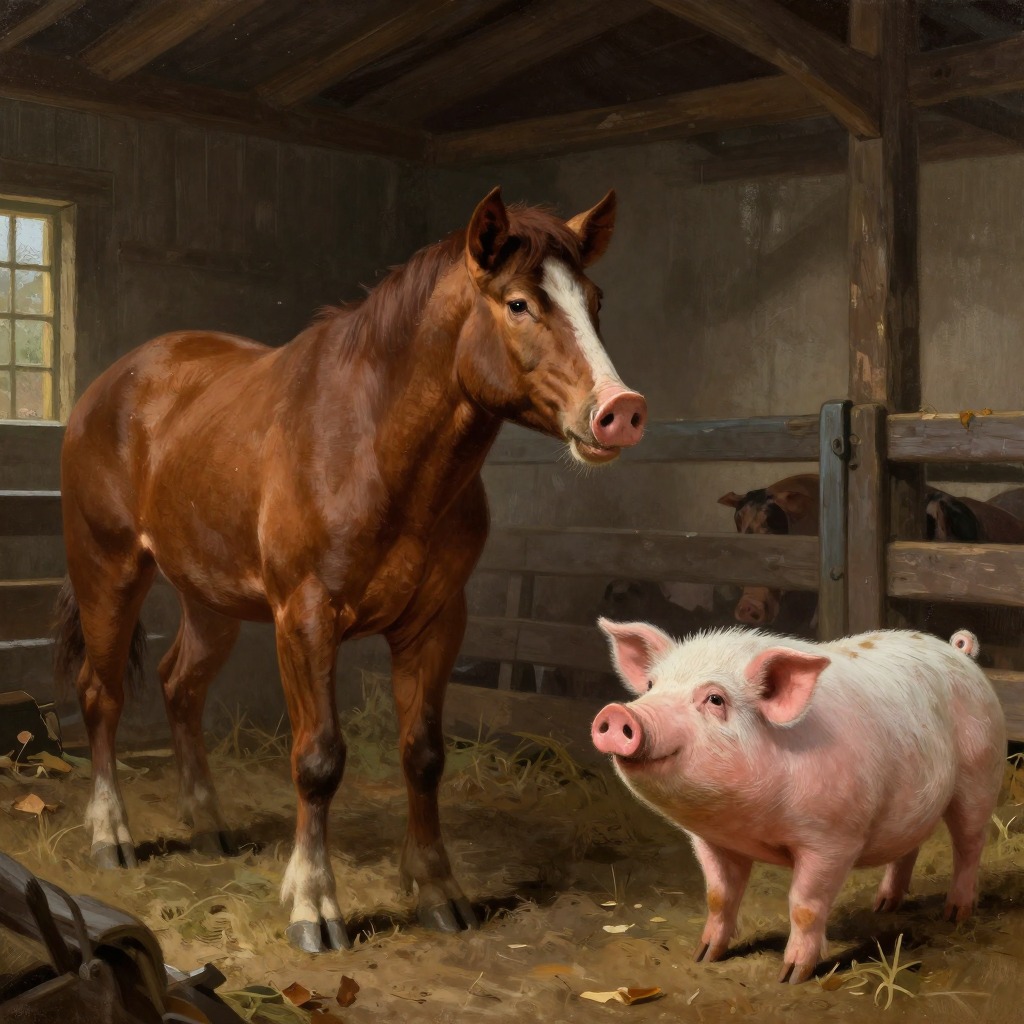
Animal FarmBoxer's death is the decisive moral catastrophe of Animal Farm, the moment when the revolutionary promise of equality and comradeship is finally and irrevocably broken. The cart-horse who had been the physical and spiritual backbone of the farm, whose unwavering faith in Napoleon and whose personal motto "I will work harder" had sustained the entire community through years of deprivation, is callously discarded by the very leader he worshipped. His end is not a natural death from old age or a heroic fall in battle, but a sordid, commercial transaction: the pigs sell their most loyal worker to the knacker's yard for cash, then fabricate a deathbed scene to conceal their treachery.
Collapse and Abandonment
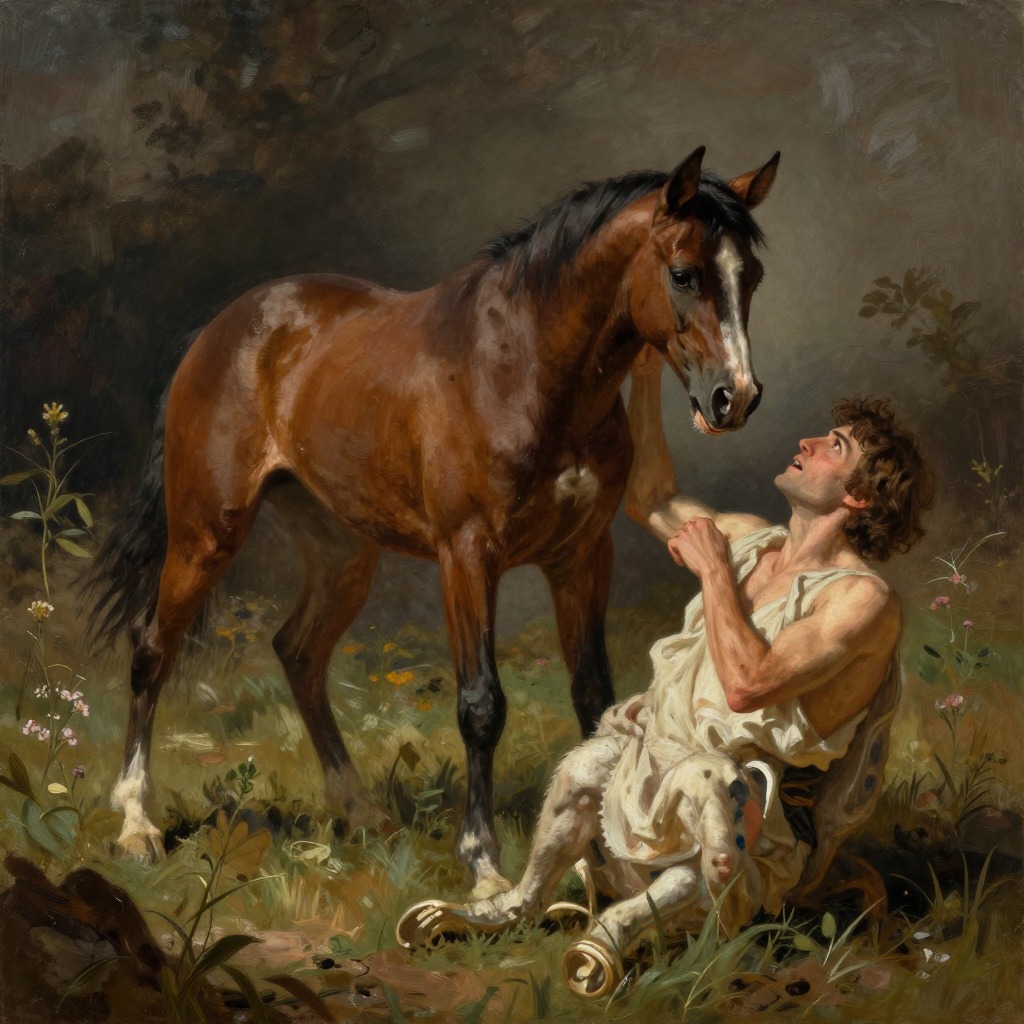
Late one summer evening, a rumour raced around the farm that Boxer had fallen. He had gone out alone to drag a load of stone down to the windmill, and the rumour proved true. The animals found him lying on his side between the shafts of the cart, his neck stretched out, unable even to raise his head. His eyes were glazed, his sides matted with sweat, and a thin stream of blood had trickled from his mouth. Clover dropped to her knees beside him. Boxer spoke in a weak voice, saying it was his lung, and that he did not matter. He thought the others could finish the windmill without him, as a good store of stone had been accumulated. He had only another month to go before his retirement, and he had been looking forward to it, hoping that perhaps Benjamin, who was also growing old, might be allowed to retire at the same time and be a companion to him. Clover immediately sent word to Squealer. When Squealer appeared, he was full of sympathy and concern, announcing that Comrade Napoleon had learned of the misfortune with the very deepest distress and was already making arrangements to send Boxer to the hospital at Willingdon. The animals felt uneasy, for except for Mollie and Snowball, no animal had ever left the farm, and they did not like to think of their sick comrade in the hands of human beings. But Squealer easily convinced them that the veterinary surgeon in Willingdon could treat Boxer's case more satisfactorily. Boxer was helped to his feet and managed to limp back to his stall, where Clover and Benjamin had prepared a good bed of straw for him.
The Van and the Revelation
For the next two days Boxer remained in his stall. The pigs sent a large bottle of pink medicine from the bathroom chest, and Clover administered it twice a day. In the evenings she lay in his stall and talked to him while Benjamin kept the flies off. Boxer professed not to be sorry for what had happened; if he made a good recovery, he might expect to live another three years, and he looked forward to peaceful days in the corner of the big pasture, where he intended to devote the rest of his life to learning the remaining twenty-two letters of the alphabet. But Clover and Benjamin could only be with him after working hours, and it was in the middle of the day that the van came to take him away. The animals were all at work weeding turnips under the supervision of a pig when they were astonished to see Benjamin come galloping from the direction of the farm buildings, braying at the top of his voice. It was the first time they had ever seen Benjamin excited, indeed the first time anyone had ever seen him gallop. "Quick, quick!" he shouted. "Come at once! They're taking Boxer away!" The animals broke off work and raced back. There in the yard was a large closed van drawn by two horses, with lettering on its side and a sly-looking man in a low-crowned bowler hat sitting on the driver's seat. Boxer's stall was empty. The animals crowded around the van, chorusing good-bye. "Fools! Fools!" shouted Benjamin, prancing and stamping the earth with his small hoofs. "Do you not see what is written on the side of that van?" In the midst of a deadly silence, he read aloud: "'Alfred Simmonds, Horse Slaughterer and Glue Boiler, Willingdon. Dealer in Hides and Bone-Meal. Kennels Supplied.' Do you not understand what that means? They are taking Boxer to the knacker's!" A cry of horror burst from all the animals. The man on the box whipped up his horses and the van moved out of the yard at a smart trot. All the animals followed, crying out. Clover forced her way to the front, trying to stir her stout limbs to a gallop. "Boxer!" she cried. "Boxer! Boxer! Boxer!" Just then, as though he had heard the uproar, Boxer's face, with the white stripe down his nose, appeared at the small window at the back of the van. "Boxer!" cried Clover in a terrible voice. "Get out! Get out quickly! They're taking you to your death!" All the animals took up the cry. But the van was already gathering speed and drawing away. A moment later Boxer's face disappeared from the window, and there was the sound of a tremendous drumming of hoofs inside the van as he tried to kick his way out. The time had been when a few kicks from Boxer's hoofs would have smashed the van to matchwood, but his strength had left him, and in a few moments the sound of drumming hoofs grew fainter and died away. In desperation, the animals appealed to the two horses drawing the van to stop, shouting, "Comrades, comrades! Don't take your own brother to his death!" But the stupid brutes merely set back their ears and quickened their pace. Boxer's face did not reappear. Too late, someone thought of racing ahead and shutting the five-barred gate, but the van was already through it and rapidly disappearing down the road. Boxer was never seen again.
The Official Lie
Three days later it was announced that Boxer had died in the hospital at Willingdon, in spite of receiving every attention a horse could have. Squealer came to announce the news, claiming he had been present during Boxer's last hours. "It was the most affecting sight I have ever seen!" he said, lifting his trotter and wiping away a tear. He reported that at the end, almost too weak to speak, Boxer had whispered in his ear that his sole sorrow was to have passed on before the windmill was finished, and that his very last words were: "Forward, comrades! Forward in the name of the Rebellion. Long live Animal Farm! Long live Comrade Napoleon! Napoleon is always right." Then Squealer's demeanour suddenly changed. He fell silent, his little eyes darting suspicious glances, and proceeded to denounce a foolish and wicked rumour that some animals had noticed the van was marked "Horse Slaughterer" and had jumped to the conclusion that Boxer was being sent to the knacker's. The explanation, he said indignantly, was very simple: the van had previously been the property of the knacker and had been bought by the veterinary surgeon, who had not yet painted the old name out. The animals were enormously relieved. When Squealer went on to give further graphic details of Boxer's death-bed, the admirable care he had received, and the expensive medicines for which Napoleon had paid without a thought as to the cost, their last doubts disappeared. Their sorrow was tempered by the thought that at least he had died happy. Napoleon himself appeared at the meeting on the following Sunday morning and pronounced a short oration in Boxer's honour, ending with a reminder of Boxer's two favourite maxims, "I will work harder" and "Comrade Napoleon is always right"—maxims, he said, which every animal would do well to adopt as his own. A few days later, the pigs held a memorial banquet, and that night there was the sound of uproarious singing followed by a violent quarrel and a tremendous crash of glass. No one stirred in the farmhouse before noon the following day, and the word went round that the pigs had acquired the money to buy themselves another case of whisky.