Destruction of the Windmill (First)
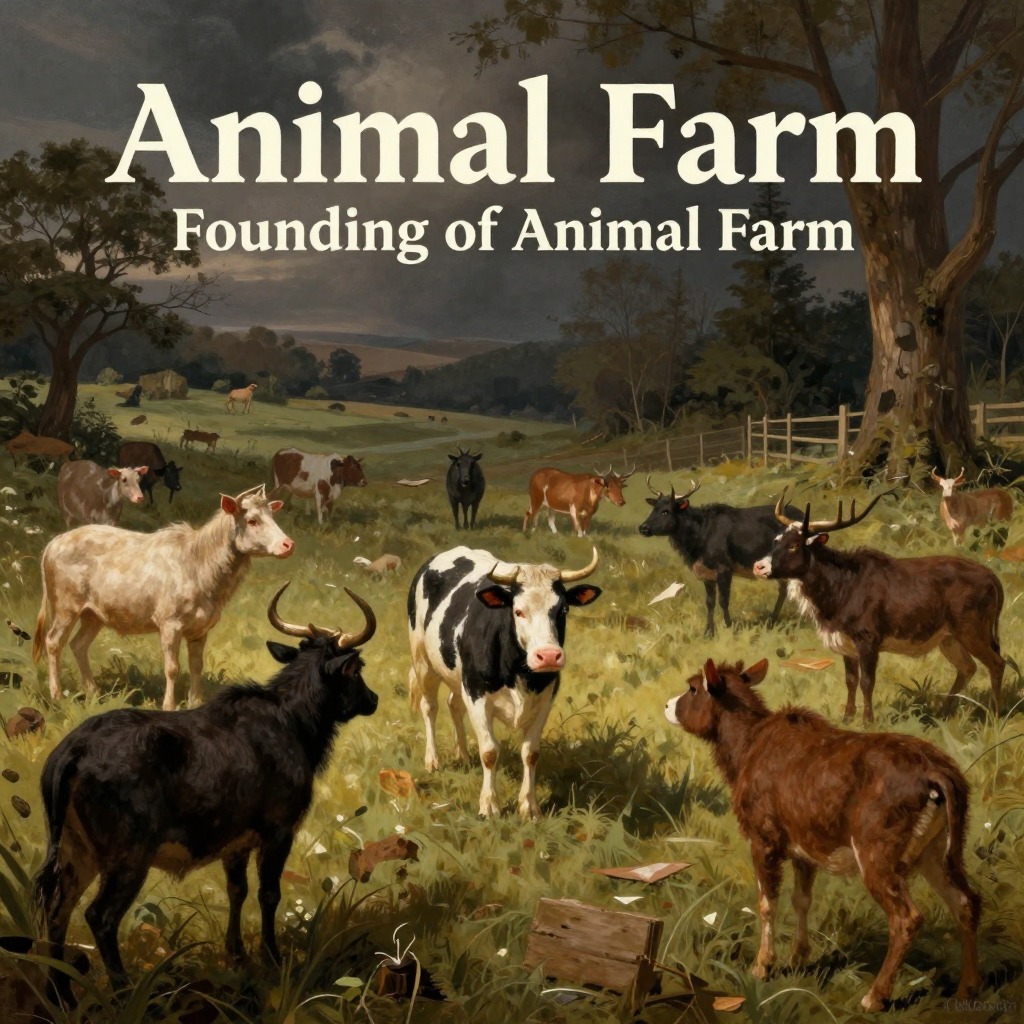
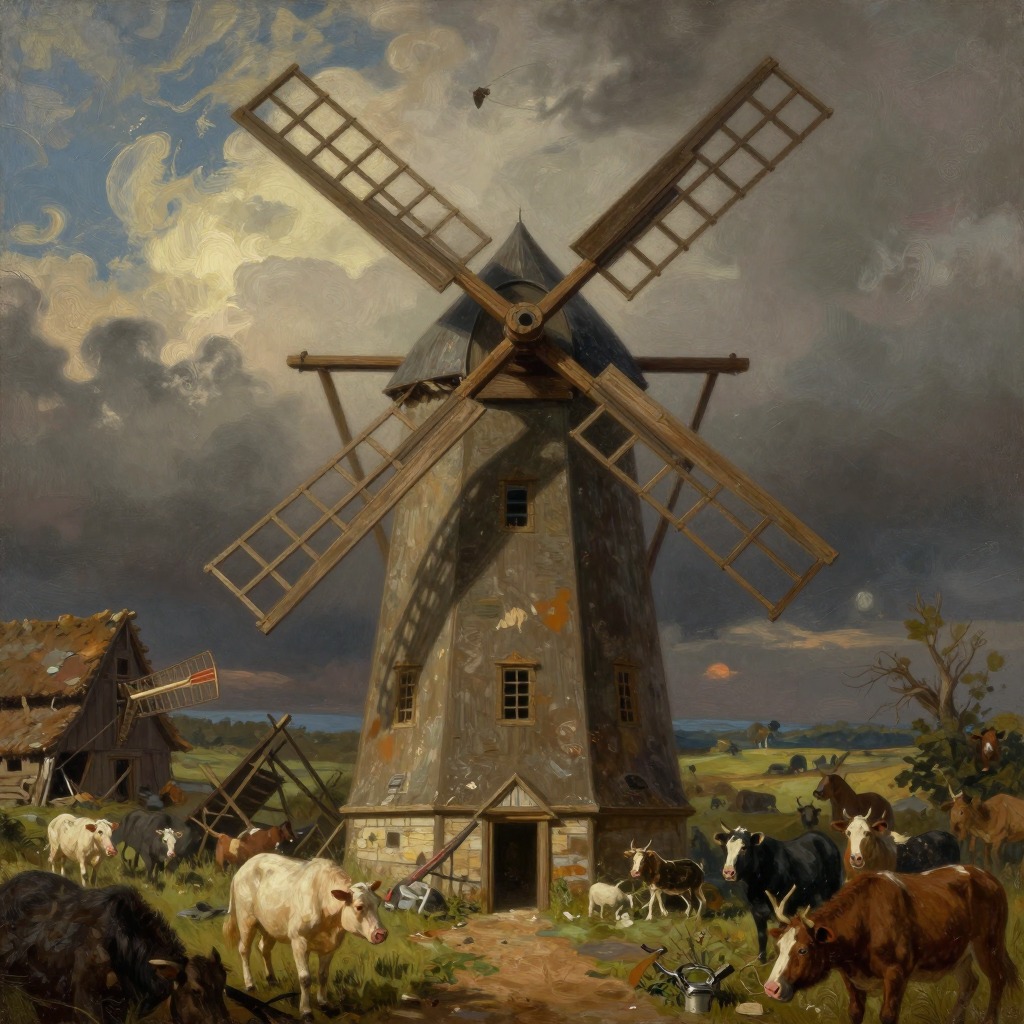
Animal FarmThe destruction of the windmill, occurring on a violent November night, was the most devastating blow the animals of Animal Farm had yet suffered. The windmill, which Snowball had conceived as a means to generate electrical power and lift the burden of manual labor from the animals' backs, had been the central project of the farm for nearly a year. Its collapse, leveled to its foundations by a raging gale, not only erased the fruit of their exhausting labor but also became the catalyst for Napoleon's most brazen act of psychological manipulation, as he blamed the disaster on the exiled Snowball and used the ensuing outrage to tighten his grip on the farm.
The Windmill and the Animals' Hopes
Snowball had first proposed the windmill after surveying the farm's highest point, a small knoll near the farm buildings, declaring it the ideal location for a structure that would operate a dynamo and supply the farm with electrical power. He envisioned it lighting and warming the stalls in winter, and running a circular saw, a chaff-cutter, a mangel-slicer, and an electric milking machine. The animals, who had never heard of such things, listened in astonishment as Snowball painted pictures of fantastic machines that would do their work while they grazed at ease or improved their minds. The windmill became the focus of a bitter rivalry between Snowball and Napoleon, with Napoleon opposing it from the start, even urinating on Snowball's plans. After Napoleon's dogs expelled Snowball, Napoleon announced that the windmill would be built after all, claiming the plan as his own. The animals threw themselves into the work with desperate hope, dragging huge boulders from the quarry up the slope to shatter them below, a slow and laborious process that often took a whole day to move a single stone. Boxer, whose strength seemed equal to that of all the other animals combined, was the backbone of the effort, straining against the ropes when boulders began to slip and pulling them to a stop. By autumn, the windmill was almost half built, and the animals, though tired and hungry after a hard year and the sale of part of the hay and corn, found compensation in the sight of the rising walls, admiring their strength and perpendicularity.
The Night of the Gale
November brought raging south-west winds so violent that the farm buildings rocked on their foundations and several tiles were blown off the barn roof. The hens woke up squawking with terror, having all dreamed simultaneously of hearing a gun go off in the distance. In the morning, the animals emerged from their stalls to find the flagstaff blown down and an elm tree at the foot of the orchard plucked up like a radish. Then a cry of despair broke from every throat: the windmill was in ruins. With one accord they dashed down to the knoll. Napoleon, who seldom moved out of a walk, raced ahead of them all. There lay the fruit of all their struggles, levelled to its foundations, the stones they had broken and carried so laboriously scattered all around. Unable at first to speak, they stood gazing mournfully at the litter of fallen stone. Napoleon paced to and fro in silence, occasionally snuffing at the ground, his tail rigid and twitching sharply from side to side—a sign of intense mental activity.
Napoleon's Accusation and the Blame on Snowball
Suddenly Napoleon halted as though his mind were made up. He asked the animals if they knew who was responsible, then roared in a voice of thunder: "SNOWBALL!" He declared that Snowball, in sheer malignity, had crept in under cover of night and destroyed their work of nearly a year to avenge himself for his ignominious expulsion. Napoleon pronounced the death sentence upon Snowball, offering "Animal Hero, Second Class" and half a bushel of apples to any animal who brought him to justice, and a full bushel to anyone who captured him alive. The animals were shocked beyond measure to learn that even Snowball could be guilty of such an action. Almost immediately, the footprints of a pig were discovered in the grass at a little distance from the knoll, appearing to lead to a hole in the hedge. Napoleon snuffed deeply at them and pronounced them to be Snowball's, giving it as his opinion that Snowball had probably come from the direction of Foxwood Farm. The human beings, out of spite, pretended not to believe it was Snowball, saying the walls were too thin, but the animals knew this was not the case. Nevertheless, it was decided to rebuild the walls three feet thick instead of eighteen inches, meaning much larger quantities of stone would be needed.
Consequences and the Deepening of Tyranny
The destruction of the windmill had immediate and far-reaching consequences. The animals, already exhausted and underfed, faced a bitter winter of rebuilding. The stormy weather was followed by sleet and snow, then a hard frost that did not break until well into February. The quarry was full of snowdrifts, and progress was slow and cruel. The animals were always cold and usually hungry. In January, food fell short; the corn ration was drastically reduced, and the greater part of the potato crop was frosted in the clamps. For days at a time, the animals had nothing to eat but chaff and mangels. Starvation seemed to stare them in the face. Napoleon, rarely appearing in public now and guarded by fierce dogs, used the crisis to demand even greater sacrifices. He ordered the hens to surrender their eggs to be sold for grain, leading to the first rebellion since the expulsion of Jones, which was crushed ruthlessly, with nine hens dying. The windmill disaster also provided the foundation for the later purge, as Napoleon's accusations against Snowball escalated into a full-scale terror, with animals confessing to imaginary crimes and being executed. The windmill itself, when finally rebuilt, was not used for generating electrical power as Snowball had dreamed, but for milling corn, bringing in a money profit. The luxuries of electric light, hot and cold water, and the three-day week were no longer talked about. Napoleon denounced such ideas as contrary to the spirit of Animalism, declaring that the truest happiness lay in working hard and living frugally. The destruction of the windmill thus marked the moment when the animals' hope for a better future was not only physically shattered but also ideologically replaced by a system of exploitation and fear.