Egg Production Committee
Animal FarmThe Egg Production Committee was one of the many Animal Committees created by Snowball during the hopeful period following the Rebellion. Snowball, indefatigable in his efforts to organize the farm, formed this committee specifically for the hens, alongside other bodies such as the Clean Tails League for the cows and the Whiter Wool Movement for the sheep. These committees were part of a broader attempt to apply the principles of Animalism to every aspect of farm life, with the Egg Production Committee intended to rationalize and increase the laying of eggs for the benefit of all animals. The committee was a product of the early revolutionary spirit, when the pigs, led by Snowball, believed that through education and organization, the farm could be made prosperous and self-sufficient.
The Committee's Purpose and the Exploitation of Eggs
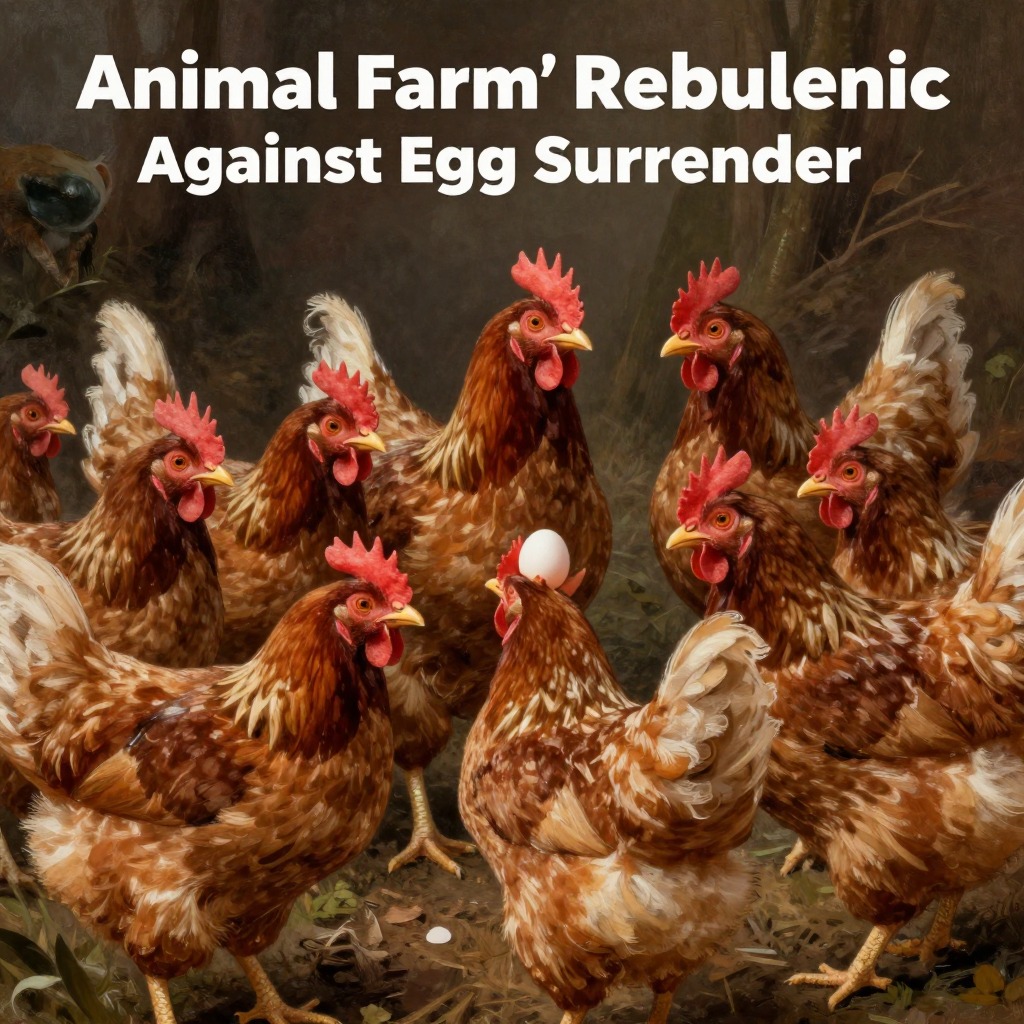
The Egg Production Committee's original purpose was to manage the hens' labor for the collective good, but this ideal was quickly subverted. As the pigs began to claim privileges for themselves, the milk and the windfall apples were reserved for their exclusive use, justified by Squealer's argument that these were necessary for the brainworkers who managed the farm. This logic was extended to the eggs. When food shortages threatened the farm during the bitter winter, Napoleon announced that the hens must surrender their eggs to be sold. Through the intermediary Mr. Whymper, Napoleon accepted a contract for four hundred eggs a week, the price of which would pay for grain and meal to keep the farm going. The Egg Production Committee, which had been formed to serve the collective, was thus repurposed as a mechanism for extracting the hens' produce for trade with humans, a practice the Rebellion had originally forbidden.
The Hens' Rebellion and the Enforcement of the Contract
The imposition of the egg contract led to the first significant act of resistance since the expulsion of Jones. When the hens heard they must give up their eggs, they raised a terrible outcry. Led by three young Black Minorca pullets, they attempted to thwart Napoleon's wishes by flying up to the rafters and laying their eggs there, smashing them on the floor. Napoleon responded with ruthless force: he ordered the hens' rations to be stopped and decreed that any animal giving so much as a grain of corn to a hen would be punished by death. The dogs enforced these orders, and after five days the hens capitulated. Nine hens died during the standoff, their bodies buried in the orchard, and it was given out that they had died of coccidiosis. The Egg Production Committee, which should have been a vehicle for the hens' own organized labor, was now the instrument through which their eggs were forcibly taken. The contract was fulfilled, with a grocer's van driving up to the farm once a week to collect the eggs, and the committee's name became a hollow echo of its original purpose.
The Committee's Legacy and the Pigs' Control
In the years that followed, the Egg Production Committee ceased to be a meaningful body for the hens' benefit and became part of the pigs' apparatus of control. The farm's prosperity increased, but the animals themselves remained hungry and overworked. The contract for eggs was increased to six hundred a week, so that the hens barely hatched enough chicks to maintain their numbers. The pigs, who directed all farm work, including the supervision of the hens, grew fat and comfortable, while the other animals labored under the constant threat of the dogs. The committee, like the other Animal Committees Snowball had founded, was absorbed into the pigs' system of command, its original democratic and organizational intent forgotten. The hens, like all the other animals, were left with nothing but Squealer's lists of figures, which invariably proved that everything was getting better, and the hollow comfort of the Spontaneous Demonstrations, where they marched in military formation behind the pigs. The Egg Production Committee, once a symbol of the animals' hope for a self-governing, cooperative society, had become a tool for the very exploitation it was meant to prevent.