Mr. Frederick
Animal FarmMr. Frederick is the owner of Pinchfield, the smaller and better-kept of the two farms adjoining Animal Farm. Described as a tough, shrewd man perpetually involved in lawsuits and with a name for driving hard bargains, he stands in permanent opposition to his neighbor Mr. Pilkington of Foxwood, a fact that Napoleon exploits in his dealings with the outside world. Frederick's role in the narrative is that of a calculating opportunist and a direct military threat, whose actions—particularly his forgery of banknotes and his destruction of the windmill—expose the moral bankruptcy of the human world and the ultimate futility of the animals' struggle.
Identity and Background
Mr. Frederick is introduced as the proprietor of Pinchfield Farm, a smaller but better-maintained property than the neighboring Foxwood. He is a tough, shrewd man, perpetually involved in lawsuits and known for driving hard bargains. His permanent enmity with Mr. Pilkington of Foxwood prevents the two human farmers from uniting against Animal Farm, a fact that Napoleon later exploits. Frederick's farm is the rumored hiding place of Snowball after his expulsion, and it is from Pinchfield that the most terrible stories of cruelty to animals leak out—stories of flogging an old horse to death, starving cows, killing a dog by throwing it into a furnace, and making cocks fight with splinters of razor-blade tied to their spurs. These tales inflame the animals' rage and deepen their hatred of Frederick.
Business Dealings with Napoleon
Frederick becomes a central figure in Napoleon's economic maneuvers when he expresses a strong desire to purchase the pile of well-seasoned timber that has been stacked on Animal Farm for ten years. Napoleon, through his intermediary Mr. Whymper, plays Frederick and Pilkington against each other, hesitating between the two buyers. The pattern is clear: whenever Napoleon seems on the point of agreeing with Frederick, Snowball is declared to be hiding at Foxwood; when he inclines toward Pilkington, Snowball is said to be at Pinchfield. After a period of apparent friendship with Pilkington, Napoleon reveals that he has been in secret agreement with Frederick all along, having forced Frederick to raise his price by twelve pounds through the pretense of dealing with Pilkington. Frederick pays for the timber with what appear to be real five-pound notes, but three days later it is discovered that the banknotes are forgeries—Frederick has obtained the timber for nothing. Napoleon, in a terrible voice, pronounces the death sentence upon Frederick, declaring that when captured he should be boiled alive.
The Battle of the Windmill
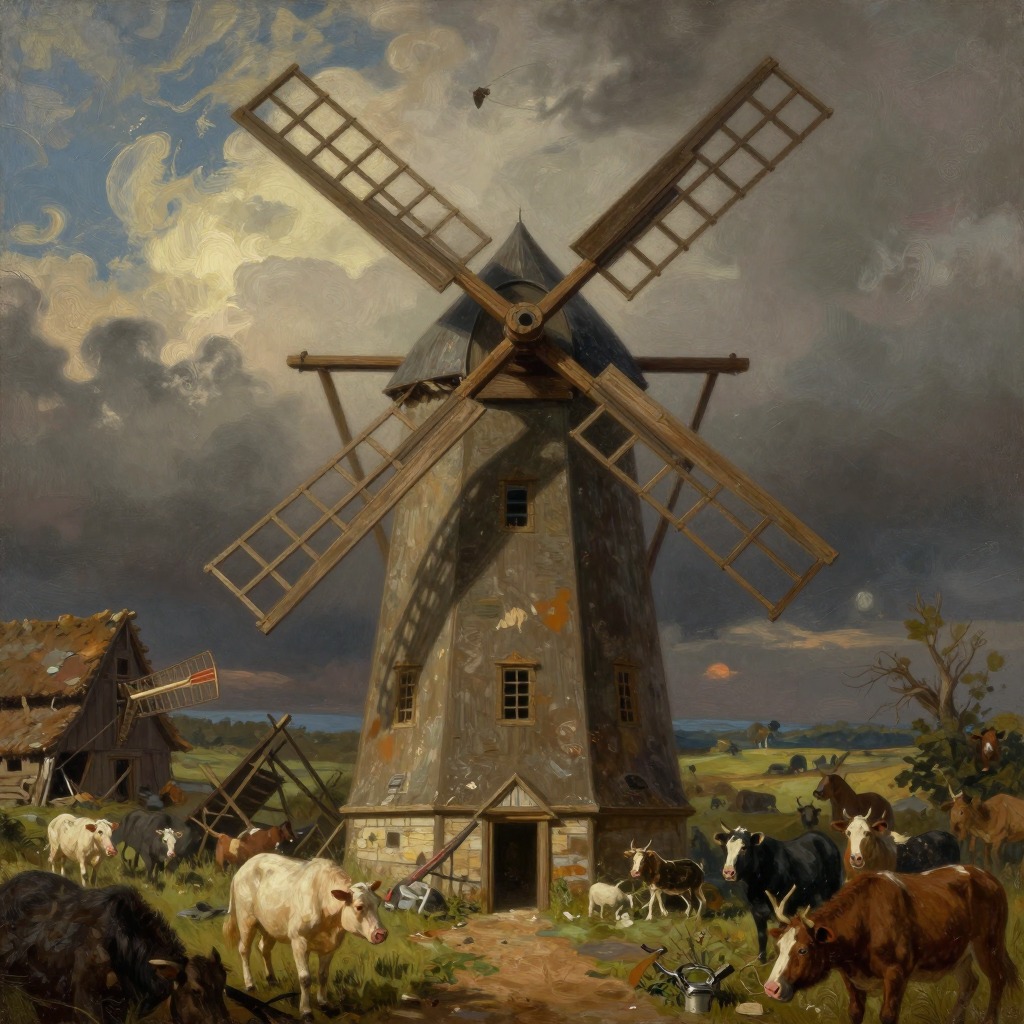
The very next morning after the forgery is discovered, Frederick launches his long-expected attack on Animal Farm. He leads fifteen men, armed with half a dozen guns, against the farm. This time the animals do not have the easy victory they enjoyed at the Battle of the Cowshed. The men open fire as soon as they are within fifty yards, and the animals, unable to face the terrible explosions and stinging pellets, are driven back despite the efforts of Napoleon and Boxer to rally them. The enemy takes possession of the big pasture, including the windmill. Frederick's men then produce a crowbar and a sledge hammer, drill a hole near the base of the windmill, and pack it with blasting powder. The resulting explosion destroys the windmill completely, scattering the stones to distances of hundreds of yards. The animals, enraged by this vile act, charge forth and engage in a savage, bitter battle. Three of Frederick's men have their heads broken by blows from Boxer's hoofs; another is gored in the belly by a cow's horn; another has his trousers nearly torn off by the dogs Jessie and Bluebell. When Napoleon's nine bodyguard dogs appear on the men's flank, panic overtakes them, and Frederick shouts to his men to get out while they can. The animals chase them down to the bottom of the field, but the windmill is gone.
Consequences and Significance
Frederick's attack, though ultimately repelled, inflicts lasting damage. The windmill, the fruit of two years of labor, is reduced to rubble, and the animals suffer casualties: a cow, three sheep, and two geese are killed, and nearly everyone is wounded. The battle is named the Battle of the Windmill, and Napoleon creates a new decoration, the Order of the Green Banner, which he confers upon himself. The forgery of the banknotes is forgotten in the general rejoicing over the victory, but the episode underscores the theme of human treachery and the impossibility of honest dealings between the pigs and the outside world. Frederick's character—shrewd, ruthless, and utterly without scruple—serves as a mirror to Napoleon's own developing cynicism, and his destruction of the windmill marks a turning point after which the animals' hopes for a better future are permanently diminished.